


Monday, 07/09/2026, 11:00 (GMT +7)
 1133
1133
International Shipping and Logistics Market Update Week 36/2026 | Phaata

International shipping and logistics market update - Week 36/2026
Table of Contents
-
World Container Index Week 36/2026
-
Asia - North America Ocean Freight Rates
-
Asia - Europe Ocean Freight Rates
-
Northern America - Asia Ocean Freight Rates
-
Northern Europe - Asia Ocean Freight Rates
-
Conclusions and Recommendations by Phaata
1. World Container Index Week 36/2026
Drewry’s World Container Index (WCI) for Week 36/2026 (from August 31 to September 6, 2026) dipped slightly by 0.18% compared to the previous week, settling at $4,465/FEU.
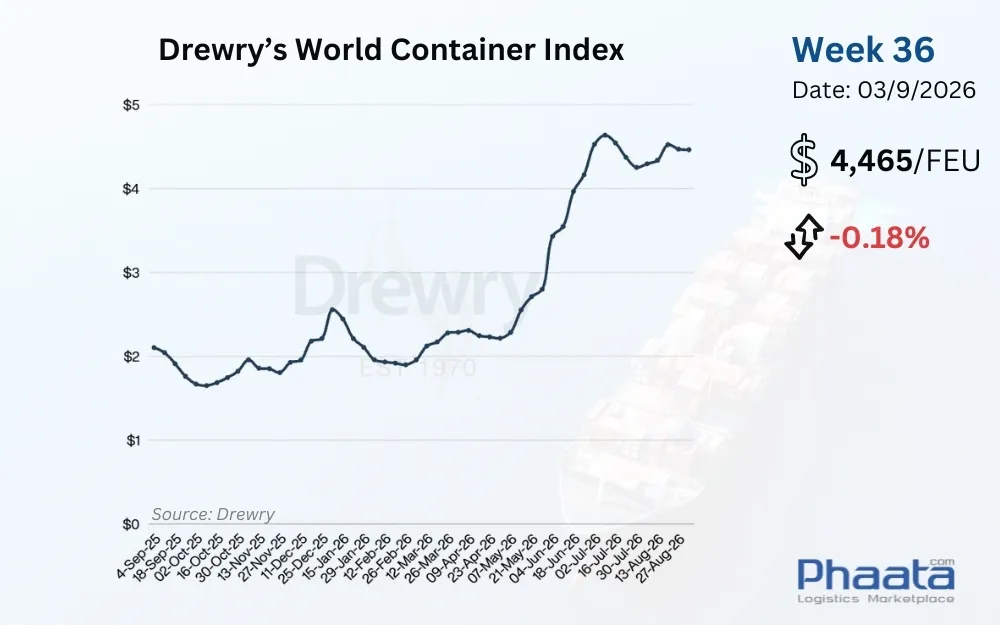
Drewry's World Container Index Week 36/2026 (Photo: Phaata)
2. Asia-North America Ocean Freight Rates
Supply and Demand:
Capacity Management & Golden Week Scenarios: Carriers continue to operate at 100% of design capacity. The blank sailing ratio is forecast to remain low - under 10% in September - and may inch up to approximately 8% during the week of October 5 as carriers begin adjusting capacity ahead of China's Golden Week. However, this adjustment is currently just a forecast and has not yet become an official mandate. Blank sailing rates are expected to rise significantly post-Golden Week.
Origin Port Congestion Bottlenecks: The primary barrier to effective capacity supply is currently not blank sailings, but port congestion. Operational disruptions in East Asia continue to hamper space availability and schedule reliability, particularly at the Shanghai and Ningbo port clusters.
Panama Canal Variables: The Panama Canal Authority's decision to cut daily transits officially took effect on September 3, with the next adjustment slated for September 15. On a positive note, the plan to tighten draft limits has been pushed back to October 1, temporarily easing the pressure on vessel payload capacities.
North American Inland Transit Pressure (IPI & MLB): The volume of cargo moving via Interior Point Intermodal (IPI) is trending upwards. Instead of utilizing all-water routes, a segment of shippers is shifting to routing cargo through West Coast ports like Los Angeles and Long Beach, followed by rail transport to inland destinations. This Mini Land Bridge (MLB) trend could intensify pressure on regional rail capacity, subsequently escalating the risks of increased dwell times and congestion.
Rate Developments:
Ocean freight rates from Asia to the North America West Coast in Week 36/2026 increased by 3.18% week-on-week, reaching $7,527/FEU. This rate is up 12.61% month-on-month, according to Xeneta data.
Upward Momentum on Both Coasts: September freight rates maintain their upward trajectory on both the U.S. East Coast and West Coast corridors. Relatively stable demand, high capacity utilization, coupled with weather-induced disruptions at origin ports and operational restrictions at the Panama Canal, are exerting additional upward pressure on the rate baseline across the entire trade lane.
Stay tuned to Phaata International Logistics Marketplace for in-depth and fast market updates.
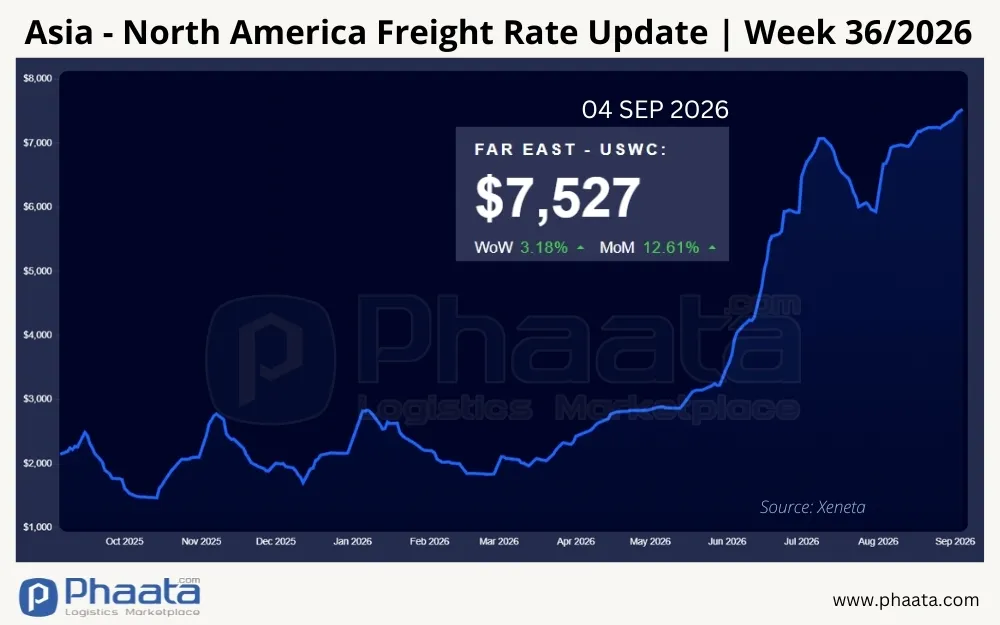
Asia-North America Freight Rates | Week 36/2026 (Photo: Phaata.com)
US Tariff Updates:
1. Legislative Moves: Proposed Tariff Repeals & Russian Sanctions
Proposed Tariff Repeal: Senator Chuck Schumer recently introduced a bill proposing the repeal of Section 338 and Section 122 tariffs. The bill also proposes terminating Section 301 tariffs related to forced labor allegations and refunding the duties collected under this measure.
Russian Sanctions Bill Progress: In a separate development, the likelihood of the U.S. House of Representatives voting to pass the Senate's bill on sanctions and secondary tariffs targeting Russian energy is currently assessed at "over 50%." If advanced, this development could somewhat alleviate the market uncertainty seen in recent weeks.
2. African Growth and Opportunity Act (AGOA): Validity Extension
Progress Update: Through a continuing resolution, the AGOA has been extended until December 2028. Furthermore, based on recent hearings, the House Ways and Means Committee has recommended that Congress consider extending the act for another 10 years to provide greater long-term stability for trade activities.
3. Enforcement Guidelines for Section 232 Tariffs on Unmanned Aircraft Systems (UAS)
Clarifying Enforcement Procedures: U.S. Customs and Border Protection (CBP) recently issued detailed operational guidelines on the enforcement of Section 232 tariffs on UAS and related components, effective September 3. The new guidance focuses on clarifying issues related to commodity classification codes and the sequence of tariff application, thereby assisting businesses and customs brokers in navigating the regulations.
4. CPSC eFiling Standards for International Parcels
Accelerating Parcel Declaration Digitization: Starting October 22, the Consumer Product Safety Commission (CPSC) will mandate electronic filing (eFiling) for international parcel shipments processed under Entry Type 13. This regulation represents the next step in digitizing the declaration and processing of cross-border parcels, requiring affected businesses to proactively review their data workflows and ready their systems ahead of the implementation date.
Stay tuned to articles on the Phaata International Logistics Marketplace for rapid and in-depth market updates.
3. Asia-Europe Ocean Freight Rates
Supply and Demand:
Capacity Maintenance & Golden Week Scenarios: Carriers continue to operate at 100% capacity, while the blank sailing ratio remains extremely low in the current forecast cycle. This ratio is expected to tick up only slightly in early October as a capacity adjustment measure aligning with the anticipated seasonal demand slump during China's Golden Week.
Origin Port Schedule Pressure: Alongside pre-Golden Week capacity adjustments, operational disruptions across the Chinese seaport system continue to pressure schedules and service reliability right from the start of the voyage.
Strike Variable at Dutch Gateways: European transport operations may face additional pressure as a nationwide strike is slated to hit Dutch seaports on September 4. Key port clusters such as Rotterdam, Amsterdam, and Zeeland are projected to be impacted, which could heighten the risk of delays for vessel schedules and regional delivery operations.
Suez Canal Rerouting Progress: The gradual resumption of Red Sea services by certain carriers is expanding the options for shippers to shorten transit times. Compared to a few weeks ago, the scope of Suez transits has expanded on select services. However, this rerouting process remains uneven and will likely continue to vary depending on individual carrier operational strategies.
Freight Rate Developments:
Ocean freight rates from Asia to Europe in Week 36/2026 decreased by 5.34% week-on-week, settling at $4,361/FEU. This rate is down 11.70% month-on-month, according to Xeneta data.
Rate Baseline Continues to Cool: Spot rates on the Asia-Europe corridor have continued to decline in recent weeks. This trend partially reflects an improvement in capacity supply as operational activities on the route gradually return to a more stable state.
Stay tuned to Phaata International Logistics Marketplace for in-depth and fast market updates.
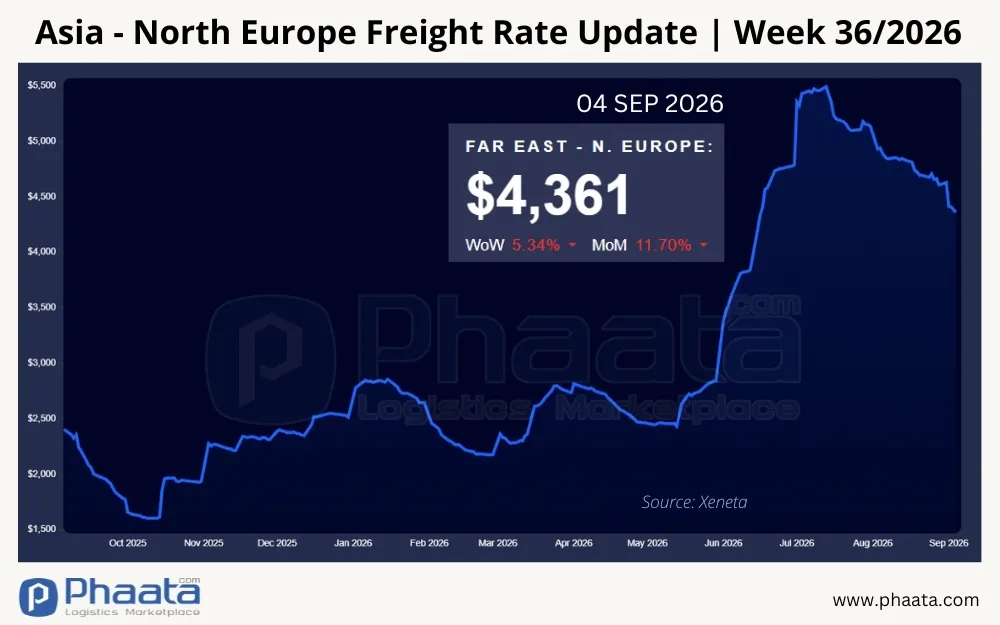
Asia-Europe Freight Rates | Week 36/2026 (Photo: Phaata.com)
4. North America - Asia Ocean Freight Rates
Ocean freight rates from North America (West Coast) to Asia in Week 36/2026 increased by 4.45% week-on-week, reaching $727/FEU. This rate is up 6.29% month-on-month, according to Xeneta data.
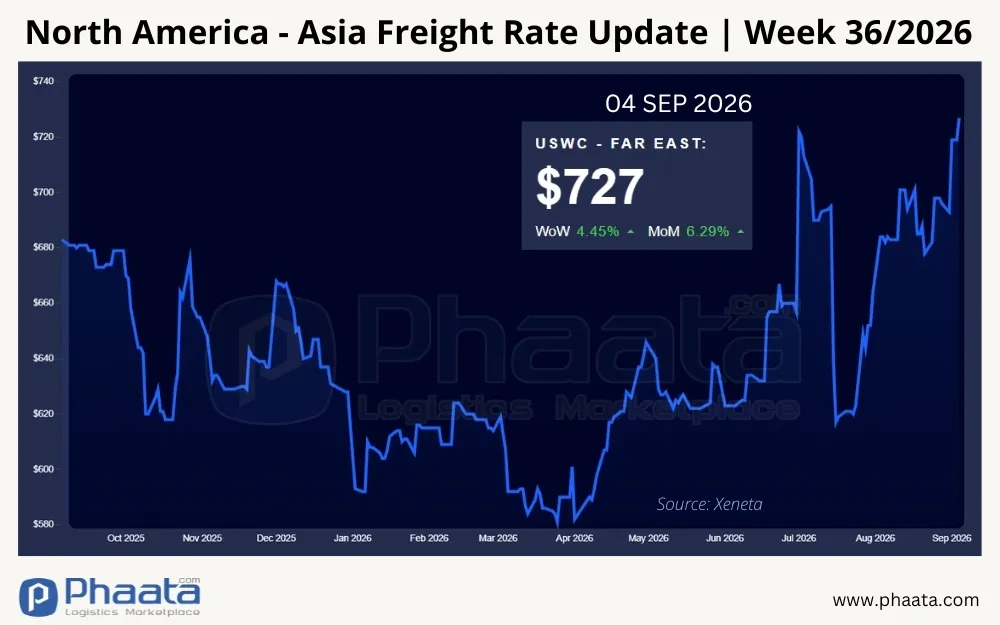
North America (West Coast) - Asia freight rates | Week 36/2026 (Photo: Phaata.com)
5. Northern Europe - Asia Ocean Freight Rates
Ocean freight rates from North Europe to Asia in Week 36/2026 fell by 20.51% week-on-week, settling at $217/FEU. This rate is down 19.93% month-on-month, per Xeneta data.
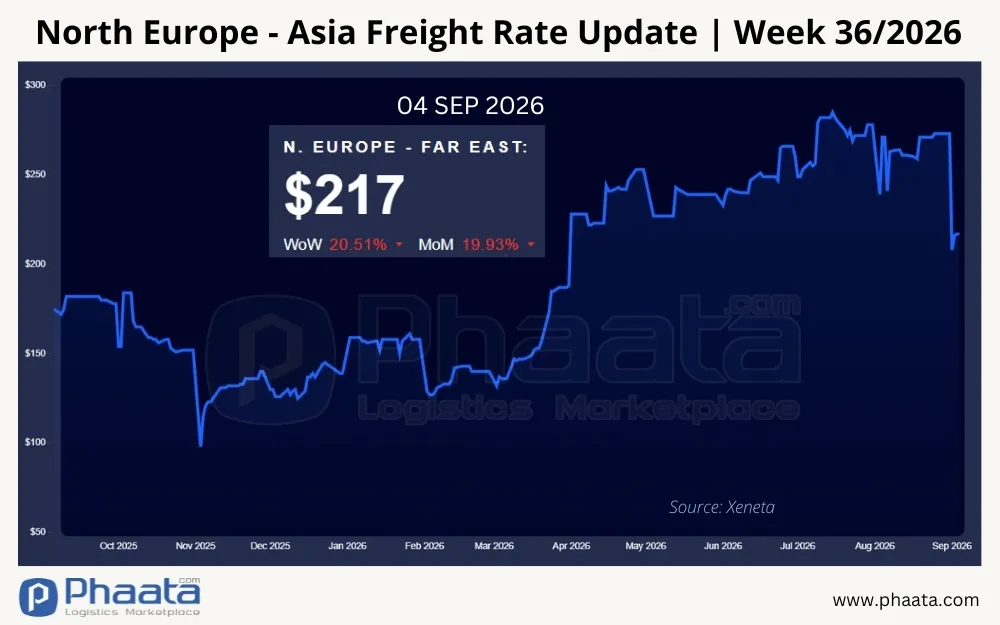
Container Freight rates from Northern Europe to Asia | Week 36/2026 (Photo: Phaata.com)
6. Conclusion and Recommendations from Phaata
The global logistics market in Week 36/2026 continues to demonstrate a stark divergence in freight rate trends and operational conditions between the two major East-West trade corridors. Drewry's composite WCI dipped slightly by 0.18% to $4,465/FEU, while lane-specific dynamics varied significantly: North American rates continued to rise, whereas the European market maintained its corrective trend.
Trans-Pacific Route (Asia - North America): The spot rate baseline continued its ascent, pushing West Coast rates to $7,527/FEU, up 3.18% WoW and 12.61% MoM. Actual capacity supply faces added pressure from three primary factors: post-typhoon yard congestion at Shanghai and Ningbo; the reduction in daily transit slots at the Panama Canal effective September 3; and mounting pressure on the rail networks connecting the ports of Los Angeles and Long Beach as a portion of cargo shifts from all-water routing to the Mini Land Bridge (MLB) model.
Far East - West Europe Route: Contrary to the North American market, Europe-bound spot rates fell 5.34% to $4,361/FEU and are 11.70% lower month-on-month (MoM), amid improved capacity supply and an early cooling of the peak season. However, short-term operational risks remain notable due to the nationwide strike at Dutch gateway ports (Rotterdam, Amsterdam, and Zeeland) on September 4, coupled with cascading schedule disruptions originating from Asian departure ports.
U.S. Trade Policy and Legal Environment: The market continues to navigate multiple trade policy shifts. Senator Chuck Schumer's bill proposing the repeal of Sections 338, 122, and 301, alongside the House's potential consideration of secondary sanctions on Russian energy, is elevating uncertainty for trade operations and supply chains. Furthermore, enforcement guidelines for Section 232 tariffs on UAS have officially taken effect, while the CPSC eFiling standards for Entry Type 13 are slated for implementation starting October 22.
Recommendations from Phaata
Space Management and Golden Week Preparation:
-
Proactive Early Booking: Businesses should finalize booking plans for September export orders right at the beginning of the month. Although the pre-Golden Week blank sailing ratio is only around 8%, post-holiday capacity adjustments are expected to be concentrated, heightening the risk of space shortages and impacting October transport schedules.
-
Integrate Buffer Time: For shipments departing from Shanghai and Ningbo, shippers should add a 5–7 day buffer to their cargo readiness dates to proactively mitigate the risk of vessel delays and port congestion.
Restructuring North American Inland Transit and Panama Canal Impacts:
-
Control Dwell Times on the West Coast: The shift towards the MLB model is increasing pressure on rail capacity at the Los Angeles and Long Beach port complex. Shippers utilizing IPI services must closely monitor container dwell times and proactively negotiate free time (demurrage/detention) with transport partners to curb ancillary costs.
-
Proactively Confirm Panama Canal Transit Slots: For shipments continuing to utilize all-water routes to the East Coast or Gulf Coast, businesses must verify and confirm transit slots before finalizing transport plans. With the number of daily transits adjusted on September 3 and poised for further changes on September 15, a lack of confirmation could prolong wait times and disrupt delivery schedules.
Mitigating Disruption Risks at European Gateways:
-
Adjust Delivery Plans in the Netherlands: For containers scheduled to arrive at Rotterdam, Amsterdam, or Zeeland, businesses should coordinate early with inland transport providers to update delivery schedules and prep alternative options, including shifting to road or rail transport from neighboring ports if strike actions severely impact operations.
-
Cautiously Evaluate Suez Canal Routing: While the resumption of Suez transits by some services offers shippers alternative transit time options, the scope of application varies among carriers and services. Businesses should explicitly confirm the intended routing on each Bill of Lading and refrain from adjusting committed delivery times with clients solely based on the assumption that the cargo will transit the Suez.
Customs Compliance and Tariff Risk Control:
-
Standardize Section 232 Documentation for UAS Components: Importers of unmanned aircraft systems should review the new CBP guidelines to verify commodity classification codes and tariff application principles, ensuring self-certified component dossiers meet relevant requirements to secure preferential tariff rates.
-
Upgrade Data Systems for Entry Type 13: E-commerce and international express delivery businesses must finalize the integration of eFiling standards with the CPSC system ahead of the October 22 deadline to minimize the risk of customs holds or delayed clearance at ports of entry.
-
Monitor U.S. Legislative Volatility: Businesses should prepare concurrent contingency scenarios, including auditing files and preparing for potential refund claims if bills related to Sections 301/338 are passed. Additionally, they must re-evaluate raw material supply chains tied to Russian energy to proactively counter the risk of secondary tariffs.
Stay tuned to articles on Phaata.com or Phaata fanpage for rapid and in-depth market updates.
Find Freight Rates Here
Find Logistics Companies Here
See more:
- Maersk and ONE Hike Environmental Surcharges on Asia–Europe Trades Effective October 2026
- German Seaports: Over 6,000 Port Workers Reject ZDS's 5.1% Wage Offer; Threat of Fresh Strikes Remains on the Table
- International Shipping and Logistics Market Update Week 35/2026 | Phaata
- Port Strike in the Netherlands on September 4: Rotterdam Could Face Nearly Eight Hours of Disrupted Vessel Handling
- COSCO schedules: Vietnam - North America in Sep 2026
- SITC updates Vietnam-Intra Asia sailing schedules in Sep 2026
- Global Container Port Queue Hits 4.3 Million TEU, Surpassing 2022 COVID Peak
- Panama Canal to Cut Daily Transits to 32 from September; Four Carriers Yet to Adjust Published Surcharges
- International Shipping and Logistics Market Update Week 34/2026 | Phaata
- Shipping Lines Gradually Resume Suez Canal Services as Traffic Reaches Highest Level Since Early 2024
- COSCO and OOCL Increase Capacity on the Mediterranean–West Africa MWAX Service
- EUA Prices Hover Around EUR 82/Tonne in Mid-August: A Key Indicator to Watch for Q4/2026 ETS/FuelEU Surcharges
- COSCO and OOCL Increase Capacity on the Mediterranean–West Africa MWAX Service
Source: Phaata - Where Shippers & Logistics Providers Connect
► Find Better Freight Rates & Logistics Service Providers!


Featured News
- Hapag-Lloyd applies Peak Season Surcharge from East Asia to USA and Canada
- The world\'s largest container ships MSC Irina and MSC Loreto floated
- MSC (Mediterranean Shipping Company) - The world\'s leading container shipping lines
- Information you need to know about Maersk Line
- Top 10 export and import goods between Vietnam - Philippines in the first 5 months of 2020

 Market News
See more
_-_Copy_-_Copy.webp)

.webp)

 HOT PROMO
See more
918
 FCL
FCL
 20 Days
 Freight cost

N.B.L INTERNATIONAL TRANSPORT CO., LTD
2129
FCL
21 Days
Freight cost

MG LOGISTICS JSC
3896
FCL
28 Days
Freight cost

CÔNG TY TRÁCH NHIỆM HỮU HẠN DT LOGISTICS (VN)
4511
FCL
28 Days
Freight cost

Công Ty TNHH Quanterm Logistics Vietnam
3424
FCL
33 Days
Freight cost

CÔNG TY TNHH TIẾP VẬN TOÀN CẦU KM
Why do thousands of businesses trust Phaata?
USERS/MONTH
LOGISTICS COMPANIES
REQUEST FOR QUOTEŚ
QUOTATIONS
VIETNAM LOGISTICS COMMUNITY
5 Steps to Get the Best Quote
Find a price quickly/Send a RFQ
Compare multiple options
Contact for Further Consultation
Negotiating prices/services
Management & rating
 Freight rates
Sea freight
- FCL
See more
610
7
Days Direct
- ₫529,260 / 20'GP
- ₫3,704,820 / 40'GP
- ₫3,704,820 / 40'HQ
- ₫4,631,025 / 45'HQ

MELODY LOGISTICS COMPANY LIMITED
675
40
Days Transit
- ₫303,557,073 / 40'RF

GIA LINH LOGISTICS SERVICES CO., LTD. (G LINK Logistics)
702
25
Days Transit
- ₫142,900,200 / 20'GP
- ₫195,826,200 / 40'GP
- ₫195,826,200 / 40'HQ

OPL LOGISTICS
721
 384
20
Days Transit
384
20
Days Transit
- ₫29,884,500 / 20'GP
- ₫31,189,500 / 40'GP
- ₫31,189,500 / 40'HQ

CÔNG TY CỔ PHẦN TIẾP VẬN INTERCARGO
Sea freight
- LCL
See more
979
3
Days Direct
- Refund ₫926,205 /cbm

CÔNG TY CỔ PHẦN GIAO NHẬN VẬN TẢI HỒNG SƠN
1,420
2,169
3
Days Direct
- ₫132,315 /cbm
CÔNG TY TRÁCH NHIỆM HỮU HẠN DT LOGISTICS (VN)
2,245
3
Days Direct
- ₫0 /cbm

CÔNG TY TNHH VẬN TẢI VÀ TIẾP VẬN TOÀN CẦU
3,985
 Air freight
- General cargo
Air freight
- General cargo
See more
2,400
1
Days Direct
- 46,310 ₫/kg
N.B.L INTERNATIONAL TRANSPORT CO., LTD
3,212
1
Days Direct
- 161,424 ₫/kg
CÔNG TY CỔ PHẦN GIAO NHẬN VẬN TẢI HỒNG SƠN
6,026
10
Days Transit
- 264,630 ₫/kg

Phoenix Logistics Vietnam - chi nhánh TP. Hồ Chí Minh (Phoenix International Forwarding Vietnam )
7,682
1
Days Direct
- 185,241 ₫/kg

CÔNG TY TNHH THƯƠNG MẠI VÀ DỊCH VỤ FASTRANS
8,888

 Rail freight
- FCL
Rail freight
- FCL
See more
3,757
5
Days Direct
- ₫44,987,100 / 40'HQ
- ₫44,987,100 / 45'HQ

CÔNG TY TNHH PHƯỚC TÁ
5,653
3
Days Direct
- ₫15,083,910 / 40'HQ

CÔNG TY CỔ PHẦN VẬN TẢI VÀ THƯƠNG MẠI ĐƯỜNG SẮT
15,946
7
Days Direct
- ₫48,956,550 / 20'GP

Công ty TNHH T&M Forwarding
14,687
5
Days Direct
- ₫7,145,010 / 20'GP

ASIAN EXPRESS LINE VIETNAM ( AEL VIET NAM )
9,954
10
Days Direct
- ₫9,262,050 / 20'GP

CÔNG TY CỔ PHẦN LOGISTICS QUỐC TẾ V&T
 Road freight
- FCL
Road freight
- FCL
See more
1,895
4
Day
- ₫5,000,000 / 40'GP

CÔNG TY CỔ PHẦN IGAP
4,740
1
Day
- ₫28,000,000 / 20'GP
- ₫28,000,000 / 40'GP

CÔNG TY TNHH THƯƠNG MẠI DỊCH VỤ VÀ KHO VẬN VIETTEL POST - TTC
106,006
2
Day
- ₫6,500,000 / 40'RF
- ₫6,500,000 / 40'RQ
- ₫6,500,000 / 45'RQ

CÔNG TY CP PROSHIP
 Premium
174,611
1
Day
Premium
174,611
1
Day
- ₫18,997,200 / 20'GP
- ₫18,997,200 / 40'GP

CÔNG TY CỔ PHẦN GIAO NHẬN VẬN TẢI CON ONG
263,957
3
Day
- ₫32,000,000 / 20'GP
- ₫64,000,000 / 40'GP
- ₫64,000,000 / 40'HQ
- ₫64,000,000 / 45'HQ

Công ty Cổ phần phát triển thương mại Thuận Đạt Việt Nam


