


Monday, 26/10/2026, 09:11 (GMT +7)
 32
International Shipping and Logistics Market Update Week 43/2026 | Phaata
International shipping and logistics market update - Week 43/2026
Table of Contents
-
World Container Index Week 43/2026
-
Asia - North America Ocean Freight Rates
-
Asia - Europe Ocean Freight Rates
-
Northern America - Asia Ocean Freight Rates
-
Northern Europe - Asia Ocean Freight Rates
-
Conclusions and Recommendations by Phaata
1. World Container Index Week 43/2026
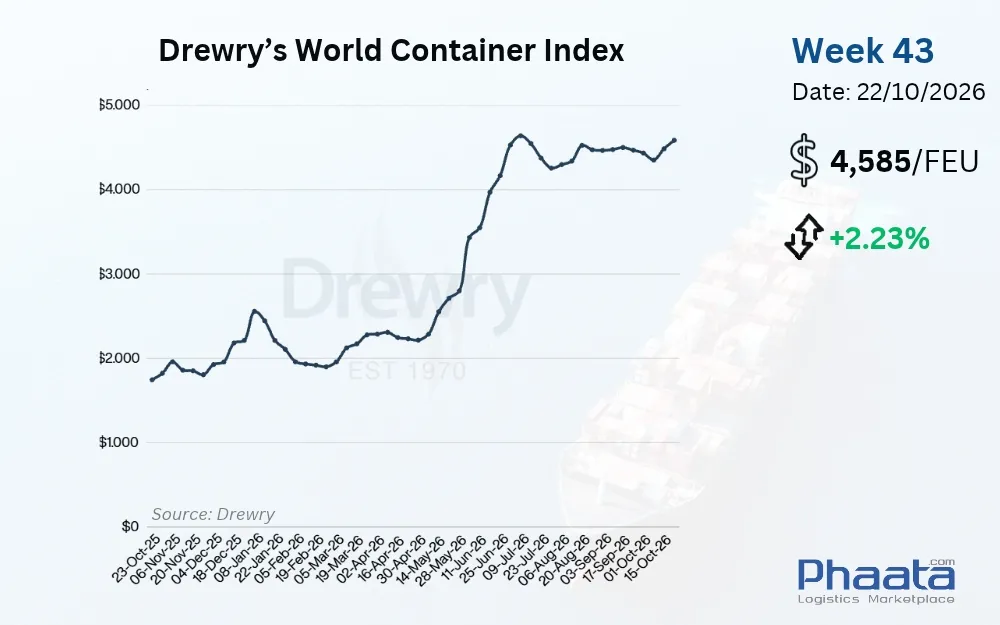
Drewry’s World Container Index (WCI) for Week 43/2026 (from October 19 to October 25, 2026) increased by 2.23% compared to the previous week, reaching $4,585/FEU.
Drewry's World Container Index Week 43/2026 (Photo: Phaata)
2. Asia-North America Ocean Freight Rates
Supply and Demand:
Operational Capacity and Targeted Blank Sailings: The peak shipping season is gradually winding down. Carriers continue to maintain operational capacity at high levels, near design capacity limits. Rather than executing broad-based capacity cuts, some carriers are tweaking operational schedules via selective blank sailings to tightly control available space on the route. This approach is expected to persist through November, contingent upon demand dynamics and individual carriers' operational strategies.
Signs of Cooling Demand: Export orders are showing signs of stalling post-peak season. Forecast data suggests U.S. import container volumes in November could drop 11% compared to October. Should this trend hold, transport demand on the route may face mounting downward pressure in the coming weeks.
Operational Status at Eastern China Ports: Congestion across Eastern China port clusters has improved significantly following the completion of post-typhoon recovery efforts. However, vessel schedules in certain areas remain susceptible to delays. Therefore, businesses must continue to closely monitor delivery plans and transit times.
Rate Developments:
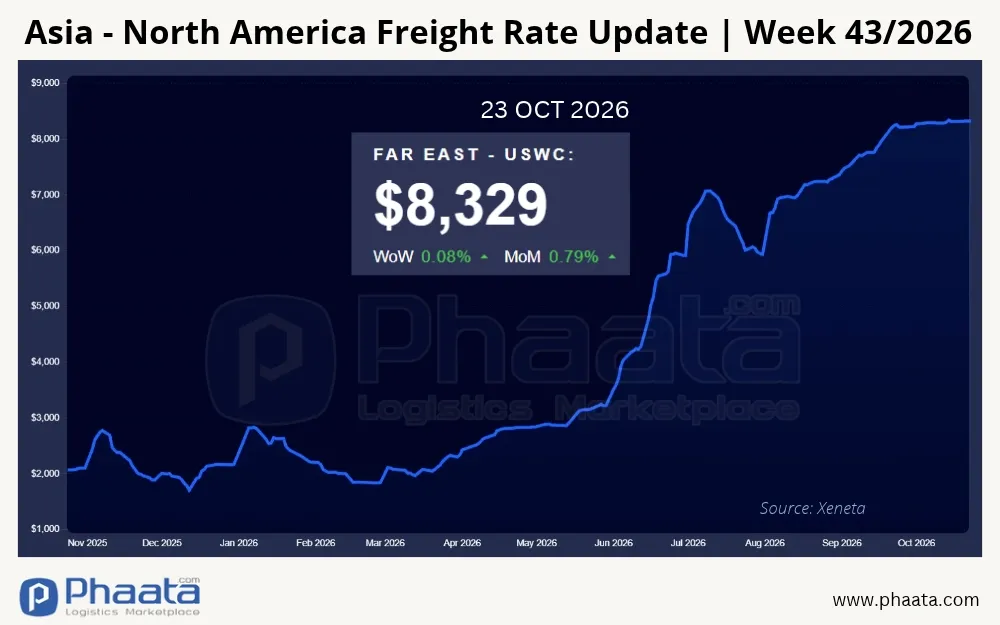
Ocean freight rates from Asia to the North America West Coast in Week 43/2026 edged up by 0.08% week-on-week, reaching $8,329/FEU. This rate is up 0.79% month-on-month, according to Xeneta data.
Spot Rates Remain Relatively Stable: Over the past month, the spot rate baseline on the route has largely maintained a sideways trajectory. Week 43 data recorded mixed movements across rate indices, but the margin of fluctuation remained relatively narrow, within a ±3% band. This dynamic indicates that the rate baseline has yet to undergo a significant correction this week, although trends on specific trade lanes vary.
Downward Rate Pressure in November: Following China's Golden Week holiday, transport demand shows signs of cooling, while carriers continue to regulate capacity. The confluence of these two factors could impact rate trajectories in November. However, the magnitude of any correction will hinge on actual cargo volumes, the volume of blank sailings, and carriers' ability to effectively manage capacity.
Stay tuned to Phaata International Logistics Marketplace for in-depth and fast market updates.
Asia-North America Freight Rates | Week 43/2026 (Photo: Phaata.com)
US Tariff Updates:
1. CAPE Phase 3 Expands Refund Filing Eligibility
Expanding System Access: According to provided information, a second group of importers has been granted access to file refund claims on the CAPE system. This cohort comprises businesses whose Importer of Record (IOR) numbers were registered in the U.S. Customs and Border Protection (CBP) system after the July 30 data cutoff. Previously, this group was denied system access when Phase 3 began accepting files from the initial cohort on October 6.
Files Still Require CBP Adjudication: Granting system access does not guarantee an automatic refund. Importers are still required to submit detailed declarations as mandated and navigate CBP’s adjudication process. Businesses should cross-reference information on the system and audit their files to determine the specific requirements applicable to their cases.
Verifying Refund-Related Information: Email notifications detailing CAPE deadlines or requesting information must be meticulously vetted before businesses act on the instructions. Cross-referencing with official CBP communications or consulting with a licensed customs broker can help verify the authenticity of such notices.
Monitoring Filing Deadlines: Based on current information, the submission deadline for this supplementary group remains undefined. Importers under review should verify their eligibility, audit documentation, and coordinate with legal departments or specialized consultants to prepare files per regulatory requirements.
2. Gellert Global Group Files Lawsuit Challenging Section 338 Tariffs on Canadian Goods
Suit Filed at the U.S. Court of International Trade (CIT): On October 20, 2026, the Gellert Global Group filed a lawsuit at the CIT, contesting the imposition of tariffs under Section 338 of the Tariff Act of 1930. This provision, dating back to the 1930s, was invoked by the U.S. administration as the legal basis for slapping 50% tariffs on select Canadian goods, amid Washington's stated concerns over Canadian trade policies in sectors such as dairy, alcoholic beverages, and automotive. In its filing, Gellert petitions the court to review the legality of this tariff measure.
Petition for Class-Action Status: Concurrently, through the Liberty Justice Center, Gellert is petitioning the court to certify the lawsuit as a class action. If granted, the scope of the litigation could encompass importers meeting criteria defined by the court. The scope of representation and associated rights will depend on the court's ruling.
Legal Precedents Involving IEEPA Tariffs: The Liberty Justice Center previously participated in litigation challenging tariffs imposed under the International Emergency Economic Powers Act (IEEPA). In February 2026, the U.S. Supreme Court concluded that IEEPA did not grant the President the authority to impose tariffs in the reviewed cases. This ruling is a relevant legal precedent regarding debates over the federal administration's tariff authority; however, the Section 338 lawsuit possesses its own distinct legal foundation and will be adjudicated on its respective merits.
Stay tuned to articles on the Phaata International Logistics Marketplace for rapid and in-depth market updates.
3. Asia-Europe Ocean Freight Rates
Supply and Demand:
Capacity and Blank Sailing Plans in November: Carriers plan to maintain high operational capacity through early November. Starting mid-month, blank sailing programs will be deployed across several services to calibrate supply on the route. During the period spanning the week of November 9 to the week of November 23, operational capacity is projected to decrease by approximately 8–11% relative to available capacity.
Capacity Adjustments Amid Cooling Demand: Transport demand on the Asia-Europe route is showing signs of weakening following the summer peak season. Against this backdrop, adjusting operational schedules will help carriers align capacity with actual cargo volumes and sustain vessel fill rates. The ultimate impact on capacity supply and the rate baseline will depend on the actual scale of blank sailings and demand dynamics in the coming weeks.
Developments in Suez Canal Rerouting:
Shortening Transit Times: Container vessel traffic through the Suez Canal is flashing signs of recovery. For services reverting to this routing, transit times between Asia and Europe can be shortened compared to the Cape of Good Hope detour.
Operational Routings Vary by Service: The return to the Suez routing is not occurring uniformly across the trade lane. Carriers are evaluating operational plans on a service-by-service basis, contingent upon security risk assessments, insurance conditions, and operational imperatives. Consequently, actual transit times may vary significantly among services on the same trade corridor.
Freight Rate Developments:
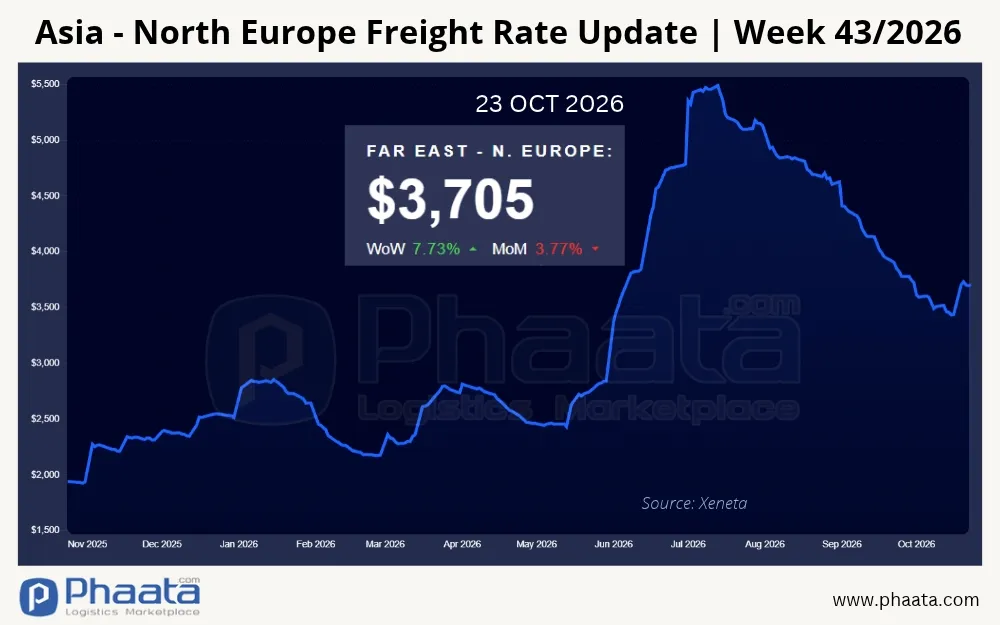
Ocean freight rates from Asia to Europe in Week 43/2026 increased by 7.73% week-on-week, reaching $3,705/FEU. This rate is down 3.77% month-on-month, according to Xeneta data.
Spot Rates Record Weekly Gains: After a protracted decline from July to early October, spot rates on the route rebounded in the most recent week. Rates to North Europe jumped 6%, while rates to the Mediterranean increased by 3%. This development indicates that rates are showing signs of recovery, though further monitoring is required to determine whether this trend is sustainable in the ensuing weeks.
Sustainability of November Rate Hikes: Carriers continue to announce General Rate Increases (GRIs) slated for the first half of November. However, the sustainability of these rate hikes will hinge on transport demand, the efficacy of capacity regulation, and operational developments via the Suez Canal. If returning to the Suez routing shortens vessel turnarounds and bolsters service capacity, the supply dynamics on the route could shift, thereby impacting the ability to sustain the rate baseline.
Stay tuned to Phaata International Logistics Marketplace for in-depth and fast market updates.
Asia-Europe Freight Rates | Week 43/2026 (Photo: Phaata.com)
4. North America - Asia Ocean Freight Rates
Ocean freight rates from North America (West Coast) to Asia in Week 43/2026 increased by 0.87% week-on-week, reaching $694/FEU. This rate is down 3.07% month-on-month, according to Xeneta data.
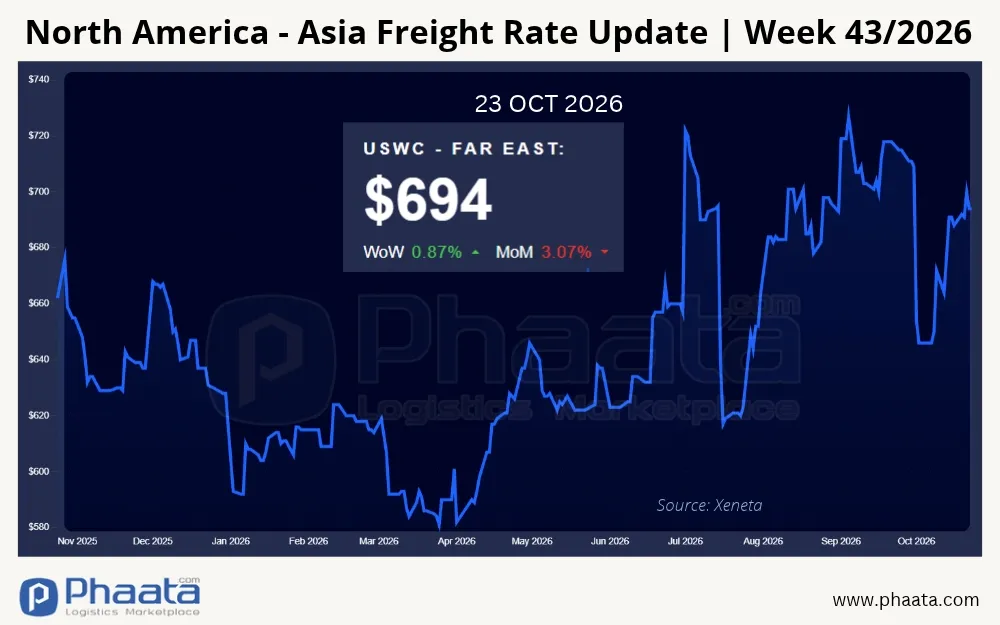
North America (West Coast) - Asia freight rates | Week 43/2026 (Photo: Phaata.com)
5. Northern Europe - Asia Ocean Freight Rates
Ocean freight rates from North Europe to Asia in Week 43/2026 decreased by 2.49% week-on-week, settling at $235/FEU. This rate is up 0.86% month-on-month, per Xeneta data.
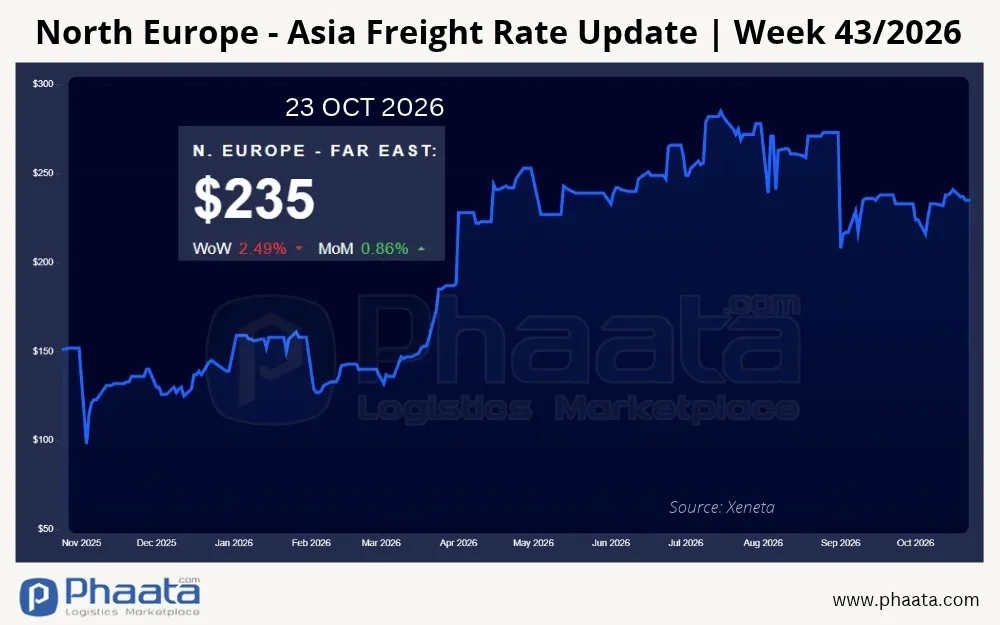
Container Freight rates from Northern Europe to Asia | Week 43/2026 (Photo: Phaata.com)
6. Conclusion and Recommendations from Phaata
In Week 43/2026, the WCI index rose 2.23% to $4,585/FEU, signaling a potential recovery in spot container freight rates. However, trends continue to diverge across trade lanes, while capacity adjustments, Suez Canal routing selections, and U.S. tariff policies remain critical focal points for import-export and logistics enterprises.
Trans-Pacific Route (Asia - North America): U.S. import container volumes in November could drop 11% compared to October. Amid signs of cooling demand, carriers continue to regulate operational capacity via selective blank sailings. Spot rates to the U.S. West Coast remain relatively stable at $8,329/FEU, but could face downward pressure in November if transport demand continues to weaken.
Far East - West Europe Route: Spot rates to North Europe recorded a 7.73% jump to $3,705/FEU ahead of anticipated General Rate Increases (GRIs) in November. Concurrently, transport demand shows signs of stalling, and carriers plan to adjust capacity with cuts ranging from 8–11% between the week of November 9 and the week of November 23. The return of select services to the Suez Canal is shortening transit times and improving vessel turnarounds, which directly impacts capacity supply and the tenability of the rate baseline.
U.S. Tariff Policy and Compliance: Phase 3 of CAPE has expanded refund filing eligibility to a group of importers with IORs registered after the July 30 data cutoff, according to provided information. Businesses must remain vigilant regarding CBP's documentation requirements and adjudication protocols, while rigorously verifying refund-related notifications. On the legal front, the Gellert Global Group's lawsuit challenging Section 338 tariffs on certain Canadian goods is being closely monitored at the U.S. Court of International Trade (CIT). Case developments could influence how importers evaluate strategies to protect their interests, depending on the court's ruling and specific applied scope.
Recommendations from Phaata
Monitor Rate Developments and Booking Plans:
North America Route: Amid potential spot rate volatility in November, businesses should solicit quotes from carriers and forwarders to select transport options aligning with delivery schedules. For shipments expected to depart in late December 2026 and January 2027, businesses should review cargo-ready dates, transport plans to the loading port, and partner delivery schedules. Engaging with transport providers early will enhance proactivity in securing space, especially as pre-Lunar New Year transport demand is likely to surge.
Far East - West Europe Route: Ahead of planned capacity adjustments in November, businesses should proactively request updated operational schedules and space availability from carriers or forwarders, tailored to their shipping timelines and delivery requirements. For shipments with rigid delivery deadlines, booking early can mitigate the impact of schedule changes or cargo roll-overs. For shipments requiring expedited transit times, businesses can explore services operating via the Suez Canal, ensuring they confirm the intended routing, transit time, and related insurance conditions prior to selecting the option.
Update Compliance Policies and U.S. Legal Developments:
CAPE Refund Files: Importers granted access to the CAPE system should consult CBP guidelines to verify eligibility criteria and prepare detailed declarations as required. Regarding refund-related emails, businesses should verify the information via official CBP channels or consult with licensed customs brokers before submitting data or accessing links.
Section 338 Tariff Lawsuit: Importers of Canadian goods subject to Section 338 tariffs should continue tracking developments at the CIT, particularly decisions regarding class-action certification and issues related to tax collection during the trial period. Since the scope of representation and legal ramifications depend entirely on the court's ruling, the applicability of the case's outcome to individual businesses must be assessed on a case-by-case basis. For significant tax liabilities, businesses may seek specialized legal counsel to understand applicable deadlines, conditions, and appropriate strategies to safeguard their interests.
Stay tuned to articles on Phaata.com or Phaata fanpage for rapid and in-depth market updates.
Find Freight Rates Here
Find Logistics Companies Here
See more:
- SITC updates Vietnam-Intra Asia sailing schedules in Nov 2026
- Panama Canal: Transits Rise 4.1% and Revenue Increases 16.6% in Fiscal 2026
- Maritime Connectivity: Diverging Port Trends Amid Geopolitical Disruptions
- Container Shipping Networks: A Shift Away from Shared Capacity Among Carriers
- International Shipping and Logistics Market Update Week 42/2026 | Phaata
- Hapag-Lloyd to Adjust Six Asia–Europe Services Under Gemini Cooperation from November 2026
- Port of Rotterdam Container Throughput Remains Nearly Flat as Transshipment Volumes Fall 20%
- Strait of Hormuz Sees Further Attacks as Two Commercial Vessels Sink
- Port of Oakland Signals Recovery as September Container Throughput Rises 5.4%
- Mega-Container Vessels Return to the Suez Canal Despite Persistent Red Sea Risks
- Ship Recycling Activity Drops to More Than 50-Year Low as Global Fleet Faces Rapid Aging
- ClarkSea Index Sets Fifth Consecutive Record as Daily Vessel Earnings Reach $84,951
- COSCO schedules: Vietnam - North America in Oct 2026
- COSCO updates Vietnam-North Europe sailing schedules in Oct 2026
Source: Phaata - Where Shippers & Logistics Providers Connect
► Find Better Freight Rates & Logistics Service Providers!


Featured News
- Hapag-Lloyd applies Peak Season Surcharge from East Asia to USA and Canada
- The world\'s largest container ships MSC Irina and MSC Loreto floated
- MSC (Mediterranean Shipping Company) - The world\'s leading container shipping lines
- Information you need to know about Maersk Line
- Top 10 export and import goods between Vietnam - Philippines in the first 5 months of 2020

 Market News
See more






 HOT PROMO
See more
803
 FCL
 12 Days
 Freight cost

Compass Logistics
 Premium
1500
FCL
12 Days
Freight cost

ASIAN EXPRESS LINE VIETNAM ( AEL VIET NAM )
2548
FCL
6 Days
Freight cost

CÔNG TY CỔ PHẦN TIẾP VẬN INTERCARGO
3365
FCL
5 Days
Freight cost

CÔNG TY TNHH VẬN CHUYỂN QUỐC TẾ N.B.L
4014
FCL
20 Days
Freight cost

N.B.L INTERNATIONAL TRANSPORT CO., LTD
Why do thousands of businesses trust Phaata?
USERS/MONTH
LOGISTICS COMPANIES
REQUEST FOR QUOTEŚ
QUOTATIONS
VIETNAM LOGISTICS COMMUNITY
5 Steps to Get the Best Quote
Find a price quickly/Send a RFQ
Compare multiple options
Contact for Further Consultation
Negotiating prices/services
Management & rating
 Freight rates
Sea freight
- FCL
See more
17
131
3
Days Direct
- ₫9,262,050 / 20'GP
- ₫19,847,250 / 40'GP
- ₫19,847,250 / 40'HQ
- ₫19,847,250 / 45'HQ

NP LOGISTICS CO.,LTD
402
8
Days Direct
- ₫38,106,720 / 20'GP
- ₫39,429,870 / 40'GP
- ₫38,106,720 / 40'HQ

GIA LINH LOGISTICS SERVICES CO., LTD. (G LINK Logistics)
1,068
14
Days Transit
- ₫4,366,395 / 20'GP
- ₫9,658,995 / 40'HQ

CÔNG TY TNHH GIAO NHẬN TOÀN CẦU GS
1,528
37
Days Transit
- ₫70,920,840 / 20'GP
- ₫104,396,535 / 40'GP
- ₫104,396,535 / 40'HQ

Công Ty TNHH Quanterm Logistics Vietnam
Sea freight
- LCL
See more
2,159
 3,083
5
Days Direct
- ₫26,463 /cbm

CÔNG TY TNHH T&M FORWARDING - CHI NHÁNH HÀ NỘI
4,371
3
Days Direct
- Refund ₫926,205 /cbm

CÔNG TY CỔ PHẦN GIAO NHẬN VẬN TẢI HỒNG SƠN
4,852
4,123
3
Days Direct
- ₫132,315 /cbm

CÔNG TY TRÁCH NHIỆM HỮU HẠN DT LOGISTICS (VN)
 Air freight
- General cargo
See more
5,097
1
Days Direct
- 46,310 ₫/kg
N.B.L INTERNATIONAL TRANSPORT CO., LTD
6,666
1
Days Direct
- 161,424 ₫/kg
CÔNG TY CỔ PHẦN GIAO NHẬN VẬN TẢI HỒNG SƠN
9,183
10
Days Transit
- 264,630 ₫/kg

Phoenix Logistics Vietnam - chi nhánh TP. Hồ Chí Minh (Phoenix International Forwarding Vietnam )
10,729
1
Days Direct
- 185,241 ₫/kg

CÔNG TY TNHH THƯƠNG MẠI VÀ DỊCH VỤ FASTRANS
9,755

 Rail freight
- FCL
See more
6,435
5
Days Direct
- ₫44,987,100 / 40'HQ
- ₫44,987,100 / 45'HQ

CÔNG TY TNHH PHƯỚC TÁ
9,042
3
Days Direct
- ₫15,083,910 / 40'HQ

CÔNG TY CỔ PHẦN VẬN TẢI VÀ THƯƠNG MẠI ĐƯỜNG SẮT
18,973
7
Days Direct
- ₫48,956,550 / 20'GP

Công ty TNHH T&M Forwarding
17,591
5
Days Direct
- ₫7,145,010 / 20'GP
ASIAN EXPRESS LINE VIETNAM ( AEL VIET NAM )
10,685
10
Days Direct
- ₫9,262,050 / 20'GP

CÔNG TY CỔ PHẦN LOGISTICS QUỐC TẾ V&T
 Road freight
- FCL
See more
2,344
 9,383
1
Day
- ₫28,000,000 / 20'GP
- ₫28,000,000 / 40'GP

CÔNG TY TNHH THƯƠNG MẠI DỊCH VỤ VÀ KHO VẬN VIETTEL POST - TTC
110,291
2
Day
- ₫6,500,000 / 40'RF
- ₫6,500,000 / 40'RQ
- ₫6,500,000 / 45'RQ

CÔNG TY CP PROSHIP
Premium
178,708
1
Day
- ₫18,997,200 / 20'GP
- ₫18,997,200 / 40'GP

CÔNG TY CỔ PHẦN GIAO NHẬN VẬN TẢI CON ONG
266,449
3
Day
- ₫32,000,000 / 20'GP
- ₫64,000,000 / 40'GP
- ₫64,000,000 / 40'HQ
- ₫64,000,000 / 45'HQ

Công ty Cổ phần phát triển thương mại Thuận Đạt Việt Nam


