


Monday, 26/01/2026, 06:12 (GMT +7)
 1286
1286
International Shipping and Logistics Market Update Week 4/2026 | Phaata

International shipping and logistics market update - Week 4/2026
Table of Contents
-
World Container Index Week 4/2026
-
Asia - North America Ocean Freight Rates
-
Asia - Europe Ocean Freight Rates
-
Northern America - Asia Ocean Freight Rates
-
Northern Europe - Asia Ocean Freight Rates
-
Conclusions and Recommendations by Phaata
1. World Container Index Week 4/2026
Drewry’s World Container Index (WCI) for Week 4/2026 (January 19–25, 2026) continued to plummet by 10% week-on-week, dropping to $2,212/FEU. This marks the second consecutive week of decline, primarily driven by falling rates on Transpacific and Asia-Europe trade lanes.
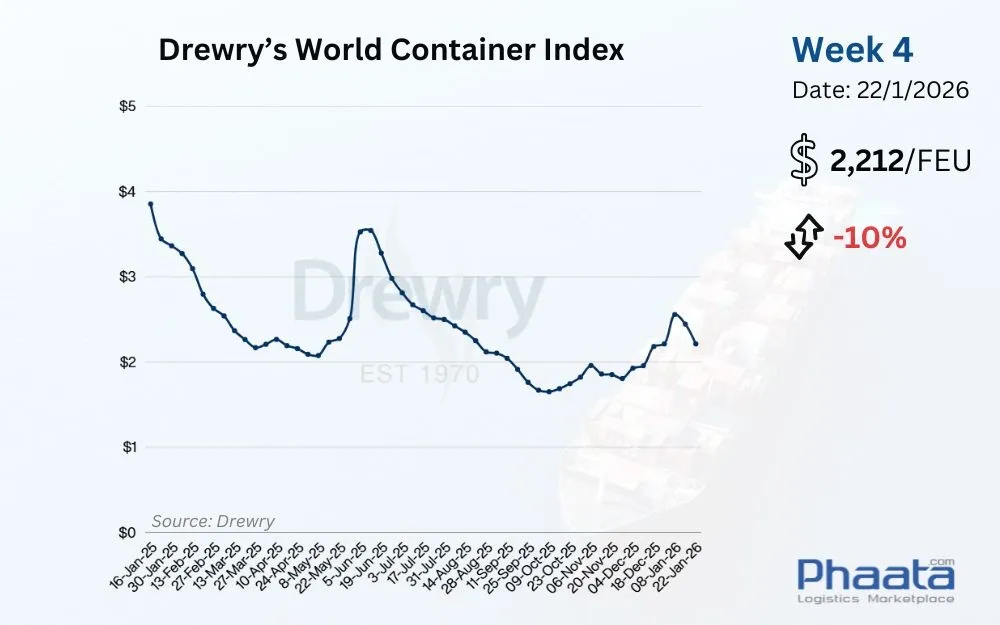
Drewry's World Container Index Week 4/2026 (Photo: Phaata)
2. Asia-North America Ocean Freight Rates
The Asia to North America West Coast market in the penultimate week of January is operating in stark contrast to the "scarcity and price hike" scenarios typical of previous years. The late arrival of the Lunar New Year (mid-February) has effectively "flattened" the demand curve, dispersing transport pressure. With excess capacity and stable demand, current negotiating leverage lies firmly with shippers.
Supply and Demand:
Demand Side:
Cargo volumes have remained steady since the post-holiday period in December, showing no signs of further growth. This year, the pre-Tet peak was pushed forward by 3-4 weeks and "spread out" due to the late holiday. Instead of creating compressed spikes in volume like in previous years, demand is distributed evenly, leaving the market devoid of the urgent pressure needed to push rates up.
Supply Side:
January & Early February: Available capacity remains high, estimated at 80-85% in January. This figure is forecast to rise slightly to 90% in the first half of February to sweep up the final pre-Tet cargo.
Post-Tet Warning: However, shippers must pay close attention to the "post-holiday supply adjustment" phase. A widespread blank sailing campaign is expected to begin from late February and extend to the first week of March. This is a technical move by carriers to cut excess supply and arrest the rate slide when demand bottoms out after Tet.
Space Status: Currently, space is open at most major Asian gateway ports. Only a few specific service loops are showing signs of mild tightness.
Rate Developments:
Freight rate indices are faithfully reflecting the "oversupply - lack of heat" condition. Ocean Freight rates from Asia to the North America West Coast in Week 4/2026 (Jan 19–25) continued to drop sharply by 9.17% week-on-week, falling to $2,386/FEU. This represents a 9.95% increase month-on-month, according to Xeneta data.
Failed Jan 15 GRI: Most carriers were forced to withdraw their January 15 General Rate Increase (GRI) announcements due to weak volumes. A few chose to "buy time" by postponing hikes for a week or signaling an extension of current rates into February.
PSS Delayed to March: Carriers have confirmed pushing the Peak Season Surcharge (PSS) back to March.
Phaata's Assessment: With Tet just over 4 weeks away, these moves clearly indicate a lack of peak season pressure in the current market. This is the most critical indicator that negotiating leverage belongs to shippers.
Stay tuned to Phaata International Logistics Marketplace for in-depth and fast market updates.
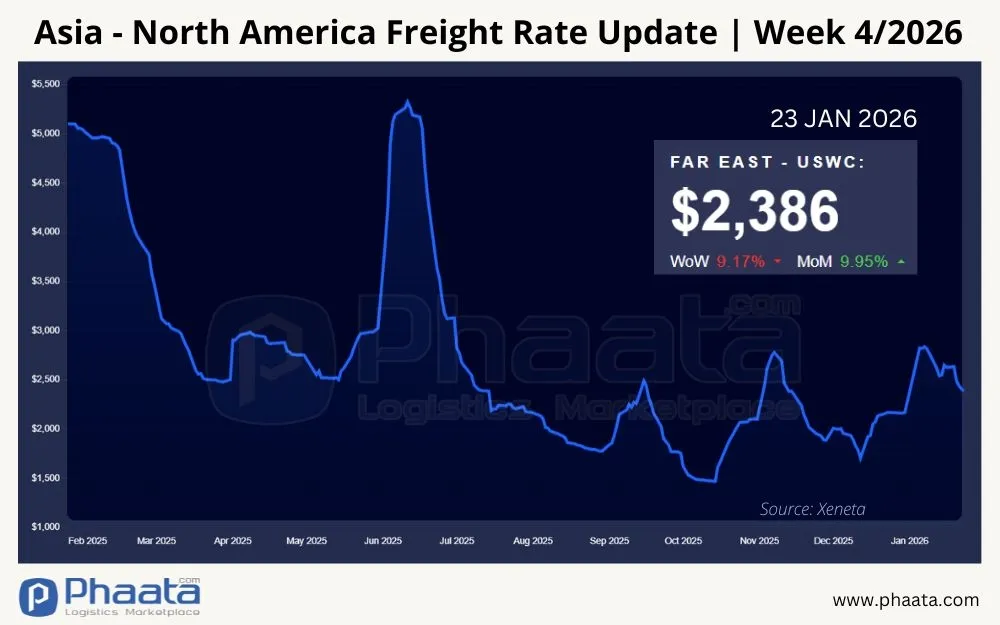
Asia-North America Freight Rates | Week 4/2026 (Photo: Phaata.com)
US Tariff Updates:
Week 4/2026 showed a temporary cooling in US-Europe tensions regarding Greenland, but new storm clouds immediately appeared threatening the French wine industry and signaling a stalemate in bilateral trade agreements. Furthermore, compliance deadlines (electronic drawback, eFiling) are approaching, demanding immediate action from businesses to avoid cash flow blockages.
1. US-Europe Relations: A Temporary Lull, Not Peace
On Jan 21, President Trump announced a framework agreement with NATO regarding the Arctic/Greenland issue. Consequently, the 10% tariff scheduled for 8 European trading partners on Feb 1 was officially cancelled. The Trans-Atlantic supply chain breathed a temporary sigh of relief. However, the European Parliament has suspended ratification of the US-EU trade agreement (reached last summer).
Deadline Feb 6, 2026: The suspension of EU retaliatory measures against the US will expire. If not extended, the EU could re-impose tariffs on €93 billion ($109 billion) of US goods. A new trade war is poised to erupt in early February.
2. Awaiting US Court Ruling Schedule on Tariffs
Justices are taking a 4-week recess. The earliest next ruling date is Feb 20, 2026.
Scenarios:
-
If Government Loses: CBP stops collecting duties immediately. However, the risk remains that the Government could use other statutes (Section 301, 232, 338) to re-impose tariffs under different names.
-
If Government Wins: Tariffs remain in place.
3. New Risk for Luxury Goods: 200% Tariff on French Wine
On Jan 19, President Trump threatened a 200% tariff on French wine and champagne. The alleged reason is to "pressure" France into joining the "Board of Peace." This is a prime example of using tariffs as diplomatic leverage. Wine importers need to prepare stockpiling plans or shift sourcing immediately.
4. Compliance: Deadlines That Cannot Be Moved
Electronic Drawback (CBP): From Feb 6, 2026, CBP will stop issuing drawback checks. All refunds will be electronic. Businesses must have an ACE Portal account and set up ACH information immediately to avoid capital lock-up.
eFiling (CPSC): Deadline July 8, 2026 for consumer goods. Businesses should register for a CPSC eFiling account now to run beta tests.
5. Other Updates
US - Taiwan: Agreement to reduce tariffs to 15% and semiconductor import incentives finalized.
25% Chip Tariff: Effective from Jan 15 for advanced chips (with Data Center exceptions).
Iran: Risk of 25% tariffs for nations dealing with Iran (especially China) remains looming.
Stay tuned to articles on the Phaata International Logistics Marketplace for rapid and in-depth market updates.
3. Asia-Europe Ocean Freight Rates
The Asia - North Europe market in Week 4 (Jan 19 - 25, 2026) is in a sensitive transition phase. To meet pent-up demand, carriers have deployed record capacity (1.15 million TEU), defying standard seasonal norms. However, the effectiveness of this supply injection is threatened by operational paralysis in North Europe. Rates are showing signs of "technical cooling" to consolidate volumes before zero hour.
On supply and demand:
Demand:
Shippers have aggressively executed front-loading strategies. Demand peaked 6 weeks earlier than usual, turning January—typically a buffer month—into the focal point of shipping pressure. European importers are racing against time to secure inventory before Asian factories close in mid-February.
Supply:
To meet this compressed demand, carriers injected a record amount of capacity: 1.15 million TEU in January alone, up 50% compared to pre-pandemic baselines. Blank sailing rates are currently quite low (removing only about 25,000 TEU). This is a distinct divergence from traditional tactics. Carriers are prioritizing cargo clearance to optimize revenue on every full vessel before the holiday begins.
February & Post-Tet Strategy (Weeks 8-9): Capacity is expected to drop from 1.15 million TEU to over 1 million TEU in February. Carriers have confirmed an aggressive blank sailing schedule for Weeks 8 and 9 (immediately post-Tet). This move aims to: (1) Manage the post-holiday demand void and (2) Anchor rates at high levels for leverage in upcoming long-term contract negotiations.
On Operations and Container Equipment Situation:
The supply chain is severely fractured at destination due to harsh winter weather:
-
Hamburg (Germany): Truck handling capacity has plummeted. Average berthing wait times increased to 1.65 days. Rail paralysis: As of Week 3, up to 21 METRANS trains were immobilized en route to Hamburg due to frozen tracks and power lines. Systemic congestion is unavoidable.
-
Rotterdam (Netherlands): Vessel delays reaching 48 hours.
-
Yard Utilization: At both major ports, yard density has hit the critical threshold of 80% to 95%. At this level, terminal efficiency is virtually strangled.
-
Equipment Situation: The shortage of empty containers, especially 40’ High Cubes (HC), has officially been reported as "tight" at major export hubs like Shanghai and Ningbo. Therefore, shippers must treat empty pickup as a vital priority right now to ensure cargo makes it onboard before the holiday.
Freight Rate Developments:
The market is entering a transition phase before the cut-off for Lunar New Year (Feb 17). Ocean Freight rates from Asia to Europe in Week 4/2026 reversed to a slight decline of 3.91%, down to $2,730/FEU. This represents a 7.14% increase month-on-month, according to Xeneta data. This signals that spot demand is cooling as shippers finalize their last shipments.
Although carriers were keen to raise prices early in the month, the reality of late January shows more caution. Some carriers have extended or adjusted FAK rates to secure full loads before factories close. Rates are entering a stability zone.
Phaata notes that while base rates may soften, environmental and fuel surcharges (BAF/ETS) remain mandatory and account for a large proportion of the 2026 cost structure.
Stay tuned to Phaata International Logistics Marketplace for in-depth and fast market updates.

Asia-Europe Freight Rates | Week 4/2026 (Photo: Phaata.com)
4. North America - Asia Ocean Freight Rates
Ocean Freight rates from North America (West Coast) to Asia in Week 4/2026 reversed to a slight decline of 0.16% week-on-week, falling to $611/FEU. This represents a 3.17% decrease month-on-month, according to Xeneta data.

North America (West Coast) - Asia freight rates | Week 4/2026 (Photo: Phaata.com)
5. Northern Europe - Asia Ocean Freight Rates
Ocean Freight rates from North Europe to Asia in Week 4/2026 reversed to a slight decline of 0.63%, falling to $157/FEU week-on-week. This represents an 8.28% increase month-on-month, according to Xeneta data.
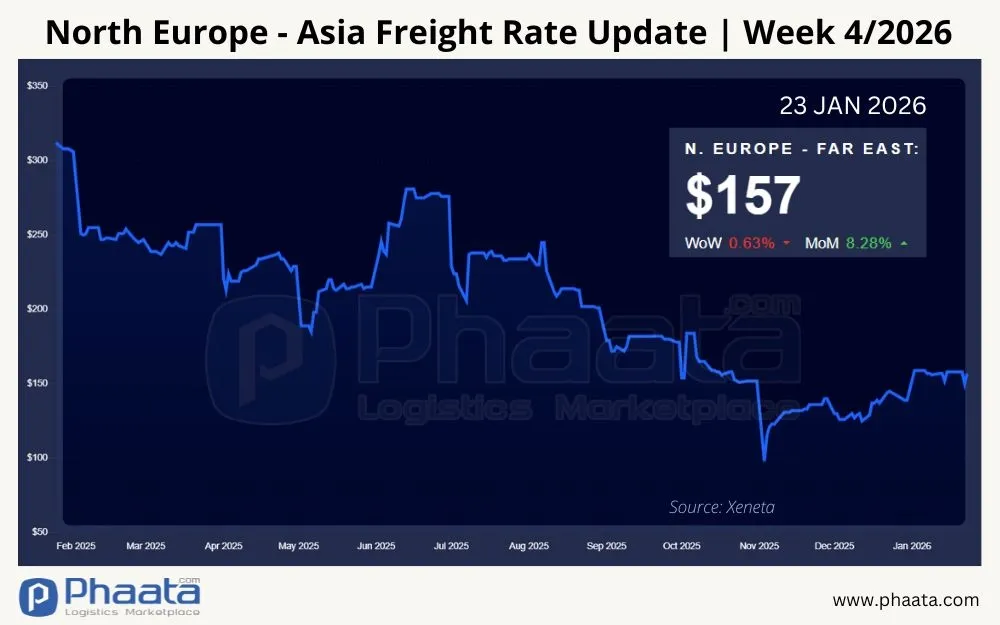
Container Freight rates from Northern Europe to Asia | Week 4/2026 (Photo: Phaata.com)
6. Conclusion and Recommendations from Phaata
The international logistics market in Week 4/2026 is witnessing a paradox: "Prices Down, Risks Up."
Collapse of "Peak Season": The 10% WCI drop and ~9% US rate decline confirm that the 2026 Tet peak season has ended before it truly began. Diluted demand and excess capacity neutralized carrier GRI efforts. This is a golden time for shippers to optimize costs.
Operational Crisis in Europe: While Europe rates show signs of cooling, the risk of supply chain fracture is extremely high. Record supply injection (1.15 million TEU) is being choked by weather bottlenecks in Hamburg/Rotterdam and 40'HC shortages in China. Cargo may depart, but timely arrival is not guaranteed.
Unpredictable Policy: From the cancellation of Greenland tariffs to the threat of 200% taxes on French wine, US trade policy is changing daily. Compliance risks (electronic drawback, eFiling) are becoming direct financial pressures.
Recommendations from Phaata
Businesses need to apply flexible tactics depending on the target market:
1. Tactics for US Trade:
With PSS moved to March and GRIs failing, shippers should check and request Forwarders to remove all peak season surcharges (if any) for pre-Tet bookings.
Prepare for Weeks 8-9: Phaata predicts carriers will cut supply aggressively immediately after Tet to stop rate declines. Therefore, shippers should book space early for shipments expected to depart in late February right now.
2. Tactics for Europe Trade:
With Hamburg port efficiency down 80% and Rotterdam congested, exporters should notify import partners of potential delivery delays of 3-7 days after vessel arrival.
Routing Priority: If possible, shippers should consider routing options into South European ports or niche ports less affected by snowstorms to clear cargo faster.
3. Tech Supply Chain Strategy (Act Now):
Leverage Taiwan Incentives: US businesses importing components, auto parts, and lumber from Taiwan need to review HS codes immediately. The tariff reduction to 15% is a huge opportunity to lower COGS.
Review China Risks: With the threat of 25% tariffs for nations dealing with Iran, importers from China need to monitor closely. US importers should diversify backup supply sources to avoid being impacted by sudden sanctions in a worst-case scenario.
Wine & Luxury Goods: With the threat of 200% tariffs on French wine, importers need plans to stock up early or shift sourcing to Italy/California/South America to hedge against sudden geopolitical risks.
Electronic Drawback: There are less than 2 weeks left (Feb 6) until the US government stops issuing drawback checks. Accounting departments of US businesses must ensure ACE Portal accounts and bank information are ready so cash flow from refunds is not blocked.
4. IEEPA Plan:
Although the ruling date is moved to Feb 20, US importers should still use this time to review import records from previous years. Be ready to file claims immediately upon a favorable ruling to recover capital.
Stay tuned to articles on Phaata.com or Phaata fanpage for rapid and in-depth market updates.
Find Freight Rates Here
Find Logistics Companies Here
See more:
- CMA CGM Welcomes 400th Owned Vessel: A Methanol Milestone with the 'Mega-Vessel' CMA CGM MONTE CRISTO
- PIL Secures Deal for 8 LNG Dual-Fuel Neo-Panamax Vessels
- Lunar New Year 2026 Logistics Strategy: Shippers Prioritize Critical SKU Replenishment Over Mass Stockpiling
- Port of Los Angeles Surpasses 10 Million TEU in 2025 - Marking the Third Time in History
- Vienna Airport Sets New Air Cargo Record in 2025
- CMA CGM Scraps Red Sea Plans for Asia-Europe Trade; Xeneta Warns of Supply Chain Unpredictability
- Pre-Lunar New Year Air Freight Peak: Shippers Urged to Book Early
- Surging India-Iran Air Freight: Risk of 'Collateral Damage' from Proposed US 25% Tariffs
- Global Tanker Market Forecast 2026
- COSCO schedules: Vietnam - North America in Jan 2026
- SITC updates Vietnam-Intra Asia sailing schedules in Jan 2026
Source: Phaata - Vietnam's First International Logistics Marketplace
► Find Better Freight Rates & Logistics Service Providers!


Featured News
- Hapag-Lloyd applies Peak Season Surcharge from East Asia to USA and Canada
- The world\'s largest container ships MSC Irina and MSC Loreto floated
- MSC (Mediterranean Shipping Company) - The world\'s leading container shipping lines
- Information you need to know about Maersk Line
- Top 10 export and import goods between Vietnam - Philippines in the first 5 months of 2020

 Market News
See more
_-_Copy_-_Copy.webp)

.webp)


 HOT PROMO
See more
337
 FCL
FCL
 20 Days
 Freight cost

N.B.L INTERNATIONAL TRANSPORT CO., LTD
1229
FCL
21 Days
Freight cost

MG LOGISTICS JSC
3002
FCL
28 Days
Freight cost

CÔNG TY TRÁCH NHIỆM HỮU HẠN DT LOGISTICS (VN)
3618
FCL
28 Days
Freight cost

Công Ty TNHH Quanterm Logistics Vietnam
3037
FCL
33 Days
Freight cost

CÔNG TY TNHH TIẾP VẬN TOÀN CẦU KM
Why do thousands of businesses trust Phaata?
USERS/MONTH
LOGISTICS COMPANIES
REQUEST FOR QUOTEŚ
QUOTATIONS
VIETNAM LOGISTICS COMMUNITY
5 Steps to Get the Best Quote
Find a price quickly/Send a RFQ
Compare multiple options
Contact for Further Consultation
Negotiating prices/services
Management & rating
 Freight rates
Sea freight
- FCL
See more
146
7
Days Direct
- ₫529,260 / 20'GP
- ₫3,704,820 / 40'GP
- ₫3,704,820 / 40'HQ
- ₫4,631,025 / 45'HQ

MELODY LOGISTICS COMPANY LIMITED
201
40
Days Transit
- ₫303,557,073 / 40'RF

GIA LINH LOGISTICS SERVICES CO., LTD. (G LINK Logistics)
228
25
Days Transit
- ₫142,900,200 / 20'GP
- ₫195,826,200 / 40'GP
- ₫195,826,200 / 40'HQ

OPL LOGISTICS
274
 196
20
Days Transit
196
20
Days Transit
- ₫29,884,500 / 20'GP
- ₫31,189,500 / 40'GP
- ₫31,189,500 / 40'HQ

CÔNG TY CỔ PHẦN TIẾP VẬN INTERCARGO
Sea freight
- LCL
See more
564
3
Days Direct
- Refund ₫926,205 /cbm

CÔNG TY CỔ PHẦN GIAO NHẬN VẬN TẢI HỒNG SƠN
919
1,733
3
Days Direct
- ₫132,315 /cbm
CÔNG TY TRÁCH NHIỆM HỮU HẠN DT LOGISTICS (VN)
1,841
3
Days Direct
- ₫0 /cbm

CÔNG TY TNHH VẬN TẢI VÀ TIẾP VẬN TOÀN CẦU
3,842
 Air freight
- General cargo
Air freight
- General cargo
See more
2,034
1
Days Direct
- 46,310 ₫/kg
N.B.L INTERNATIONAL TRANSPORT CO., LTD
2,751
1
Days Direct
- 161,424 ₫/kg
CÔNG TY CỔ PHẦN GIAO NHẬN VẬN TẢI HỒNG SƠN
5,616
10
Days Transit
- 264,630 ₫/kg

Phoenix Logistics Vietnam - chi nhánh TP. Hồ Chí Minh (Phoenix International Forwarding Vietnam )
7,293
1
Days Direct
- 185,241 ₫/kg

CÔNG TY TNHH THƯƠNG MẠI VÀ DỊCH VỤ FASTRANS
8,787

 Rail freight
- FCL
Rail freight
- FCL
See more
3,383
5
Days Direct
- ₫44,987,100 / 40'HQ
- ₫44,987,100 / 45'HQ

CÔNG TY TNHH PHƯỚC TÁ
5,170
3
Days Direct
- ₫15,083,910 / 40'HQ

CÔNG TY CỔ PHẦN VẬN TẢI VÀ THƯƠNG MẠI ĐƯỜNG SẮT
15,520
7
Days Direct
- ₫48,956,550 / 20'GP

Công ty TNHH T&M Forwarding
14,284
5
Days Direct
- ₫7,145,010 / 20'GP

ASIAN EXPRESS LINE VIETNAM ( AEL VIET NAM )
9,853
10
Days Direct
- ₫9,262,050 / 20'GP

CÔNG TY CỔ PHẦN LOGISTICS QUỐC TẾ V&T
 Road freight
- FCL
Road freight
- FCL
See more
1,519
4
Day
- ₫5,000,000 / 40'GP

CÔNG TY CỔ PHẦN IGAP
4,101
1
Day
- ₫28,000,000 / 20'GP
- ₫28,000,000 / 40'GP

CÔNG TY TNHH THƯƠNG MẠI DỊCH VỤ VÀ KHO VẬN VIETTEL POST - TTC
105,435
2
Day
- ₫6,500,000 / 40'RF
- ₫6,500,000 / 40'RQ
- ₫6,500,000 / 45'RQ

CÔNG TY CP PROSHIP
 Premium
174,079
1
Day
Premium
174,079
1
Day
- ₫18,997,200 / 20'GP
- ₫18,997,200 / 40'GP

CÔNG TY CỔ PHẦN GIAO NHẬN VẬN TẢI CON ONG
263,631
3
Day
- ₫32,000,000 / 20'GP
- ₫64,000,000 / 40'GP
- ₫64,000,000 / 40'HQ
- ₫64,000,000 / 45'HQ

Công ty Cổ phần phát triển thương mại Thuận Đạt Việt Nam


