



Monday, 02/11/2026, 11:00 (GMT +7)
 23
International Shipping and Logistics Market Update Week 44/2026 | Phaata
International shipping and logistics market update - Week 44/2026
Table of Contents
-
World Container Index Week 44/2026
-
Asia - North America Ocean Freight Rates
-
Asia - Europe Ocean Freight Rates
-
Northern America - Asia Ocean Freight Rates
-
Northern Europe - Asia Ocean Freight Rates
-
Conclusions and Recommendations by Phaata
1. World Container Index Week 44/2026
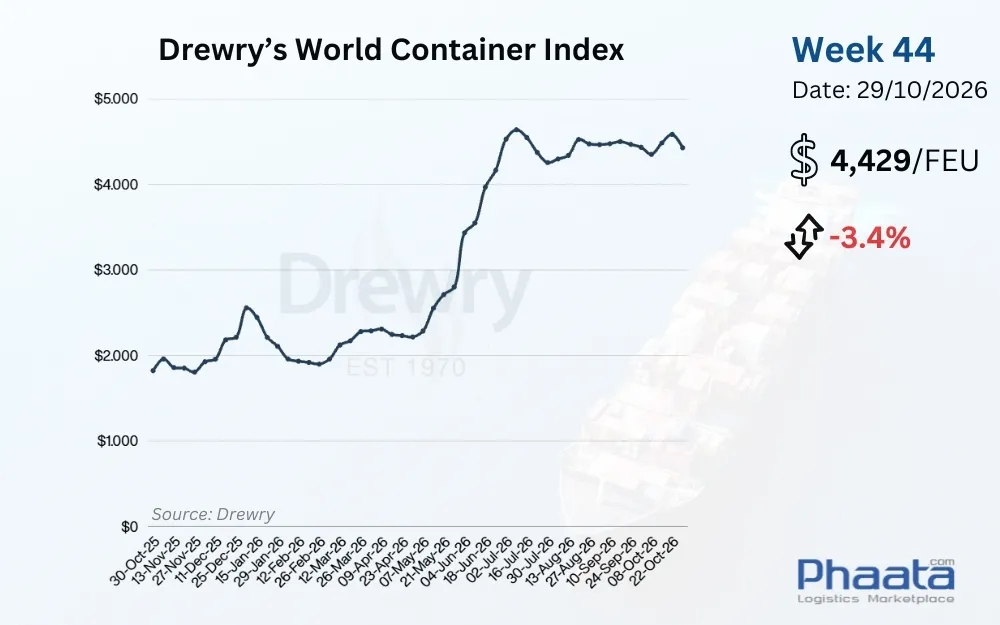
Drewry’s World Container Index (WCI) for Week 44/2026 (from October 26 to November 1, 2026) decreased by 3.4% compared to the previous week, dropping to $4,429/FEU.
Drewry's World Container Index Week 44/2026 (Photo: Phaata)
2. Asia-North America Ocean Freight Rates
Supply and Demand:
Surging Capacity and Double Sailings: During China's Golden Week, deployed capacity on the route recorded high levels. Total weekly capacity from Asia to the U.S. West Coast hit approximately 393,000 TEUs, significantly above the typical sub-300,000 TEU benchmark. Prolonged vessel delays at loading ports have triggered schedule bunching, leading to "double sailings" - where multiple vessels arrive and depart simultaneously. This dynamic has temporarily inflated capacity supply, undermining the effectiveness of previously executed blank sailing programs.
Capacity Adjustments Heading into the Winter Slack Season: The market is entering the winter slack season, with transport demand flashing signs of cooling post-Golden Week. In response, carriers have begun recalibrating operational capacity to balance supply with market demand and help stabilize the rate baseline.
Rate Developments:
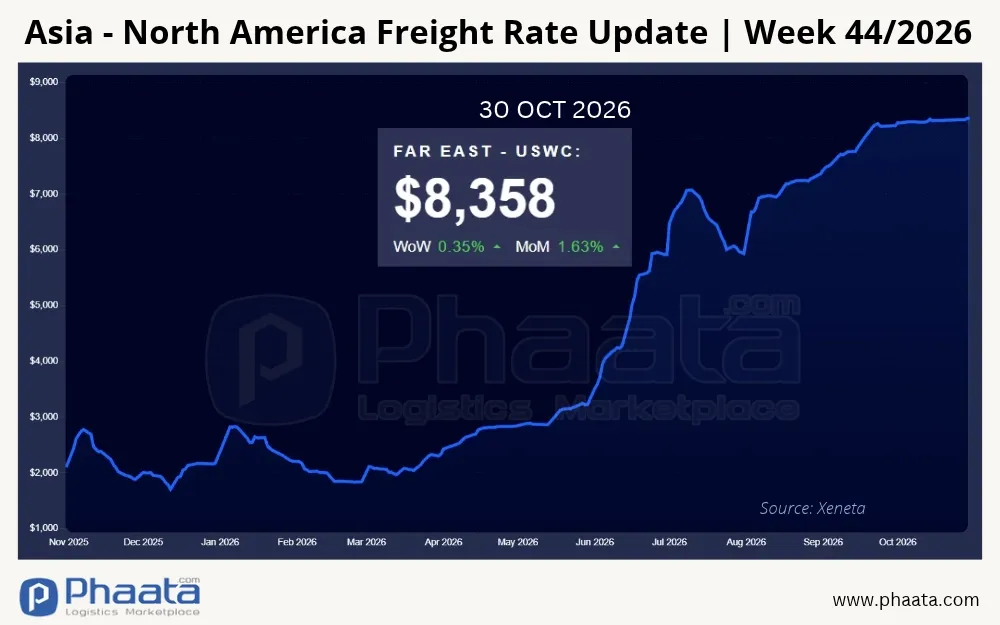
Ocean freight rates from Asia to the North America West Coast in Week 44/2026 ticked up slightly by 0.35% week-on-week, reaching $8,358/FEU. This rate is up 1.63% month-on-month, according to Xeneta data.
November GRI Faces Supply-Side Pressure: The rate baseline on the Trans-Pacific Eastbound (TPEB) route continues to outpace the Asia-Europe route. However, plans to implement a General Rate Increase (GRI) on November 1 may struggle to sustain target rate levels. A relatively ample capacity supply, coupled with signs of tapering cargo volumes, is intensifying carrier competition for bookings. This environment threatens the tenability of establishing and holding a new rate baseline.
Extension of Port Fee Suspension: Cost pressures on maritime operations may see some relief following a U.S. proposal to extend the suspension of supplementary port fees on China-linked vessels. Under the proposed plan, the current suspension - originally slated to end November 10 - would be extended to January 9, 2027. If enacted, this move would afford carriers and import-export businesses crucial lead time for proactive cost planning.
Stay tuned to Phaata International Logistics Marketplace for in-depth and fast market updates.
Asia-North America Freight Rates | Week 44/2026 (Photo: Phaata.com)
US Tariff Updates:
1. Section 338 Tariffs on Canadian Goods: Roster Adjustments Effective Oct 30
HS Code Roster Adjustments: A Presidential Executive Order published on October 23 revised the list of Canadian-origin goods subject to Section 338 tariffs. Specifically, 22 tariff lines were removed - including plywood, plastic film, corrugated cartons, and food processing machinery. Concurrently, approximately 100 new tariff lines were added, targeting commodities such as cocoa products, carpets and floor coverings, wood panels, coating materials, air conditioning equipment, and recreational products.
Applicability to In-Transit Goods: The new regulation applies to customs entries filed from October 30 onward. Consequently, the entry filing date is a critical determinant of tariff liabilities for imported goods. For instance, a freezer shipment with an entry filed no later than October 29 is solely subject to Section 232 tariffs on steel. For entries filed on or after October 30, goods falling under the new roster may incur additional Section 338 tariffs. Conversely, plywood is exempt from the 50% Section 338 tariff the moment the new regulation takes effect.
Principle of Concurrent Tariff Application: Section 338 tariffs are stacked on top of existing Section 232 duties. This stipulation applies to Canadian-origin goods even if they qualify for tariff preferences under the USMCA.
Impact on Import Operations: This second roster adjustment in just over a month further reshapes the scope of tariff-liable goods. Businesses importing goods from Canada must meticulously cross-reference HS classification codes against the new annex and note entry filing dates to ascertain their corresponding tax obligations.
2. Wind Turbines: Section 232 Investigation Concludes, Shifts to 180-Day Negotiation
Transition to Negotiation Phase: An October 22 Executive Order concluded the Section 232 investigation into wind turbines without immediately imposing new tariffs. Previously, the U.S. Department of Commerce (DOC) identified potential national security concerns regarding remote control capabilities, radar interference, and the impact of imported turbines on the power grid. Based on these findings, the U.S. President directed the DOC and the U.S. Trade Representative (USTR) to initiate negotiations with exporting nations. A report on the outcomes is due within 180 days.
Existing Metals Tariffs: The new order does not alter active Section 232 measures applied to metals. Therefore, turbine components containing steel, aluminum, or copper remain subject to applicable tariffs under current regulations.
Next Steps: The 180-day negotiation window is expected to close around April 20, 2027. During this period, existing tariff regulations on metals will be maintained. The negotiation outcomes will serve as the foundation for tracking subsequent policy adjustments regarding wind turbines.
3. Robotics and Industrial Machinery: Trade Measure Negotiations Continue
Investigation Concludes, Negotiations Commence: The Section 232 investigation into robotics and industrial equipment concluded on October 28 with an Executive Order identifying national security concerns, notably reliance on foreign supply sources and cybersecurity vulnerabilities within the equipment systems. Following the investigation, the DOC and USTR have been tasked with conducting negotiations with exporting nations over a 180-day period.
Policy Options Under Consideration: The order explicitly states that the President may impose tariffs, establish quotas, or levy fees if negotiations fail to yield an agreement within the 180-day timeframe. Thus, tariff measures remain a viable option under consideration for the ensuing phase.
Next Steps: The negotiation period is projected to run until late April 2027. Businesses importing robotics and industrial equipment should monitor the negotiation progress and subsequent policy announcements to stay abreast of tariff updates and inform their import planning.
4. UFLPA: Additions to Entity List, Supply Chain Review Scope Expanded
Entity List Updates: The U.S. Department of Homeland Security (DHS) added 3 Xinjiang-linked enterprises to the Uyghur Forced Labor Prevention Act (UFLPA) Entity List, bringing the total number of listed entities to 190.
Upstream Inputs Traceability: Under the UFLPA framework, goods mined, produced, or manufactured wholly or in part by listed entities are subject to a rebuttable presumption that they are made with forced labor. These goods may be denied entry into the U.S. unless the importer provides "clear and convincing" evidence to overcome that presumption. The scope of review can also extend to upstream inputs within the supply chain. Accordingly, U.S. Customs and Border Protection (CBP) can detain finished goods if they detect raw materials sourced from a UFLPA-listed entity, even if the direct supplier is not on the list.
Supply Chain Traceability Requirements: These list updates underscore the escalating mandate for importers to meticulously track information regarding direct suppliers (Tier 1), as well as sub-tier suppliers and subcontractors. Beyond partner data, raw material origin records and manufacturing process documentation are critical assets during origin verification and CBP inquiries.
Stay tuned to articles on the Phaata International Logistics Marketplace for rapid and in-depth market updates.
3. Asia-Europe Ocean Freight Rates
Supply and Demand:
Capacity Dynamics and Blank Sailing Plans: The blank sailing ratio for Week 44 stood at 8.1%, and is projected to drop to 3.4% the following week before fluctuating between 4.8% and 11.4% throughout November. Meanwhile, total deployed capacity on the North Europe route is slated to remain high. Blank sailing programs are being executed to manage vessel fill rates amid a relatively abundant capacity supply, rather than signaling a genuine space shortage.
Suez Canal Resumption and European Port Dynamics:
Suez Canal Routing Trends: Traffic via the Suez Canal is recovering on the Far East - Europe route. Currently, roughly 63% of total deployed capacity on the route has reverted to the Suez itinerary, hitting approximately 70% on the Mediterranean leg and 58% on the North Europe leg.
Recovery Pace Varies by Carrier and Alliance: The return to the Suez routing remains fragmented across carriers and alliances. MSC resumed operations in August. The Gemini Cooperation (Maersk and Hapag-Lloyd) began phasing select services back in Q3, aiming for a full service restoration by March 2027. CMA CGM continues to operate via Suez, while the Ocean Alliance has returned 6 services to the route. Recently, the Premier Alliance also announced plans to transit the Suez, whereas ZIM currently maintains alternative routings. Furthermore, some carriers continue utilizing the Cape of Good Hope detour as a fallback operational option.
Vessel Arrivals and European Congestion: Carriers concurrently operating Suez and Cape of Good Hope routings could disrupt vessel arrival timing. Suez-routed vessels with shorter transit times may arrive at ports clustered closely with Cape-routed vessels. This bunching of arrivals could intensify operational pressure and exacerbate congestion at several European discharge ports.
Freight Rate Developments:
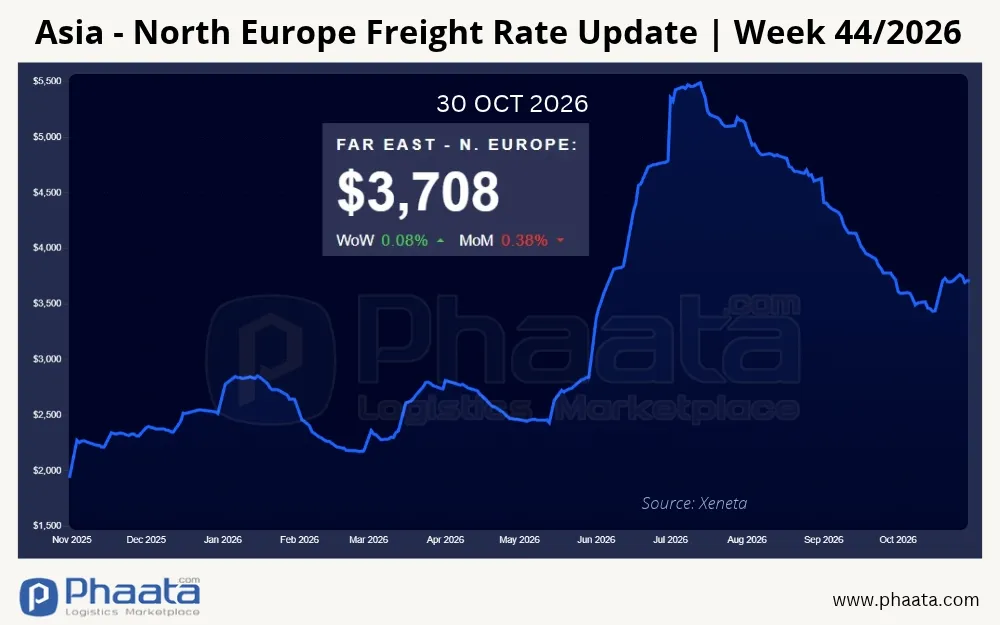
Ocean freight rates from Asia to Europe in Week 44/2026 increased marginally by 0.08% week-on-week, settling at $3,708/FEU. This rate is down 0.38% month-on-month, according to Xeneta data.
Spot Rates Stabilize, GRI Plans Require Monitoring: Spot rate indices on the benchmark Shanghai - North Europe route remained virtually flat week-on-week. Given that capacity supply continues to outstrip transport demand, the viability of sustaining the General Rate Increase (GRI) slated for November 1 remains contingent upon cargo volumes, deployed capacity, and carriers' blank sailing execution.
Stay tuned to Phaata International Logistics Marketplace for in-depth and fast market updates.
Asia-Europe Freight Rates | Week 44/2026 (Photo: Phaata.com)
4. North America - Asia Ocean Freight Rates
Ocean freight rates from North America (West Coast) to Asia in Week 44/2026 decreased by 0.86% week-on-week, dropping to $688/FEU. This rate is down 2.96% month-on-month, according to Xeneta data.
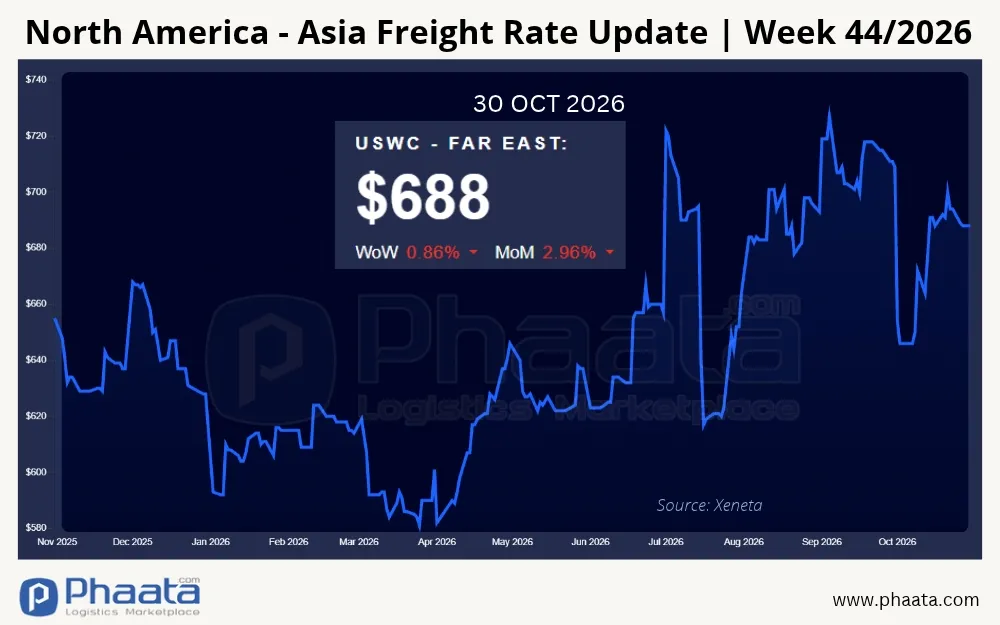
North America (West Coast) - Asia freight rates | Week 44/2026 (Photo: Phaata.com)
5. Northern Europe - Asia Ocean Freight Rates
Ocean freight rates from North Europe to Asia in Week 44/2026 decreased by 0.43% week-on-week, settling at $234/FEU. This rate is up 0.43% month-on-month, per Xeneta data.
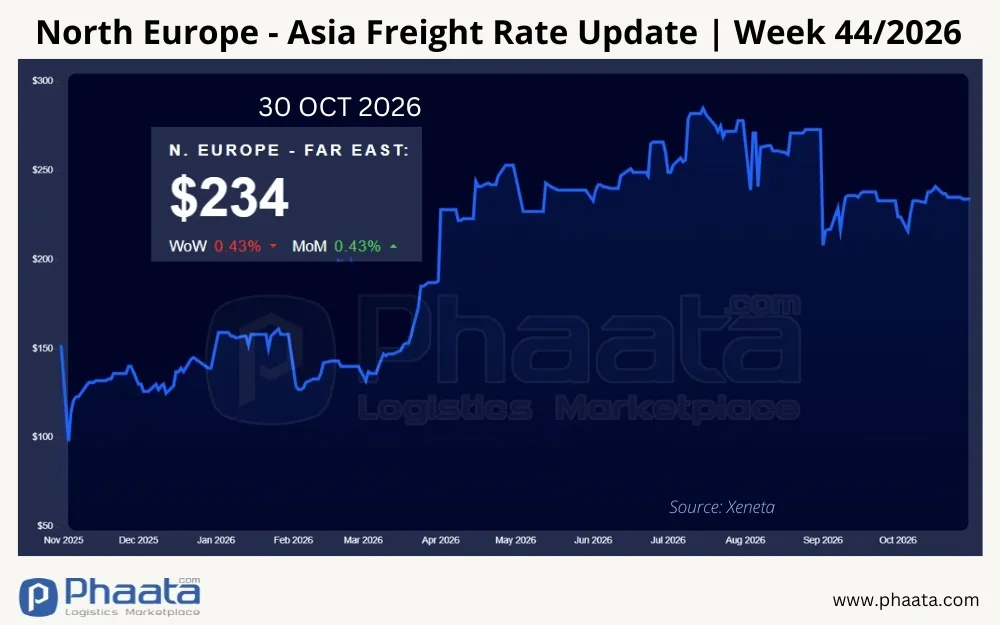
Container Freight rates from Northern Europe to Asia | Week 44/2026 (Photo: Phaata.com)
6. Conclusion and Recommendations from Phaata
The maritime transport market in Week 44/2026 recorded a correction as the Drewry World Container Index (WCI) dropped 3.4% to $4,429/FEU. This trend reflects downward rate pressure as transport demand shows signs of cooling and the market transitions into the Winter Slack Season. Alongside freight dynamics, operational conditions on main corridors and shifting U.S. trade policies remain critical focal points.
Trans-Pacific Route (Asia - North America): Post-Golden Week, "double sailings" artificially inflated operational capacity, with total weekly payload from Asia to the U.S. West Coast hitting roughly 393,000 TEUs. Elevated capacity supply meeting signs of waning demand is escalating carrier competition, subsequently threatening the tenability of November GRIs. Furthermore, the proposed extension of the port fee suspension for China-linked vessels until January 2027 warrants close monitoring.
Far East - West Europe Route: Operations via the Suez Canal continue to rebound, with approximately 63% of total capacity on the route returning to this itinerary. The simultaneous use of Suez and Cape of Good Hope routings may alter vessel arrival clusters, thereby increasing operational pressure at select European ports. In November, blank sailing ratios are projected to fluctuate between 4.8% and 11.4%, reflecting carriers' efforts to calibrate capacity in a market characterized by relatively abundant supply and stagnant spot rates.
U.S. Tariff Policy and Compliance:
-
Section 338 Tariffs: The roster of Canadian goods subject to tariffs was revised effective October 30, with 22 tariff lines removed and approximately 100 added. These shifts directly impact the scope of taxable goods and importers' tax liabilities.
-
Section 232 Tariffs: Investigations into wind turbines, robotics, and industrial machinery have transitioned to a 180-day negotiation phase, holding off on new tariffs for now. Negotiation outcomes are expected around April 2027.
-
UFLPA: Three additional entities were added to the Entity List, bringing the total to 190. The scope of origin reviews now clearly encompasses upstream inputs, underscoring the escalating imperative for rigorous traceability and robust origin record-keeping.
Recommendations from Phaata
Amid volatility in transport supply and demand, operational schedules, and trade policies, import-export and logistics enterprises should consider the following guidelines to proactively enhance their transport planning, cost management, and compliance readiness.
Freight & Space Management:
North America Route: The relatively abundant capacity supply in November presents an opportunity for businesses to negotiate freight rates with carriers and forwarders. Continuously updating quotes, benchmarking service terms, and tracking GRI developments will empower businesses to select optimal transport solutions. For high-volume shipments or those with rigid delivery schedules, businesses should consider splitting bookings across multiple sailings to increase agility and mitigate roll-over risks.
Europe Route: As carriers continue to adjust operational routings, confirming the actual itinerary - Suez Canal vs. Cape of Good Hope - at the time of booking will provide a firmer foundation for delivery planning. Additionally, baking buffer time into receiving, warehousing, and inland distribution schedules will help buffer the impact of schedule volatility, particularly for shipments with strict delivery deadlines.
Monitor Customs Policies and Manage Tariff Liabilities:
Section 338 Tariffs on Canadian Goods: For Canadian-origin goods currently in transit or slated for U.S. import, businesses must proactively cross-reference HS codes against the newly updated roster. Factoring in effective dates, the scope of taxable goods, and the potential for tariff stacking with existing duties will equip businesses to calculate highly accurate landed costs.
Section 232 Tariff Measures: For importers of wind turbines, robotics, and industrial equipment, the 180-day negotiation process is a critical watchpoint. Businesses should continue tracking U.S. agency updates while discussing supply structures and commercial terms with partners to ensure readiness should new tariff measures emerge post-negotiation.
UFLPA Compliance: For U.S.-bound exports, continually updating data on Tier 1 suppliers and sub-tier partners, and cross-referencing them against the UFLPA Entity List, is essential for robust origin control. Businesses should also systematically perfect their record-keeping regarding raw material origins, Bills of Materials (BOM), and manufacturing processes. These records are indispensable assets for tracing, verifying, and responding to U.S. customs inquiries.
Stay tuned to articles on Phaata.com or Phaata fanpage for rapid and in-depth market updates.
Find Freight Rates Here
Find Logistics Companies Here
See more:
- THE NORTHWEST SEAPORT ALLIANCE HIGHLIGHTS TRANSPACIFIC GATEWAY ADVANTAGES AND INFRASTRUCTURE INVESTMENTS AT NOVEMBER 4 EXECUTIVE ROUNDTABLE IN HO CHI MINH CITY
- COSCO schedules: Vietnam - North America in Nov 2026
- COSCO updates Vietnam-North Europe sailing schedules in Nov 2026
- SITC updates Vietnam-Intra Asia sailing schedules in Nov 2026
- Hapag-Lloyd Implements $500/TEU Peak Season Surcharge on Asia and Oceania to South Africa Trades
- Over 35,000 Containers Await Rail Transport at the Los Angeles–Long Beach Port Complex
- WorldACD: Chargeable Weight Up 2%, Air Rates Rise 4% in Week 42
- Nationwide Trucking Strike in Mexico: Supply Chain Disruption Warnings Raised
- Deployed Capacity on Asia–US and Asia–Europe Trades Hits Record Highs Over Golden Week 2026
- Hapag-Lloyd Warns of Potential Transport Disruptions in Kenya Due to Heavy Rainfall
Source: Phaata - Where Shippers & Logistics Providers Connect
► Find Better Freight Rates & Logistics Service Providers!


Featured News
- Hapag-Lloyd applies Peak Season Surcharge from East Asia to USA and Canada
- The world\'s largest container ships MSC Irina and MSC Loreto floated
- MSC (Mediterranean Shipping Company) - The world\'s leading container shipping lines
- Information you need to know about Maersk Line
- Top 10 export and import goods between Vietnam - Philippines in the first 5 months of 2020

 Market News
See more


 HOT PROMO
See more
1000
 Other

INTERLOG CORP - CÔNG TY CỔ PHẦN GIAO NHẬN TIẾP VẬN QUỐC TẾ
1648
 FCL
 50 Days
 Freight cost

NP LOGISTICS CO.,LTD
2097
FCL
35 Days
Freight cost

CÔNG TY TNHH CARDINAL GLOBAL LOGISTICS (VIETNAM)
 Premium
2415
Other

TRUNG PHÁT LOGISTICS - TPL
2008
FCL
3 Days
Freight cost

Interchains JSC
Why do thousands of businesses trust Phaata?
USERS/MONTH
LOGISTICS COMPANIES
REQUEST FOR QUOTEŚ
QUOTATIONS
VIETNAM LOGISTICS COMMUNITY
5 Steps to Get the Best Quote
Find a price quickly/Send a RFQ
Compare multiple options
Contact for Further Consultation
Negotiating prices/services
Management & rating
 Freight rates
Sea freight
- FCL
See more
29
8
Days Direct
- ₫9,262,050 / 20'RF
- ₫10,585,200 / 40'RF
- ₫10,585,200 / 40'RQ

CÔNG TY TNHH TIẾP VẬN TỐC ĐỘ
32
35
Days Transit
- ₫171,347,925 / 40'RQ

GIA LINH LOGISTICS SERVICES CO., LTD. (G LINK Logistics)
42
4
Days Direct
- ₫1,852,410 / 20'GP
- ₫3,175,560 / 40'HQ

Compass Logistics
Premium
1,157
44
Days Direct
- ₫97,913,100 / 20'GP
- ₫103,205,700 / 40'GP
- ₫103,205,700 / 40'HQ

ALLIANCE INTERNATIONAL LOGISTICS CO., LTD
Premium
867
3
Days Direct
- ₫1,587,780 / 20'GP
- ₫3,175,560 / 40'GP
- ₫3,175,560 / 40'HQ
.webp)
GAMA INTERNATIONAL CORPORATION
Sea freight
- LCL
See more
109
45
Days Transit
- Refund ₫131,570 /cbm

CÔNG TY TNHH LIÊN KẾT HOÀN HẢO (PERFECTLINK CO.,LTD)
2,456
7
Days Direct
- Refund ₫261,590 /cbm

CÔNG TY TNHH VẬN TẢI VÀ TIẾP VẬN TOÀN CẦU
5,059
 5,963
5
Days Direct
- ₫26,463 /cbm

CÔNG TY TNHH T&M FORWARDING - CHI NHÁNH HÀ NỘI
6,022
3
Days Direct
- Refund ₫926,205 /cbm

CÔNG TY CỔ PHẦN GIAO NHẬN VẬN TẢI HỒNG SƠN
 Air freight
- General cargo
See more
7,265
1
Days Direct
- 46,310 ₫/kg

N.B.L INTERNATIONAL TRANSPORT CO., LTD
9,315
1
Days Direct
- 161,424 ₫/kg
CÔNG TY CỔ PHẦN GIAO NHẬN VẬN TẢI HỒNG SƠN
11,723
10
Days Transit
- 264,630 ₫/kg

Phoenix Logistics Vietnam - chi nhánh TP. Hồ Chí Minh (Phoenix International Forwarding Vietnam )
13,176
1
Days Direct
- 185,241 ₫/kg

CÔNG TY TNHH THƯƠNG MẠI VÀ DỊCH VỤ FASTRANS
10,377

 Rail freight
- FCL
See more
8,605
5
Days Direct
- ₫44,987,100 / 40'HQ
- ₫44,987,100 / 45'HQ

CÔNG TY TNHH PHƯỚC TÁ
11,668
3
Days Direct
- ₫15,083,910 / 40'HQ

CÔNG TY CỔ PHẦN VẬN TẢI VÀ THƯƠNG MẠI ĐƯỜNG SẮT
21,402
7
Days Direct
- ₫48,956,550 / 20'GP
Công ty TNHH T&M Forwarding
19,908
5
Days Direct
- ₫7,145,010 / 20'GP

ASIAN EXPRESS LINE VIETNAM ( AEL VIET NAM )
11,202
10
Days Direct
- ₫9,262,050 / 20'GP

CÔNG TY CỔ PHẦN LOGISTICS QUỐC TẾ V&T
 Road freight
- FCL
See more
1,652
4
Day
- ₫5,000,000 / 40'GP

CÔNG TY CỔ PHẦN IGAP
13,317
1
Day
- ₫28,000,000 / 20'GP
- ₫28,000,000 / 40'GP
CÔNG TY TNHH THƯƠNG MẠI DỊCH VỤ VÀ KHO VẬN VIETTEL POST - TTC
114,078
2
Day
- ₫6,500,000 / 40'RF
- ₫6,500,000 / 40'RQ
- ₫6,500,000 / 45'RQ

CÔNG TY CP PROSHIP
Premium
182,272
1
Day
- ₫18,997,200 / 20'GP
- ₫18,997,200 / 40'GP

CÔNG TY CỔ PHẦN GIAO NHẬN VẬN TẢI CON ONG
268,835
3
Day
- ₫32,000,000 / 20'GP
- ₫64,000,000 / 40'GP
- ₫64,000,000 / 40'HQ
- ₫64,000,000 / 45'HQ

Công ty Cổ phần phát triển thương mại Thuận Đạt Việt Nam


