



Monday, 09/11/2026, 06:00 (GMT +7)
 13
International Shipping and Logistics Market Update Week 45/2026 | Phaata
International shipping and logistics market update - Week 45/2026
Table of Contents
-
World Container Index Week 45/2026
-
Asia - North America Ocean Freight Rates
-
Asia - Europe Ocean Freight Rates
-
Northern America - Asia Ocean Freight Rates
-
Northern Europe - Asia Ocean Freight Rates
-
Conclusions and Recommendations by Phaata
1. World Container Index Week 45/2026
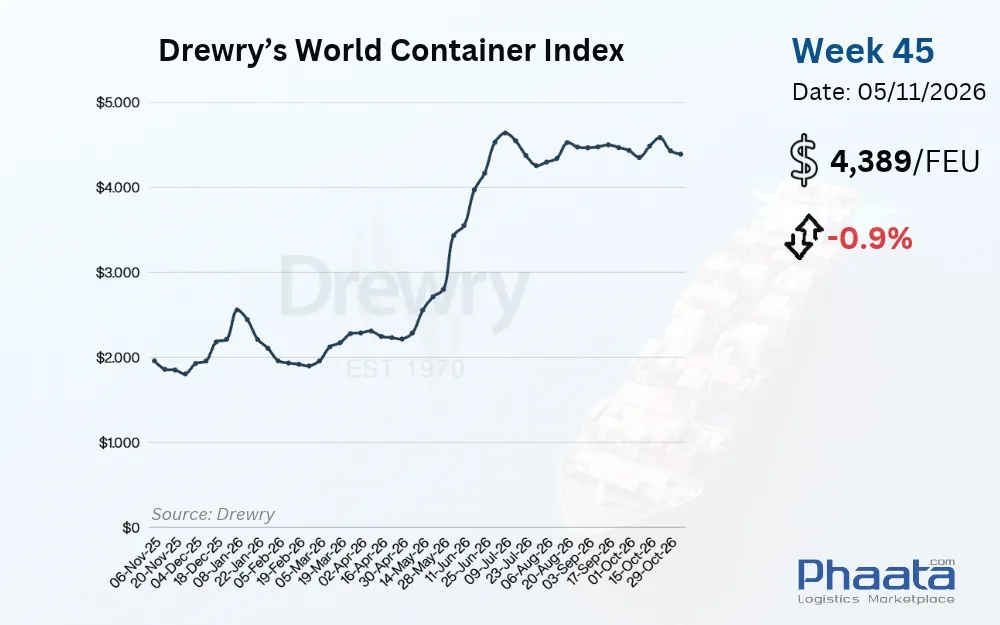
Drewry’s World Container Index (WCI) for Week 45/2026 (from November 2 to November 8, 2026) decreased by 0.9% compared to the previous week, dropping to $4,389/FEU.
Drewry's World Container Index Week 45/2026 (Photo: Phaata)
2. Asia-North America Ocean Freight Rates
Supply and Demand:
Operational Capacity and Blank Sailing Plans: For the current and subsequent week, carriers are projected to maintain 100% of planned operational capacity. However, capacity adjustments via blank sailings are anticipated toward month-end, with the blank sailing ratio expected to hit roughly 8% during the week commencing November 30. These figures remain subject to updates based on carrier alliances' sailing schedules.
Transport Demand and Capacity Supply: U.S. seaborne import container volumes are forecast to decline by 11% in November compared to October (MoM). Amid this cooling demand trend, blank sailing programs could help carriers calibrate capacity supply and support the rate baseline. Space availability on the route is currently more favorable, affording shippers greater flexibility in booking and scheduling shipments.
Rate Developments:
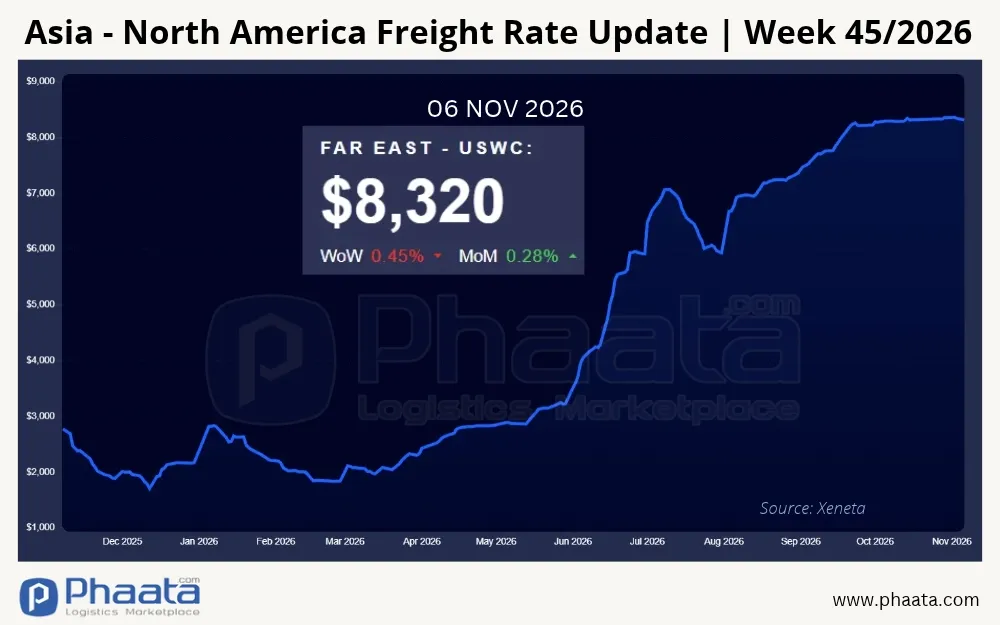
Ocean freight rates from Asia to the North America West Coast in Week 45/2026 decreased by 0.45% week-on-week, settling at $8,320/FEU. This rate is up 0.28% month-on-month, according to Xeneta data.
Index Discrepancies and Rate Trends: Current freight rate indices exhibit divergent trends. Over the past week, spot rates dropped 6% for the West Coast and 5% for the U.S. East Coast. Conversely, the index reflecting rates for shipped containers (actual cargo loaded) edged up by 2% across both regions.
The variance among indices indicates that rate trajectories may not be uniform across all transaction segments and recording periods. Nonetheless, current market signals suggest that downward rate pressure is likely to persist on the TPEB (Trans-Pacific Eastbound) route in the coming weeks.
Stay tuned to Phaata International Logistics Marketplace for in-depth and fast market updates.
Asia-North America Freight Rates | Week 45/2026 (Photo: Phaata.com)
US Tariff Updates:
CBP Adjusts Regulations for Foreign Importers of Record, Expected Effective Jan 5, 2027 U.S. Customs and Border Protection (CBP) expects to publish an Interim Final Rule in the Federal Register on November 6. The new regulation introduces several adjustments concerning registration requirements and import procedures for Foreign Importers of Record (Foreign IORs), while clarifying the responsibilities of Customs Brokers during the clearance process. According to CBP, these changes stem from an estimated $1.16 billion in uncollected duties recorded between January 2020 and August 2026, of which only about $35.7 million was recovered. The core tenets of the regulation focus on CTPAT program eligibility, criteria for determining U.S. importer status, and the verification responsibilities of customs brokers.
1. CTPAT Requirements for Foreign IORs
-
Effective January 5, 2027, under the new rule, a Foreign IOR may only act as the direct declarant to enter goods for consumption if the entity has been validated under the Customs Trade Partnership Against Terrorism (CTPAT) program.
-
Foreign entities that do not meet this criterion must execute import procedures through a CTPAT-validated customs broker. Within the CTPAT framework, the validated tier is distinct from the certified tier regarding verification and assessment requirements. This validation process may entail on-site CBP inspections to evaluate security conditions and associated documentation.
-
The regulation also addresses scenarios where a CTPAT-validated customs broker files a declaration on behalf of a foreign party that is neither the owner nor the purchaser of the goods. In such instances, the broker may be required to act as the Importer of Record (IOR) for the shipment, depending on applicable conditions.
2. Additional Criteria for Determining U.S. IOR Status
-
The new rule adds Part 110 to the regulatory framework, outlining more specific criteria for U.S. IOR status.
-
According to the outlined criteria, an entity must satisfy conditions related to ownership structure or U.S.-based assets, including having at least 51% of its shares owned by U.S. citizens or permanent residents, or directly owning unencumbered commercial real estate of significant value in the U.S.
-
Furthermore, the regulation clarifies the concept of Beneficial Owner, which includes individuals exercising actual control or holding 25% or more of the shares. These criteria are utilized to ascertain the ownership structure and controlling parties of entities registering for importer status.
3. Adjusting Customs Broker Responsibilities
-
Customer Verification: Under the new rule, prior to transmitting an entry, the customs broker is responsible for verifying the client's legal information to assess their eligibility for U.S. IOR registration. Documentation supporting the verification process may include articles of incorporation, financial statements, and other relevant documents. The mandated record retention period is 5 years.
-
The regulation also delineates the scope of declaration procedures for clients failing to meet U.S. IOR requirements, including exceptions for CTPAT-validated customs brokers meeting specific criteria.
-
Additionally, customs entry forms 3461 and 7501 are slated to include a new data field to confirm U.S. IOR status.
-
Liability Adjustments: Another provision addresses the legal liability framework for customs brokers. Specifically, certain operational violations may fall under the purview of Section 1592 (19 U.S.C. § 1592), in addition to the provisions of Section 1641. The application of penalties will depend on the nature and scope of each violation.
4. Implementation Roadmap
-
The regulation is expected to take effect on January 5, 2027. Customs brokers may file for an extension during the transition period, with a final deadline for compliance set for May 6, 2027. The public comment period runs for 60 days from the rule's publication date.
-
For Foreign Sellers currently utilizing their own entities as the IOR for U.S. imports, these changes regarding CTPAT requirements and importer status criteria are critical factors to address during preparation.
-
Businesses should consult their customs brokers regarding documentation requirements, client onboarding verification procedures, and the appropriate IOR arrangement. These are also key areas that parties can review during the transition period before the rule is officially enforced.
Stay tuned to articles on the Phaata International Logistics Marketplace for rapid and in-depth market updates.
3. Asia-Europe Ocean Freight Rates
Supply and Demand:
Capacity Adjustments Slated for Late November: For the current and subsequent week, carrier alliances are expected to maintain 100% of operational capacity. However, capacity adjustments via blank sailings could intensify starting mid-November. The blank sailing ratio is forecast to surpass 7% during the week commencing November 16, and hit 10% or higher during the weeks of November 30 and December 7.
Capacity Supply and the Impact of Suez Resumptions: Transport demand on the route remains relatively stable. With capacity supply still elevated, increasing the volume of canceled sailings could help carriers calibrate operational capacity and balance supply and demand. Furthermore, the resumption of transits via the Suez Canal is shortening vessel turnarounds, thereby boosting capacity supply on the route. This dynamic necessitates further capacity adjustments to align with actual transport demand.
Freight Rate Developments:
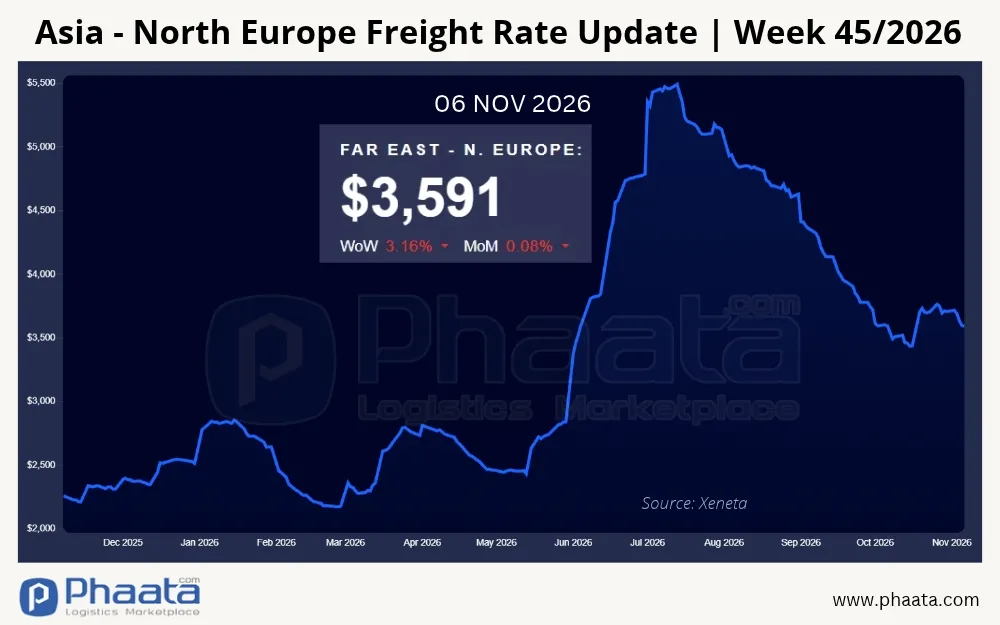
Ocean freight rates from Asia to Europe in Week 45/2026 decreased by 3.16% week-on-week, settling at $3,591/FEU. This rate is down 0.08% month-on-month, according to Xeneta data.
Post-Nov 1 GRI Developments: Buoyed by port congestion and mid-October capacity adjustments, the rate index over the past week largely flatlined or ticked up slightly - maxing out at around 5% depending on the specific metric. However, the November 1 General Rate Increase (GRI) fell short of expectations, as transport demand failed to generate sufficient momentum to support the hike. Current transaction indicators suggest that spot rates on the route may remain under downward pressure in the coming weeks.
Stay tuned to Phaata International Logistics Marketplace for in-depth and fast market updates.
Asia-Europe Freight Rates | Week 45/2026 (Photo: Phaata.com)
4. North America - Asia Ocean Freight Rates
Ocean freight rates from North America (West Coast) to Asia in Week 45/2026 increased by 1.31% week-on-week, settling at $697/FEU. This rate is up 7.89% month-on-month, according to Xeneta data.
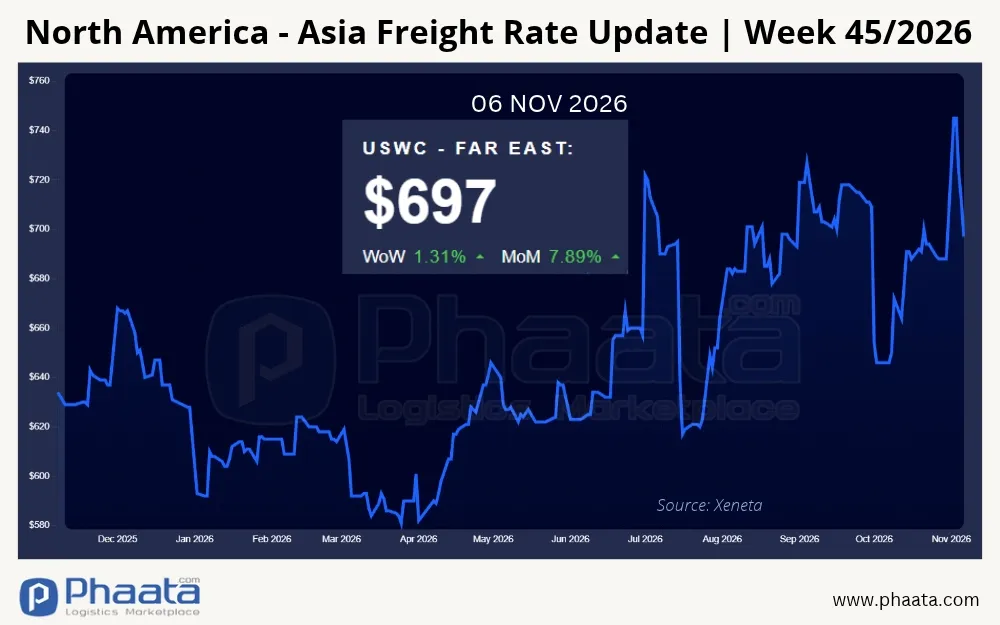
North America (West Coast) - Asia freight rates | Week 45/2026 (Photo: Phaata.com)
5. Northern Europe - Asia Ocean Freight Rates
Ocean freight rates from North Europe to Asia in Week 45/2026 increased by 8.12% week-on-week, reaching $253/FEU. This rate is up 11.95% month-on-month, per Xeneta data.
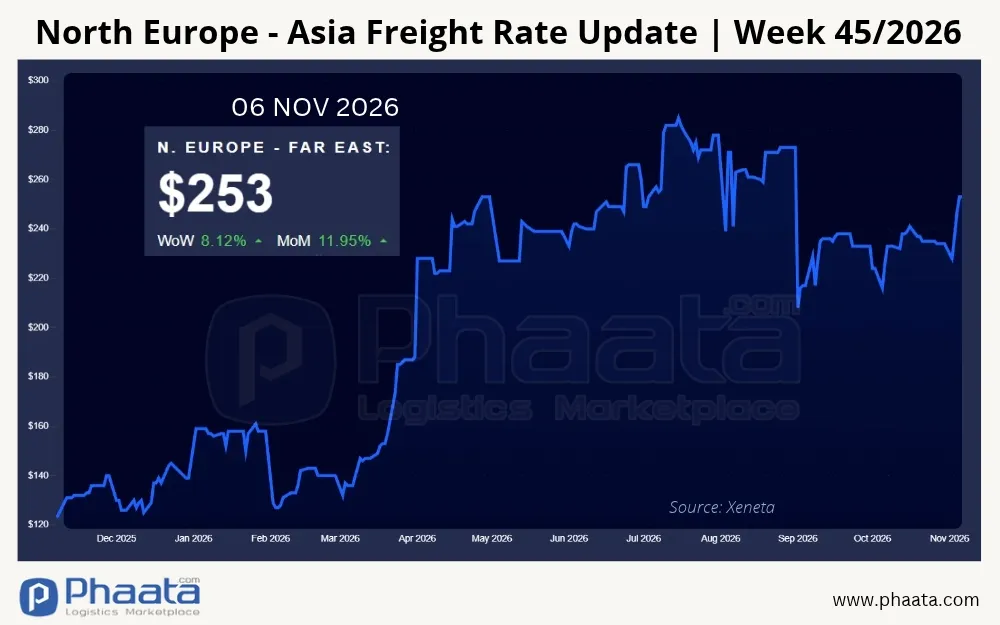
Container Freight rates from Northern Europe to Asia | Week 45/2026 (Photo: Phaata.com)
6. Conclusion and Recommendations from Phaata
The maritime transport market in Week 45/2026 continued to exhibit signs of cooling as it enters the Winter Slack Season. The Drewry World Container Index (WCI) dropped 3.4% to $4,429/FEU, reflecting downward rate pressure amidst persistently high capacity supply on several major trade lanes. Beyond supply-demand dynamics, shifts in carrier operational strategies and U.S. customs regulations emerged as key focal points this week.
East-West Trade Routes (TPEB and FEWB): Freight rates on both the Trans-Pacific and Far East - Westbound routes are facing downward pressure. On the North American route, U.S. import container volumes are forecast to decline by 11% MoM in November, while capacity supply remains relatively abundant. On the European route, the resumption of Suez Canal transits is shortening vessel turnarounds and boosting capacity supply. Consequently, the November 1 General Rate Increase (GRI) failed to meet expectations. Carrier alliances plan to adjust capacity via blank sailings in late November and early December, with projected ratios of roughly 8% on the TPEB and over 10% on the FEWB.
U.S. Customs Policy and Compliance: CBP's new regulations regarding Foreign Importer of Record (Foreign IOR) conditions are poised to reshape import operations, particularly for Direct-to-Consumer (D2C) models and DDU/DAP shipments. The CTPAT validation requirement for Foreign IORs, coupled with adjustments to customs brokers' legal liabilities under Section 1592, demands critical attention from businesses importing into the U.S. The regulations also establish more precise criteria regarding ownership structures and controlling entities, thereby heightening transparency requirements for parties involved in import activities.
Recommendations from Phaata
Amid volatility in transport supply and demand, operational schedules, and trade policies, import-export and logistics enterprises should consider the following guidelines to proactively enhance their transport planning, cost management, and compliance readiness.
Freight and Booking Management:
-
Monitor Spot Market Baselines: The relatively abundant capacity supply in the first half of November presents businesses with broader pricing and service options. Soliciting quotes from multiple carriers and forwarders - and benchmarking them against October baselines - will empower businesses to select optimal transport solutions aligned with their delivery schedules and budgets.
-
Transport Planning for Late November and Early December: Given the projected blank sailing ratios - over 10% for the FEWB and roughly 8% for the TPEB starting late November - operational schedules are prone to adjustments. For shipments with cargo-ready dates during this window, engaging early regarding vessel schedules, booking timelines, and alternative transport options will increase planning agility and mitigate the risk of cargo roll-overs.
U.S. Customs Compliance and Foreign IORs:
-
IOR Registration Requirements: For Foreign Sellers utilizing their own entities as the U.S. IOR, the shifting registration criteria and CTPAT validation requirements should be integrated into upcoming compliance audits. If current requirements are unmet, businesses should consult with CTPAT-validated customs brokers to explore compliant import procedures. The transition period running through May 2027 provides a window for stakeholders to digest the regulations and implement necessary adjustments.
-
Legal Documentation and Beneficial Owner Information: The stringent new criteria for verifying IOR status will likely impact the onboarding and vetting processes of U.S. customs brokers. When engaging with partners, businesses should proactively review frequently requested documentation. Preparing the requisite information in advance will streamline the verification process and ensure smooth coordination for import clearance once the new rules take effect.
Stay tuned to articles on Phaata.com or Phaata fanpage for rapid and in-depth market updates.
Find Freight Rates Here
Find Logistics Companies Here
See more:
- MSC Extends PRS and SCS Coverage to All Mediterranean and Black Sea Ports
- Hapag-Lloyd Imposes US$400/TEU PSS on Cargo from Asia and Oceania to Tema
- Kuehne+Nagel Port Operations Update: Vessel Waiting Times in Ningbo and Shanghai Exceed Two Days
- BIMCO Releases Contract Addendum Establishing Framework for Sharing Costs and Benefits of Fuel-Saving Retrofits
- International Shipping and Logistics Market Update Week 44/2026 | Phaata
- Hapag-Lloyd Implements $500/TEU Peak Season Surcharge on Asia and Oceania to South Africa Trades
- Over 35,000 Containers Await Rail Transport at the Los Angeles–Long Beach Port Complex
- THE NORTHWEST SEAPORT ALLIANCE HIGHLIGHTS TRANSPACIFIC GATEWAY ADVANTAGES AND INFRASTRUCTURE INVESTMENTS AT NOVEMBER 4 EXECUTIVE ROUNDTABLE IN HO CHI MINH CITY
- COSCO schedules: Vietnam - North America in Nov 2026
- COSCO updates Vietnam-North Europe sailing schedules in Nov 2026
- SITC updates Vietnam-Intra Asia sailing schedules in Nov 2026
- WorldACD: Chargeable Weight Up 2%, Air Rates Rise 4% in Week 42
- Nationwide Trucking Strike in Mexico: Supply Chain Disruption Warnings Raised
- Deployed Capacity on Asia–US and Asia–Europe Trades Hits Record Highs Over Golden Week 2026
- Hapag-Lloyd Warns of Potential Transport Disruptions in Kenya Due to Heavy Rainfall
- Panama Canal: Transits Rise 4.1% and Revenue Increases 16.6% in Fiscal 2026
Source: Phaata - Where Shippers & Logistics Providers Connect
► Find Better Freight Rates & Logistics Service Providers!


Featured News
- Hapag-Lloyd applies Peak Season Surcharge from East Asia to USA and Canada
- The world\'s largest container ships MSC Irina and MSC Loreto floated
- MSC (Mediterranean Shipping Company) - The world\'s leading container shipping lines
- Information you need to know about Maersk Line
- Top 10 export and import goods between Vietnam - Philippines in the first 5 months of 2020

 Market News
See more





 HOT PROMO
See more
7957
 FCL
 35 Days
 Freight cost

CÔNG TY TNHH CARDINAL GLOBAL LOGISTICS (VIETNAM)
 Premium
896
FCL
38 Days
Freight cost

CHI NHÁNH THÀNH PHỒ HỒ CHÍ MINH - CÔNG TY TNHH HECNY SHIPPING VIỆT NAM
3228
 Other

INTERLOG CORP - CÔNG TY CỔ PHẦN GIAO NHẬN TIẾP VẬN QUỐC TẾ
5689
FCL
3 Days
Freight cost

CÔNG TY TNHH GIAO NHẬN TOÀN CẦU GS
5257
FCL
40 Days
Freight cost

N.B.L INTERNATIONAL TRANSPORT CO., LTD
Why do thousands of businesses trust Phaata?
USERS/MONTH
LOGISTICS COMPANIES
REQUEST FOR QUOTEŚ
QUOTATIONS
VIETNAM LOGISTICS COMMUNITY
5 Steps to Get the Best Quote
Find a price quickly/Send a RFQ
Compare multiple options
Contact for Further Consultation
Negotiating prices/services
Management & rating
 Freight rates
Sea freight
- FCL
See more
32
28
Days Direct
- ₫149,515,950 / 20'GP
- ₫172,009,500 / 40'HQ

Compass Logistics
Premium
700
50
Days Transit
- ₫175,185,060 / 20'GP
- ₫218,584,380 / 40'GP
- ₫218,584,380 / 40'HQ

CÔNG TY TNHH TIẾP VẬN TOÀN CẦU KM
779
 774
13
Days Transit
- ₫10,585,200 / 20'GP
- ₫22,493,550 / 40'HQ
CÔNG TY TNHH GIAO NHẬN TOÀN CẦU GS
379
18
Days Transit
- ₫41,546,910 / 20'GP
- ₫82,961,505 / 40'GP
- ₫82,961,505 / 40'HQ

Công ty TNHH Giao nhận quốc tế HP LINK
Sea freight
- LCL
See more
697
13
Days Direct
- ₫0 /cbm

CÔNG TY TNHH DỊCH VỤ VẬN TẢI BIỂN VESTAL
2,141
45
Days Transit
- Refund ₫131,570 /cbm

CÔNG TY TNHH LIÊN KẾT HOÀN HẢO (PERFECTLINK CO.,LTD)
4,602
7
Days Direct
- Refund ₫261,590 /cbm

CÔNG TY TNHH VẬN TẢI VÀ TIẾP VẬN TOÀN CẦU
8,001
5
Days Direct
- ₫26,463 /cbm

CÔNG TY TNHH T&M FORWARDING - CHI NHÁNH HÀ NỘI
6,671
3
Days Direct
- Refund ₫926,205 /cbm

CÔNG TY CỔ PHẦN GIAO NHẬN VẬN TẢI HỒNG SƠN
 Air freight
- General cargo
See more
530
 8,999
1
Days Direct
- 46,310 ₫/kg
N.B.L INTERNATIONAL TRANSPORT CO., LTD
11,196
1
Days Direct
- 161,424 ₫/kg
CÔNG TY CỔ PHẦN GIAO NHẬN VẬN TẢI HỒNG SƠN
13,540
10
Days Transit
- 264,630 ₫/kg

Phoenix Logistics Vietnam - chi nhánh TP. Hồ Chí Minh (Phoenix International Forwarding Vietnam )
14,192
1
Days Direct
- 185,241 ₫/kg

CÔNG TY TNHH THƯƠNG MẠI VÀ DỊCH VỤ FASTRANS
 Rail freight
- FCL
See more
10,183
5
Days Direct
- ₫44,987,100 / 40'HQ
- ₫44,987,100 / 45'HQ

CÔNG TY TNHH PHƯỚC TÁ
13,520
3
Days Direct
- ₫15,083,910 / 40'HQ

CÔNG TY CỔ PHẦN VẬN TẢI VÀ THƯƠNG MẠI ĐƯỜNG SẮT
23,174
7
Days Direct
- ₫48,956,550 / 20'GP
Công ty TNHH T&M Forwarding
21,649
5
Days Direct
- ₫7,145,010 / 20'GP

ASIAN EXPRESS LINE VIETNAM ( AEL VIET NAM )
11,533
10
Days Direct
- ₫9,262,050 / 20'GP

CÔNG TY CỔ PHẦN LOGISTICS QUỐC TẾ V&T
 Road freight
- FCL
See more
529
4
Hour
- ₫7,500,000 / 40'GP
- ₫7,500,000 / 40'HQ
Công ty TNHH Giao nhận quốc tế HP LINK
3,340
4
Day
- ₫5,000,000 / 40'GP

CÔNG TY CỔ PHẦN IGAP
15,414
1
Day
- ₫28,000,000 / 20'GP
- ₫28,000,000 / 40'GP
CÔNG TY TNHH THƯƠNG MẠI DỊCH VỤ VÀ KHO VẬN VIETTEL POST - TTC
116,144
2
Day
- ₫6,500,000 / 40'RF
- ₫6,500,000 / 40'RQ
- ₫6,500,000 / 45'RQ

CÔNG TY CP PROSHIP
Premium
183,847
1
Day
- ₫18,997,200 / 20'GP
- ₫18,997,200 / 40'GP

CÔNG TY CỔ PHẦN GIAO NHẬN VẬN TẢI CON ONG


