


Wednesday, 11/03/2026, 09:03 (GMT +7)
 1185
1185
International Shipping and Logistics Market Update Week 10/2026 | Phaata
International shipping and logistics market update - Week 10/2026
Table of Contents
-
World Container Index Week 10/2026
-
Asia - North America Ocean Freight Rates
-
Asia - Europe Ocean Freight Rates
-
Northern America - Asia Ocean Freight Rates
-
Northern Europe - Asia Ocean Freight Rates
-
Conclusions and Recommendations by Phaata
1. World Container Index Week 10/2026
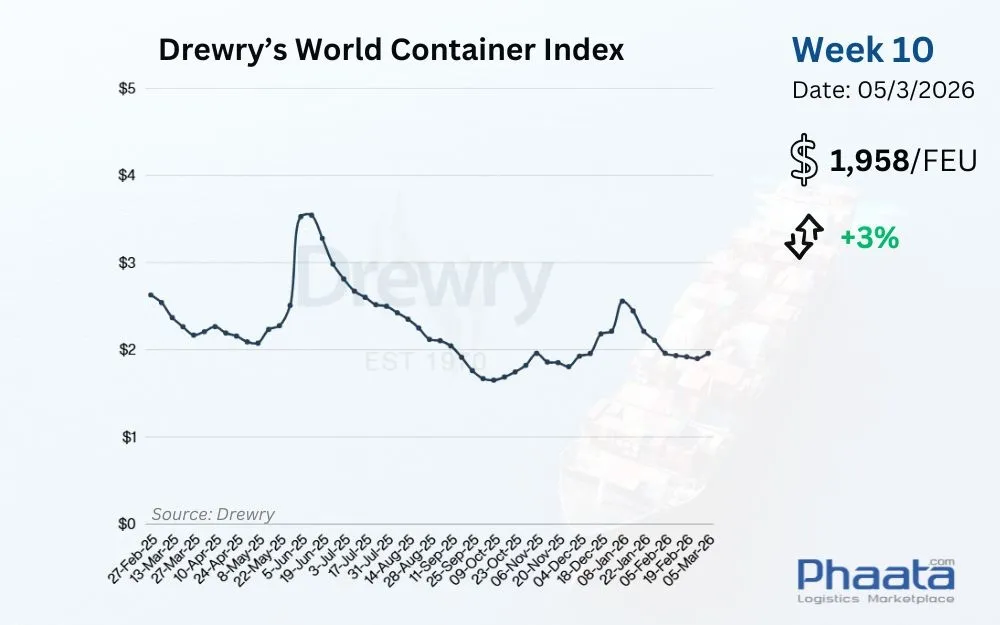
Drewry’s World Container Index (WCI) for Week 10/2026 (from Mar 2 to Mar 8, 2026) reversed its trend, increasing by 3% compared to the previous week to $1,958/FEU. This marks the first week rates have bounced back after seven consecutive weeks of decline.
Drewry's World Container Index Week 10/2026 (Photo: Phaata)
2. Asia-North America Ocean Freight Rates
The Asia - North America West Coast market in Week 10 recorded a massive supply-demand gap. Carriers' capacity injection surged from 80% to over 90%, concentrated primarily on services discharging at the US West Coast (USWC), while the volume of new bookings merely flatlined at pre-Lunar New Year levels.
Supply and Demand:
Demand Side:
Booking volumes from shippers continue to move sideways. Total current export volumes are only maintaining levels recorded just prior to the Lunar New Year holiday, with no new growth registered.
Supply Side:
Total capacity supply across the market has reached 80%, and according to allocation plans, this figure will rise to 90-95% in the coming weeks. The vast majority of these added vessels and empty slots will be concentrated on USWC services.
Conflicts in the Middle East are forcing carriers to withdraw assets from the region to ensure crew safety. While the Asia - North America West Coast route is not directly affected, this disruption causes container equipment imbalances, alters vessel rotations and personnel allocation, thereby indirectly delaying operational schedules and equipment supply on the trans-Pacific trade lane.
Rate Developments:
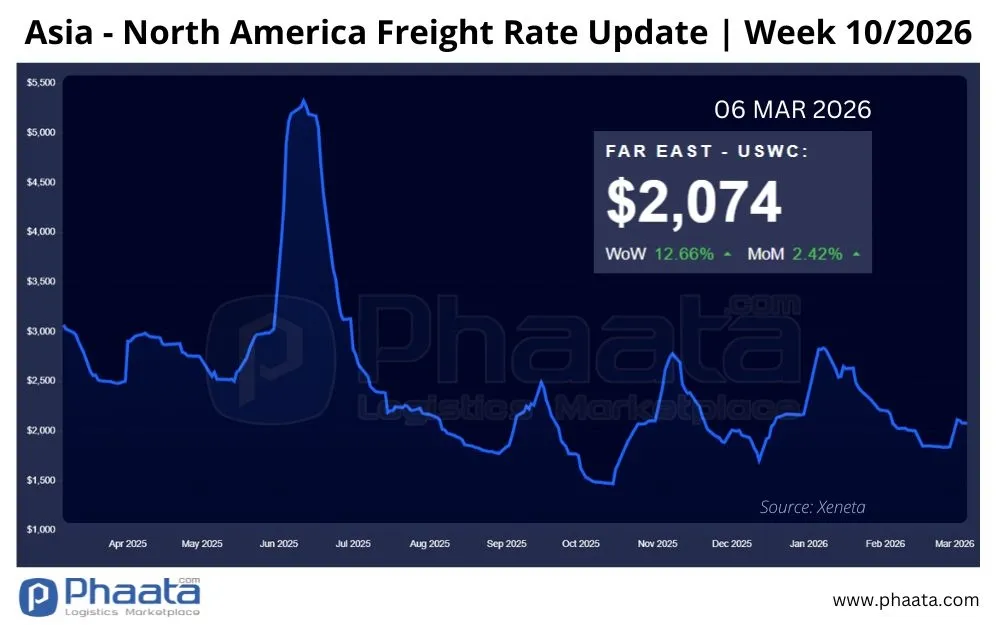
Ocean Freight rates from Asia to the North America West Coast in Week 10/2026 surged by 12.66% week-on-week, reaching $2,074/FEU. This rate is up 2.42% month-on-month, according to Xeneta data.
General Rate Increase (GRI): The GRI surcharge applied from early March is expected to be held steady by carriers until Mar 14. Simultaneously, carriers have issued notices that they will proceed with a second round of GRIs for shipments departing in the second half of March.
Peak Season Surcharge (PSS): Due to actual low export cargo volumes, carriers have been forced to push back the implementation of the PSS to the latter half of March. Based on current vessel utilization rates, this implementation timeline is likely to be pushed further into April.
Stay tuned to Phaata International Logistics Marketplace for in-depth and fast market updates.
Asia-North America Freight Rates | Week 10/2026 (Photo: Phaata.com)
US Tariff Updates:
1. Court Order on IEEPA Duty Refunds and Processing Operations
The US Court of International Trade (CIT) has officially ordered Customs and Border Protection (CBP) to refund all IEEPA duties. Specifically, CBP must liquidate unliquidated entries and re-liquidate "not final" entries without factoring in the IEEPA duties.
CBP is requesting the court allow a "review period" to cross-check other duties and fees (such as anti-dumping duties, Section 301, and Section 232 tariffs). This indicates CBP will drag out the refund process, with no immediate "automatic" refund mechanism in place. Stakeholders will hold a closed-door meeting on Mar 6 to finalize the plan.
US importers must immediately check their ACE (Automated Commercial Environment) system access and set up ACH (Automated Clearing House) accounts for receiving funds.
Direct Customs Brokers to audit all entries and check for "tariff stacking" errors.
Deadline Warning: Entries automatically finalize liquidation after 180 days. Businesses must urgently file a Protest for entries nearing the 180-day expiration to preserve their right to a refund.
2. Risk of Global Tariff (Section 122) Increasing to 15%
US Treasury Secretary Scott Bessent confirmed that the 10% global tariff (applied since Feb 24 under Section 122) is expected to be hiked to the 15% ceiling as early as this week.
The Section 122 tariff has a maximum validity of 150 days (expiring on July 24, 2026). To extend beyond this date, President Trump requires congressional approval.
The repeal of IEEPA tariffs and replacement with the 10% (or 15%) global tariff is causing many goods from the European Union (EU) to face a higher total tax burden than previously.
Scope of Section 122 Global Tariff Application:
- Exempt: Critical minerals, energy, agricultural products, USMCA-compliant goods (Canada, Mexico), and CAFTA-DR goods.
- In-transit Exemption: Only applies to cargo loaded onto the vessel before 12:01 AM on Feb 24 and completing customs clearance before 12:01 AM on Feb 28.
- Conflict with Section 232: Goods subject to Section 232 tariffs are exempt from the 10% global tariff. However, the non-metallic materials incorporated within steel, aluminum, iron, and copper products are still subject to the 10% tariff.
3. De Minimis Regulations Remain Suspended
The duty exemption for low-value goods (De Minimis) remains suspended under the new Executive Order.
Postal entries are now subject to the 10% global tariff instead of the previous flat rates ($80-$200/package) or IEEPA reciprocal tariffs. CBP continues to mandate the full customs entry filing process for this cargo group.
4. Geopolitical Risk: Threat of Embargo on Spain
A conflict has arisen regarding the use of military bases in Spain for Middle East operations.
On Mar 3, President Trump threatened to sever all trade with Spain. Although the US claimed Spain had conceded, the Spanish Foreign Minister immediately refuted this. The European Commission (EC) issued a message that it is ready to use the EU's common commercial policy to retaliate against the US if Spain is embargoed.
The US - Spain/EU commercial shipping route faces an extremely high risk of disruption in the near future.
5. The US Administration's New Post-IEEPA Tariff Toolkit
With IEEPA neutralized, businesses must prepare scenarios to cope with a more complex tariff matrix based on the following 4 legal tools:
Section 122: Currently in use (10% global tariff), a rapid response to balance of payments deficits, but limited to 150 days.
Section 301 (Unfair Trade Practices): The government is launching new investigations. This process will take months before long-term tariffs are applied.
Section 232 (National Security): Additional investigations are being expanded alongside the 9 existing ones. It will take several months for the Commerce Department to issue decisions.
Section 338 (Trade Discrimination): This is an unprecedented tool. The President has the authority to impose tariffs up to 50% on countries that discriminate against US commerce. Unlike Sections 301/232, Section 338 does not require formal agency investigations prior to enforcement. This is an imminent risk that the administration could use to levy retaliatory tariffs immediately.
Stay tuned to articles on the Phaata International Logistics Marketplace for rapid and in-depth market updates.
3. Asia-Europe Ocean Freight Rates
On supply and demand:
Demand: Cargo volumes are recovering very slowly post-Lunar New Year. Manufacturing plants in Asia are stepping up capacity gradually, leading to low short-term total export volumes. Economic growth in the Eurozone remains sluggish. Persistent inflation and weak consumer confidence indexes directly depress import order volumes.
Supply: Carriers are executing mass blank sailings to prevent an excess of vessel space. Vessel routing strategies are diverging. Many major carriers (like CMA CGM) decided to divert most Asia-Europe services around the Cape of Good Hope. The extended transit time from this route helps carriers burn off current excess capacity.
On Operations:
Suez Route Blocked: Escalating tensions in the Middle East have extinguished the possibility of reopening the maritime route via the Suez Canal. Carriers have established the Cape of Good Hope routing as the default operational plan. The extended transit times of this route are entirely neutralizing the excess vessel capacity in the market.
Soaring Insurance Costs: Marine insurance syndicates have moved to cancel war risk cover for the Persian Gulf and Gulf of Oman regions. Commercial vessels are forced to purchase specialized insurance packages at exorbitant premiums to transit this area.
Medium-term Risk Assessment: According to maritime safety standards, even if the conflict ceases, carriers will require an additional 6 months for trial runs and risk assessments before officially sending cargo ships back through the Red Sea region.
Congestion at transshipment hubs and destination ports is slowing down container turnaround times, causing severe connection delays. Specific yard utilization figures are as follows:
- Asian Transshipment: Container dwell times in Singapore have exceeded the 7-day mark. Yard density has hit 90%. Severe vessel bunching is occurring, dragging down crane productivity.
- European Destination Ports:
-
Rotterdam: Maasvlakte II (APMT MVII) has hit a ceiling of 90–95%; RWG is at 80–85%; ECT is at 75–80%.
-
Hamburg: Eurogate (CTH) is at 85-90%; HHLA (CTA) is at 80–85%.
-
Southampton: Yard utilization remains high at 85-90%.
Freight Rate Developments:
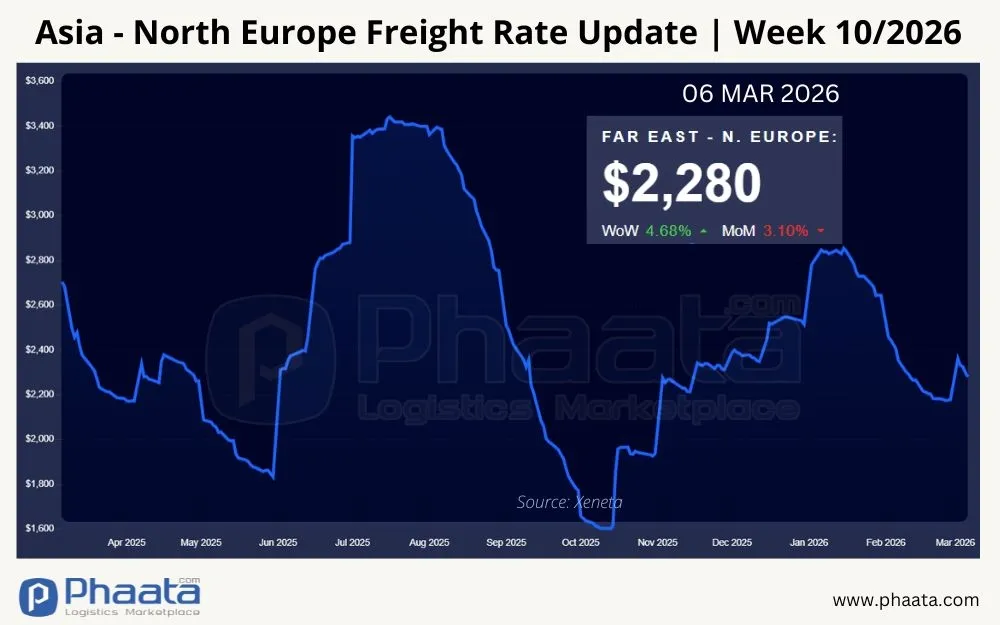
Ocean Freight rates from Asia to Europe in Week 10/2026 reversed trend, increasing by 4.68% week-on-week to $2,280/FEU. This rate is down 3.1% month-on-month, per Xeneta data.
Early March Rate Hikes Suspended: Due to low cargo volumes, carriers were forced to revise downward or cancel their Freight All Kinds (FAK) increase notices slated for the first half of March.
Cost Pressures in Late March: The de facto blockade of the Strait of Hormuz has triggered a global crude oil price surge. The sudden spike in bunker fuel costs, combined with war risk insurance premiums, is forcing carriers to urgently plan a new round of FAK rate hikes in the second half of March. The objective of this hike is to directly offset daily escalating operational costs, rather than being driven by cargo supply-demand dynamics.
Stay tuned to Phaata International Logistics Marketplace for in-depth and fast market updates.
Asia-Europe Freight Rates | Week 10/2026 (Photo: Phaata.com)
4. North America - Asia Ocean Freight Rates
Ocean Freight rates from North America (West Coast) to Asia in Week 10/2026 continued to decrease by 3.58% week-on-week, down to $592/FEU. This rate is down 2.79% month-on-month, according to Xeneta data.
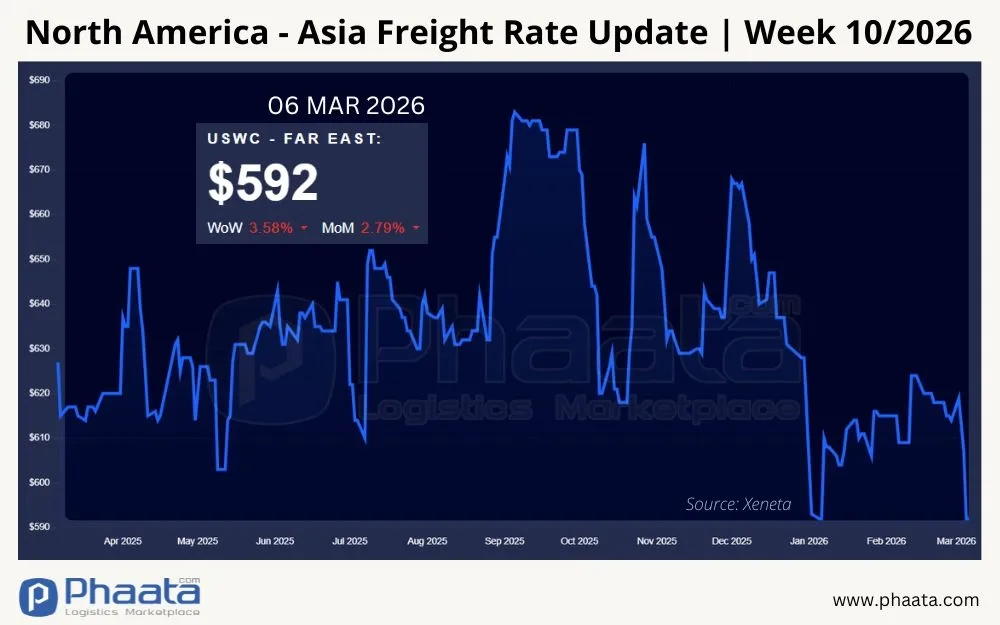
North America (West Coast) - Asia freight rates | Week 10/2026 (Photo: Phaata.com)
5. Northern Europe - Asia Ocean Freight Rates
Ocean Freight rates from North Europe to Asia in Week 10/2026 decreased by 2.86% week-on-week, down to $136/FEU. This rate is up 3.82% month-on-month, per Xeneta data.
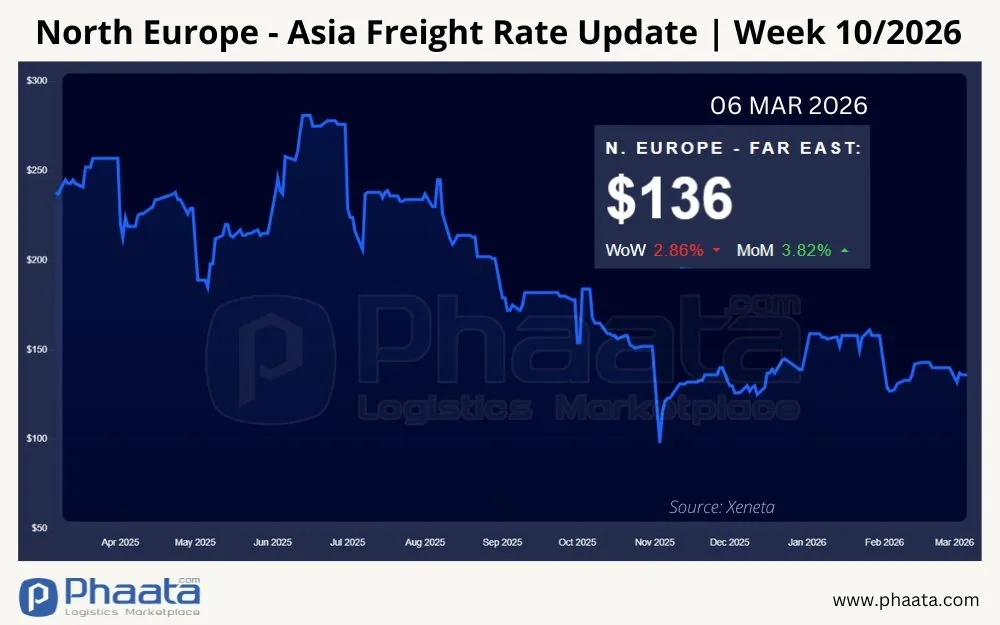
Container Freight rates from Northern Europe to Asia | Week 10/2026 (Photo: Phaata.com)
6. Conclusion and Recommendations from Phaata
Week 10 market data reveals three critical factors directly impacting logistics costs:
- Rate Reversals Disconnected from Supply-Demand: The WCI rose by 3% and North American rates surged by 12.66%, yet actual export volumes remained flat. The upward momentum stems from soaring bunker costs and war risk premiums in the Middle East, alongside carriers' efforts to anchor rates (GRI) ahead of Q2 contract negotiations.
- Persistent Infrastructure Bottlenecks: The Cape of Good Hope routing, combined with vessel bunching in Singapore and North Europe (yard density 85-95%), continues to slow down empty container turnarounds and inflate transit times.
- Massive Upheaval in US Customs Cost Structure: The opportunity to recover cash flow from the IEEPA refund order emerges in tandem with the risk of an immediate spike in import costs, as the Global Tariff (Section 122) could hit the 15% ceiling.
Recommendations from Phaata
To control risks and maintain supply chain schedules, businesses must execute the following operations immediately:
1. Freight and Transport Contract Negotiations:
North America Route: Capacity supply is extremely high (90-95%). Shippers have the leverage to reject the implementation of the second-round GRI at the end of March and refuse Peak Season Surcharges (PSS) until cargo volumes tangibly increase.
Europe Route: For export shipments in the second half of March, demand your Forwarder or carrier clearly separate the Bunker Adjustment Factor (BAF) and War Risk Surcharge (WRS) from the base rate (FAK). Clarifying this cost structure prevents opaque, bundled rate hikes.
2. Operations and Warehousing:
Control Demurrage/Detention Risks: Yard density in Singapore and Rotterdam (especially at APMT MVII) is at critical levels. Request transport partners to grant extended Free time (demurrage and detention) at destination ports—from 14 to 21 days on new bookings—to offset processing wait times at the port.
3. Financial and Customs Procedures (US Market):
Execute IEEPA Refund Rights: Task your customs broker to immediately audit IEEPA entries. It is mandatory to file a Protest instantly for entries nearing the 180-day mark from liquidation to block the risk of automatic finalization, ensuring the right to recover cash flow.
Update Cost of Goods Sold (COGS): Immediately apply the Section 122 tariff (currently 10%, with a contingency for a 15% hike) into your Landed Cost spreadsheets. Transition the filing method for postal/parcel goods (previously using De Minimis) to standard customs entry procedures to comply with the new CBP regulations.
Stay tuned to articles on Phaata.com or Phaata fanpage for rapid and in-depth market updates.
Find Freight Rates Here
Find Logistics Companies Here
See more:
- India: 95% of Trade Dependent on Foreign Fleets and the Ambition to Turn the Tide
- West Asia Tensions: Indian Exporters and Shipping Lines in Heated Standoff Over 'War Surcharges'
- Tanger Med Port Rises to Strategic Hub Status Amid Global Maritime Crisis
- Rate Volatility: CMA CGM Announces Sweeping Adjustments to FAK Rates and Peak Season Surcharges Across Major Trade Lanes
- Carriers Impose $4,000/FEU Surcharge in the Middle East: Indian Exporters Appeal to Government for Help
- The Cape of Good Hope Route: Becoming the 'New Normal' for Global Shipping?
- Middle East Crisis: MSC Declares Emergency "End of Voyage" for Gulf-Bound Cargo, Imposes $800 Surcharge
- COSCO schedules: Vietnam - North America in Mar 2026
- SITC updates Vietnam-Intra Asia sailing schedules in Mar 2026
- Iran Crisis Triggers Energy Shock: Global Oil and Gas Prices Soar, Maritime Transport Paralyzed
- Hormuz Crisis: 10% of Global Container Fleet Stranded, Risking Severe Supply Chain Disruption
- International Shipping and Logistics Market Update Week 9/2026 | Phaata
- Red Sea Crisis Returns: Nigerian Shippers Brace for a Wave of Vessel Rerouting and Surging Freight Rates
- Qatar Airways Cargo Suspends All Flights Amidst Doha Airspace Closure
Source: Phaata - Vietnam's First International Logistics Marketplace
► Find Better Freight Rates & Logistics Service Providers!


Featured News
- Hapag-Lloyd applies Peak Season Surcharge from East Asia to USA and Canada
- The world\'s largest container ships MSC Irina and MSC Loreto floated
- MSC (Mediterranean Shipping Company) - The world\'s leading container shipping lines
- Information you need to know about Maersk Line
- Top 10 export and import goods between Vietnam - Philippines in the first 5 months of 2020

 Market News
See more
.webp)
.webp)
.webp)
.webp)

 HOT PROMO
See more
1353
 FCL
FCL
 12 Days
 Freight cost

Compass Logistics
 Premium
2298
FCL
12 Days
Freight cost
Premium
2298
FCL
12 Days
Freight cost

ASIAN EXPRESS LINE VIETNAM ( AEL VIET NAM )
4132
FCL
5 Days
Freight cost

CÔNG TY TNHH VẬN CHUYỂN QUỐC TẾ N.B.L
4438
FCL
20 Days
Freight cost

N.B.L INTERNATIONAL TRANSPORT CO., LTD
4965
FCL
21 Days
Freight cost
MG LOGISTICS JSC
Why do thousands of businesses trust Phaata?
USERS/MONTH
LOGISTICS COMPANIES
REQUEST FOR QUOTEŚ
QUOTATIONS
VIETNAM LOGISTICS COMMUNITY
5 Steps to Get the Best Quote
Find a price quickly/Send a RFQ
Compare multiple options
Contact for Further Consultation
Negotiating prices/services
Management & rating
 Freight rates
Sea freight
- FCL
See more
116
32
Days Direct
- ₫162,747,450 / 20'GP
- ₫185,241,000 / 40'HQ
Compass Logistics
Premium
73
25
Days Transit
- ₫60,494,418 / 20'GP
- ₫108,127,818 / 40'GP
- ₫108,127,818 / 40'HQ

CÔNG TY TNHH GRAND OCEAN LINE VIỆT NAM
77
35
Days Transit
- ₫185,310,000 / 20'GP
- ₫221,850,000 / 40'GP
- ₫221,850,000 / 40'HQ

CÔNG TY TNHH HP TOÀN CẦU
138
12
Days Transit
- ₫60,600,270 / 20'GP

GIA LINH LOGISTICS SERVICES CO., LTD. (G LINK Logistics)
135
25
Days Direct
- ₫179,948,400 / 40'HQ

CÔNG TY TNHH LIÊN VẬN QUỐC TẾ SHINING OCEAN VIỆT NAM
Sea freight
- LCL
See more
2,536
 3,542
5
Days Direct
3,542
5
Days Direct
- ₫26,463 /cbm

CÔNG TY TNHH T&M FORWARDING - CHI NHÁNH HÀ NỘI
4,794
3
Days Direct
- Refund ₫926,205 /cbm

CÔNG TY CỔ PHẦN GIAO NHẬN VẬN TẢI HỒNG SƠN
5,259
4,265
3
Days Direct
- ₫132,315 /cbm

CÔNG TY TRÁCH NHIỆM HỮU HẠN DT LOGISTICS (VN)
 Air freight
- General cargo
Air freight
- General cargo
See more
5,425
1
Days Direct
- 46,310 ₫/kg
N.B.L INTERNATIONAL TRANSPORT CO., LTD
7,060
1
Days Direct
- 161,424 ₫/kg
CÔNG TY CỔ PHẦN GIAO NHẬN VẬN TẢI HỒNG SƠN
9,528
10
Days Transit
- 264,630 ₫/kg

Phoenix Logistics Vietnam - chi nhánh TP. Hồ Chí Minh (Phoenix International Forwarding Vietnam )
11,064
1
Days Direct
- 185,241 ₫/kg

CÔNG TY TNHH THƯƠNG MẠI VÀ DỊCH VỤ FASTRANS
9,834

 Rail freight
- FCL
Rail freight
- FCL
See more
6,737
5
Days Direct
- ₫44,987,100 / 40'HQ
- ₫44,987,100 / 45'HQ

CÔNG TY TNHH PHƯỚC TÁ
9,410
3
Days Direct
- ₫15,083,910 / 40'HQ

CÔNG TY CỔ PHẦN VẬN TẢI VÀ THƯƠNG MẠI ĐƯỜNG SẮT
19,291
7
Days Direct
- ₫48,956,550 / 20'GP

Công ty TNHH T&M Forwarding
17,896
5
Days Direct
- ₫7,145,010 / 20'GP
ASIAN EXPRESS LINE VIETNAM ( AEL VIET NAM )
10,751
10
Days Direct
- ₫9,262,050 / 20'GP

CÔNG TY CỔ PHẦN LOGISTICS QUỐC TẾ V&T
 Road freight
- FCL
Road freight
- FCL
See more
2,677
 9,916
1
Day
9,916
1
Day
- ₫28,000,000 / 20'GP
- ₫28,000,000 / 40'GP

CÔNG TY TNHH THƯƠNG MẠI DỊCH VỤ VÀ KHO VẬN VIETTEL POST - TTC
110,779
2
Day
- ₫6,500,000 / 40'RF
- ₫6,500,000 / 40'RQ
- ₫6,500,000 / 45'RQ

CÔNG TY CP PROSHIP
Premium
179,164
1
Day
- ₫18,997,200 / 20'GP
- ₫18,997,200 / 40'GP

CÔNG TY CỔ PHẦN GIAO NHẬN VẬN TẢI CON ONG
266,741
3
Day
- ₫32,000,000 / 20'GP
- ₫64,000,000 / 40'GP
- ₫64,000,000 / 40'HQ
- ₫64,000,000 / 45'HQ

Công ty Cổ phần phát triển thương mại Thuận Đạt Việt Nam


