


Monday, 14/09/2026, 09:23 (GMT +7)
 1229
1229
International Shipping and Logistics Market Update Week 37/2026 | Phaata

International shipping and logistics market update - Week 37/2026
Table of Contents
-
World Container Index Week 37/2026
-
Asia - North America Ocean Freight Rates
-
Asia - Europe Ocean Freight Rates
-
Northern America - Asia Ocean Freight Rates
-
Northern Europe - Asia Ocean Freight Rates
-
Conclusions and Recommendations by Phaata
1. World Container Index Week 37/2026
Drewry’s World Container Index (WCI) for Week 37/2026 (from September 7 to September 13, 2026) edged up by 0.25% compared to the previous week, reaching $4,476/FEU.
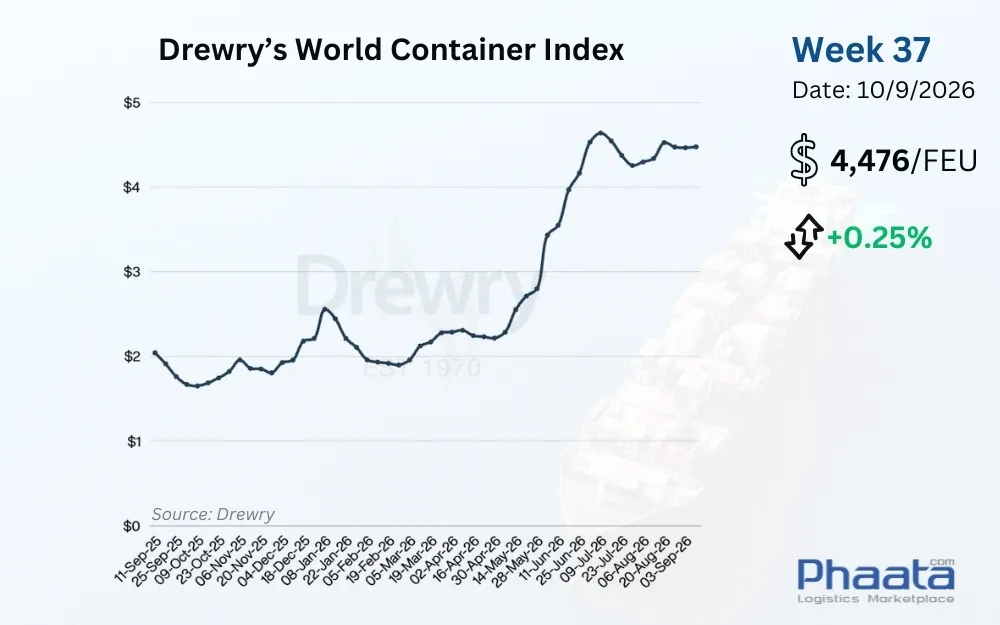
Drewry's World Container Index Week 37/2026 (Photo: Phaata)
2. Asia-North America Ocean Freight Rates
Supply and Demand:
Capacity Coordination and Golden Week Signals: Carriers currently maintain operational levels at near 100% of design capacity, with the blank sailing ratio held below 1% through mid-September. However, this status quo may shift as carriers begin adjusting operational plans for the Golden Week period. Early signals indicate that capacity cuts could intensify during and immediately following the holiday, thereby impacting capacity supply on the trade lane in October.
Origin Port Bottlenecks: The primary constraint on actual capacity supply currently stems not from blank sailings, but from port congestion. Ongoing operational disruptions in Shanghai and Ningbo continue to impede cargo turnaround speeds, prolonging vessel operational times and exacerbating schedule volatility.
Panama Canal Updates: Amid improved rainfall in certain regions, the Panama Canal Authority has deferred the implementation of tighter draft limits, temporarily easing pressure on vessel payload capabilities. Nevertheless, the daily transit quota remains capped at 34 vessels and is slated to drop further to 32 transits per day. Concurrently, canal-related surcharges are scheduled to be adjusted to a new baseline effective September 15.
Rate Developments:
Ocean freight rates from Asia to the North America West Coast in Week 37/2026 increased by 3.11% week-on-week, reaching $7,761/FEU. This rate is up 11.40% month-on-month, according to Xeneta data.
Spot Rates Sustain Upward Trend: The spot rate index on the Asia-U.S. corridor continues its upward trajectory across both the East and West Coasts. This trend is sustained as capacity supply remains constrained by congestion at several critical origin and transshipment ports, thereby continuing to exert upward pressure on the spot rate baseline.
Stay tuned to Phaata International Logistics Marketplace for in-depth and fast market updates.
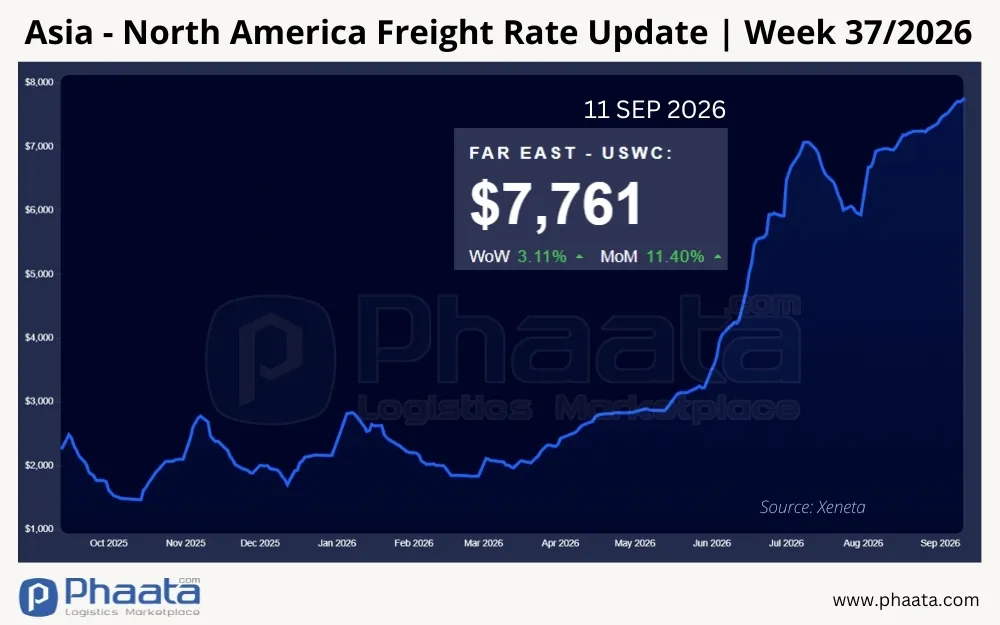
Asia-North America Freight Rates | Week 37/2026 (Photo: Phaata.com)
US Tariff Updates:
1. Activation of Import Ban on Select Canadian Commodity Groups (Effective Sept 29)
Expanding Trade Measure Tools: Alongside tariff measures, the White House recently issued a series of executive orders imposing outright import bans on specific commodity groups originating from Canada. According to preliminary assessments by trade analysts, this marks the first time the executive branch has deployed an outright import ban under the legal framework of Section 338, covering an estimated $1 billion worth of goods.
Applicable Commodity Groups:
-
Motor Vehicles: Banning imports of motorcycles with a cylinder capacity exceeding 800cc.
-
Agriculture and Food: Whey, molasses, and non-alcoholic beer are subject to the ban.
-
Alcoholic Beverages (by packaging): The regulation applies to beer, brandy, rum, and wine in direct-to-consumer packaging, including cans, bottles, kegs, and boxes. Shipments imported via pumps, vats, or bulk containers are exempt.
2. Expansion of Section 338 Scope and Tariff Stacking Risks (Effective Sept 15)
Expanding the 50% Tariff Roster: Parallel to the import ban, the U.S. administration continues to expand the list of Canadian goods subject to a 50% tariff under Section 338. New additions include cheese, animal hides, motorboats, outboard motors, paper products, electrodes, signage, golf carts, furniture, mattresses, and LED lights.
Tax Stacking Mechanism:
-
Metals (Aluminum and Steel): Aluminum extrusions, bars, billets, tubes, alongside iron and steel poles, pillars, and beams, have been added to the Section 338 list but do not qualify for exemption from existing Section 232 duties. Consequently, the combined rate could reach up to 100%, drastically inflating import costs for these raw materials.
-
Unmanned Aircraft Systems (UAS) Components: Drone components previously granted temporary exemption from Section 338 because they were already subject to Section 232 no longer qualify for this waiver. Shipments in this category may face a stacking mechanism pushing total tariffs up to 150%.
Duty Exemption Updates: As of September 15, table salt is excluded from Section 338 applicability. For whiskey and liqueurs/cordials, only shipments transported in containers exceeding 4 liters are duty-exempt; smaller packaging formats remain subject to the 50% tariff.
Stay tuned to articles on the Phaata International Logistics Marketplace for rapid and in-depth market updates.
3. Asia-Europe Ocean Freight Rates
Supply and Demand:
Capacity Maintenance and Long-Term Outlook: Carriers are currently maintaining operational levels at near 100% of design capacity, with the blank sailing ratio sitting near 0% across most of the forecast cycle. A notable signal for capacity adjustment appears in mid-October, with an expected cut of approximately 16%. However, given the extended timeframe, this adjustment remains fluid and subject to change based on booking velocities and actual market demand.
Schedule Risks at Origin and Destination Ports: At origin ports, cascading effects from operational disruptions across the Chinese port system continue to fuel the risk of vessel delays. At destination ports, ongoing labor strikes in parts of North Europe are mounting pressure on schedule reliability at key gateways, including Rotterdam, Amsterdam, Hamburg, and Zeeland.
Suez Rerouting Scope Expands: The phased resumption of Suez Canal transits by select carriers is broadening the array of transit time options for shippers. The advantage of shorter transit times is now being applied more widely across certain services. However, the extent of deployment still varies among carriers and service loops; therefore, businesses must evaluate routing specifically by port rotation and operational schedule.
Freight Rate Developments:
Ocean freight rates from Asia to Europe in Week 37/2026 dropped by 5.07% week-on-week, settling at $4,140/FEU. This rate represents a 14.60% decrease month-on-month, according to Xeneta data.
Spot Rates Continue Downward Trend: Spot rates from Asia to North Europe and the Mediterranean continue their descent, prolonging the cooling trend that emerged in late July.
Rising Supply Adds Pressure to the Rate Baseline: The decline in spot rates during this period reflects not only a demand correction but also significant supply-side impacts. The gradual restoration of the Suez routing is shortening vessel turnarounds, thereby injecting additional operational capacity back into the market. This improvement in actual capacity supply is compounding downward pressure on the rate baseline, even in the absence of a substantial shift in booking volumes.
Stay tuned to Phaata International Logistics Marketplace for in-depth and fast market updates.
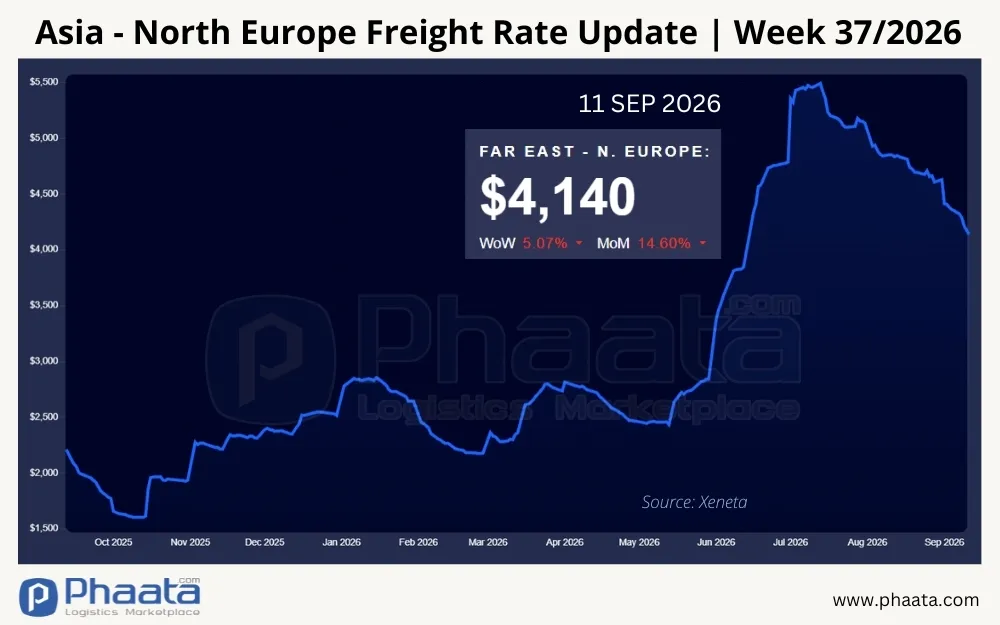
Asia-Europe Freight Rates | Week 37/2026 (Photo: Phaata.com)
4. North America - Asia Ocean Freight Rates
Ocean freight rates from North America (West Coast) to Asia in Week 37/2026 decreased by 3.30% week-on-week, down to $703/FEU. This rate is up 0.29% month-on-month, according to Xeneta data.
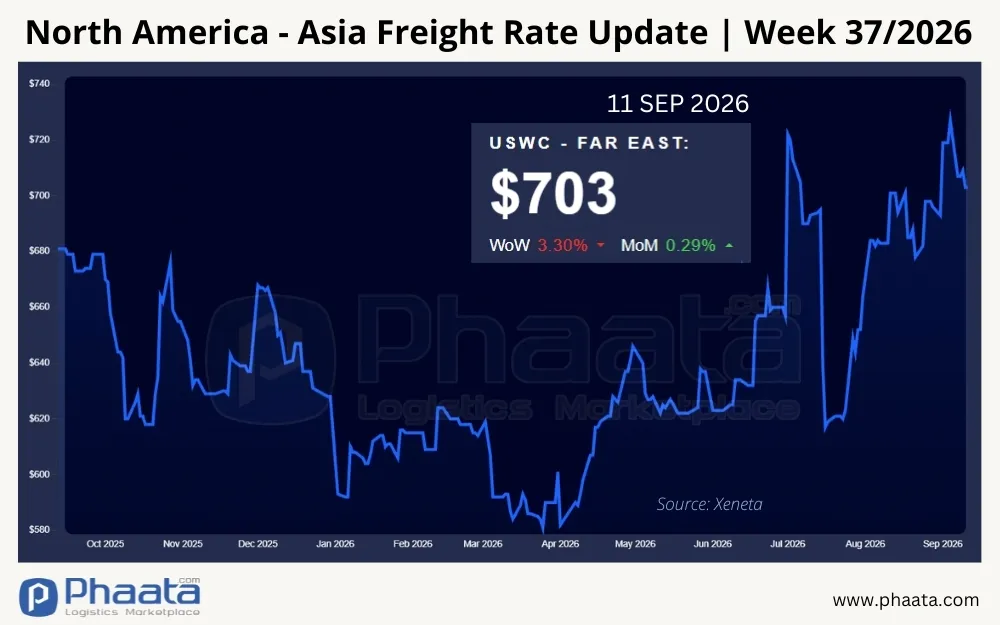
North America (West Coast) - Asia freight rates | Week 37/2026 (Photo: Phaata.com)
5. Northern Europe - Asia Ocean Freight Rates
Ocean freight rates from North Europe to Asia in Week 37/2026 increased by 8.76% week-on-week, reaching $236/FEU. This rate is down 10.61% month-on-month, per Xeneta data.
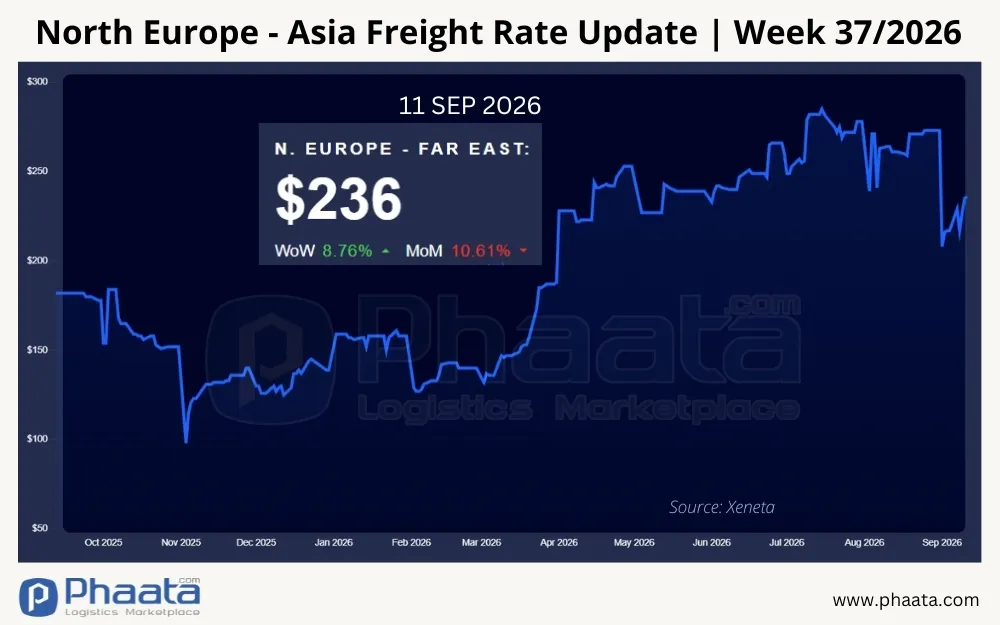
Container Freight rates from Northern Europe to Asia | Week 37/2026 (Photo: Phaata.com)
6. Conclusion and Recommendations from Phaata
The global logistics market in Week 37/2026 continues to exhibit a stark divergence in rate baselines and operational conditions across the two primary East-West trade corridors. The composite WCI index ticked up slightly by 0.25% to $4,476/FEU, but intra-trade dynamics remain highly differentiated:
Trans-Pacific Route (Asia - North America): Upward rate pressure holds firm, pushing West Coast spot rates to $7,761/FEU. This momentum stems not primarily from blank sailings (currently under 1%), but from the significant degradation of actual capacity supply caused by congestion at Shanghai and Ningbo. Furthermore, Panama Canal transits remain capped at 34 vessels per day—with a projected cut to 32—while canal-related surcharges adjusted to a new baseline effective September 15. These factors continue to exert pressure on both costs and transit times for USEC-bound cargo.
Far East - West Europe Route: Market dynamics remain more favorable for shippers as spot rates dropped 5.07% to $4,140/FEU. The phased resumption of Suez Canal transits by some carriers and alliances is injecting capacity back into the market by accelerating vessel turnarounds. This supply-side factor is adding downward pressure on the rate baseline, though the risk of schedule disruptions due to strikes at several North European ports requires ongoing monitoring.
North American Trade Compliance Risks: Shifts in US-Canada trade policy are expanding impact perimeters from tariffs to outright import controls on specific commodity groups. The import ban effective September 29 on select Canadian goods, coupled with a tariff stacking mechanism that could push total duties to 100% - 150% on certain aluminum, steel, and UAS components, threatens to drastically alter the COGS structures of supply chains tied to the North American market.
Recommendations from Phaata
Proactive Space Preparation Ahead of Golden Week:
Early Booking: Businesses should consider locking in bookings for October export shipments earlier than usual. Market signals suggest blank sailing ratios could spike during and after the Chinese holiday. Proactively securing early bookings can mitigate rollover risks and associated retention costs.
Integrate Buffer Margins: For containers routing through Shanghai and Ningbo, logistics departments should consider adding approximately 5–7 days to cargo-ready dates, contingent upon schedule stability and port operational status. This buffer can provide businesses with critical flexibility against the risk of congestion-induced vessel delays.
Flexible Cargo Routing:
North American Corridor: For USEC and Gulf Coast shipments utilizing an all-water route via the Panama Canal, businesses must verify and secure transit slots prior to finalizing transport plans. Should canal transit conditions fail to meet schedule requirements, shippers can evaluate diverting cargo through West Coast port clusters, combined with inland rail and road transport, as a viable alternative.
European Corridor: For shipments calling at Rotterdam, Amsterdam, Hamburg, and Zeeland, businesses should factor additional buffer time into transport and delivery schedules. Closely monitoring strike developments and updating operational schedules at destination ports will enable shippers to proactively adapt their strategies when necessary.
US-Canada COGS and Legal Risk Management:
Audit Import-Restricted Shipments: Procurement departments must audit orders originating from Canada involving motorcycles over 800cc, retail-packaged alcoholic beverages, whey, and molasses, particularly for shipments slated to arrive at U.S. ports from September 29 onward. Early auditing empowers businesses to proactively adjust purchasing and transport plans if goods fall under the ban's scope.
Update Landed Costs: For importers of aluminum, steel, and UAS components from Canada, businesses should remodel their landed costs based on the potential application of stacked tariff mechanisms. If import costs threaten to significantly impact business performance, companies should further explore supply diversification strategies outside the North American market.
Stay tuned to articles on Phaata.com or Phaata fanpage for rapid and in-depth market updates.
Find Freight Rates Here
Find Logistics Companies Here
See more:
- US-Iran Conflict Puts Growing Pressure on Maritime Operations in the Strait of Hormuz
- 18 Maritime Nations Warn of a “Structural Shift” in Global Trade
- Rotterdam World Gateway Completes €500 Million Financing for Expansion Project
- Maersk Updates PSS for Mediterranean–North America Trade
- Hapag-Lloyd and FIMI Given 30 More Days to Restructure ZIM Deal
- International Shipping and Logistics Market Update Week 36/2026 | Phaata
- Maersk and ONE Hike Environmental Surcharges on Asia–Europe Trades Effective October 2026
- German Seaports: Over 6,000 Port Workers Reject ZDS's 5.1% Wage Offer; Threat of Fresh Strikes Remains on the Table
- Port Strike in the Netherlands on September 4: Rotterdam Could Face Nearly Eight Hours of Disrupted Vessel Handling
- COSCO schedules: Vietnam - North America in Sep 2026
- SITC updates Vietnam-Intra Asia sailing schedules in Sep 2026
Source: Phaata - Where Shippers & Logistics Providers Connect
► Find Better Freight Rates & Logistics Service Providers!


Featured News
- Hapag-Lloyd applies Peak Season Surcharge from East Asia to USA and Canada
- The world\'s largest container ships MSC Irina and MSC Loreto floated
- MSC (Mediterranean Shipping Company) - The world\'s leading container shipping lines
- Information you need to know about Maersk Line
- Top 10 export and import goods between Vietnam - Philippines in the first 5 months of 2020

 Market News
See more
.webp)
.webp)
.webp)
.webp)
.webp)

 HOT PROMO
See more
379
 FCL
FCL
 12 Days
 Freight cost

Compass Logistics
 Premium
953
FCL
12 Days
Freight cost
Premium
953
FCL
12 Days
Freight cost

ASIAN EXPRESS LINE VIETNAM ( AEL VIET NAM )
2037
FCL
6 Days
Freight cost

CÔNG TY CỔ PHẦN TIẾP VẬN INTERCARGO
2845
FCL
5 Days
Freight cost

CÔNG TY TNHH VẬN CHUYỂN QUỐC TẾ N.B.L
3825
FCL
20 Days
Freight cost

N.B.L INTERNATIONAL TRANSPORT CO., LTD
Why do thousands of businesses trust Phaata?
USERS/MONTH
LOGISTICS COMPANIES
REQUEST FOR QUOTEŚ
QUOTATIONS
VIETNAM LOGISTICS COMMUNITY
5 Steps to Get the Best Quote
Find a price quickly/Send a RFQ
Compare multiple options
Contact for Further Consultation
Negotiating prices/services
Management & rating
 Freight rates
Sea freight
- FCL
See more
386
5
Days Direct
- ₫12,966,870 / 20'GP

GIA LINH LOGISTICS SERVICES CO., LTD. (G LINK Logistics)
543
14
Days Transit
- ₫4,366,395 / 20'GP
- ₫9,658,995 / 40'HQ

CÔNG TY TNHH GIAO NHẬN TOÀN CẦU GS
1,003
37
Days Transit
- ₫70,920,840 / 20'GP
- ₫104,396,535 / 40'GP
- ₫104,396,535 / 40'HQ

Công Ty TNHH Quanterm Logistics Vietnam
1,071
9
Days Direct
- ₫4,366,395 / 20'GP
- ₫7,938,900 / 40'GP
- ₫7,938,900 / 40'HQ

CÔNG TY TNHH SEAIR LINKS
1,094
12
Days Transit
- ₫6,120,960 / 20'GP
- ₫7,651,200 / 40'GP
- ₫7,651,200 / 40'HQ
ASIAN EXPRESS LINE VIETNAM ( AEL VIET NAM )
Sea freight
- LCL
See more
1,754
 2,600
5
Days Direct
2,600
5
Days Direct
- ₫26,463 /cbm

CÔNG TY TNHH T&M FORWARDING - CHI NHÁNH HÀ NỘI
3,922
3
Days Direct
- Refund ₫926,205 /cbm

CÔNG TY CỔ PHẦN GIAO NHẬN VẬN TẢI HỒNG SƠN
4,406
3,951
3
Days Direct
- ₫132,315 /cbm

CÔNG TY TRÁCH NHIỆM HỮU HẠN DT LOGISTICS (VN)
 Air freight
- General cargo
Air freight
- General cargo
See more
4,775
1
Days Direct
- 46,310 ₫/kg
N.B.L INTERNATIONAL TRANSPORT CO., LTD
6,278
1
Days Direct
- 161,424 ₫/kg
CÔNG TY CỔ PHẦN GIAO NHẬN VẬN TẢI HỒNG SƠN
8,832
10
Days Transit
- 264,630 ₫/kg

Phoenix Logistics Vietnam - chi nhánh TP. Hồ Chí Minh (Phoenix International Forwarding Vietnam )
10,386
1
Days Direct
- 185,241 ₫/kg

CÔNG TY TNHH THƯƠNG MẠI VÀ DỊCH VỤ FASTRANS
9,673

 Rail freight
- FCL
Rail freight
- FCL
See more
6,110
5
Days Direct
- ₫44,987,100 / 40'HQ
- ₫44,987,100 / 45'HQ

CÔNG TY TNHH PHƯỚC TÁ
8,657
3
Days Direct
- ₫15,083,910 / 40'HQ

CÔNG TY CỔ PHẦN VẬN TẢI VÀ THƯƠNG MẠI ĐƯỜNG SẮT
18,643
7
Days Direct
- ₫48,956,550 / 20'GP

Công ty TNHH T&M Forwarding
17,272
5
Days Direct
- ₫7,145,010 / 20'GP
ASIAN EXPRESS LINE VIETNAM ( AEL VIET NAM )
10,621
10
Days Direct
- ₫9,262,050 / 20'GP

CÔNG TY CỔ PHẦN LOGISTICS QUỐC TẾ V&T
 Road freight
- FCL
Road freight
- FCL
See more
2,014
 8,932
1
Day
8,932
1
Day
- ₫28,000,000 / 20'GP
- ₫28,000,000 / 40'GP

CÔNG TY TNHH THƯƠNG MẠI DỊCH VỤ VÀ KHO VẬN VIETTEL POST - TTC
109,861
2
Day
- ₫6,500,000 / 40'RF
- ₫6,500,000 / 40'RQ
- ₫6,500,000 / 45'RQ

CÔNG TY CP PROSHIP
Premium
178,300
1
Day
- ₫18,997,200 / 20'GP
- ₫18,997,200 / 40'GP

CÔNG TY CỔ PHẦN GIAO NHẬN VẬN TẢI CON ONG
266,249
3
Day
- ₫32,000,000 / 20'GP
- ₫64,000,000 / 40'GP
- ₫64,000,000 / 40'HQ
- ₫64,000,000 / 45'HQ

Công ty Cổ phần phát triển thương mại Thuận Đạt Việt Nam


