


Sunday, 12/04/2026, 16:00 (GMT +7)
 1370
1370
International Shipping and Logistics Market Update Week 15/2026 | Phaata
International shipping and logistics market update - Week 15/2026
Table of Contents
-
World Container Index Week 15/2026
-
Asia - North America Ocean Freight Rates
-
Asia - Europe Ocean Freight Rates
-
Northern America - Asia Ocean Freight Rates
-
Northern Europe - Asia Ocean Freight Rates
-
Conclusions and Recommendations by Phaata
1. World Container Index Week 15/2026
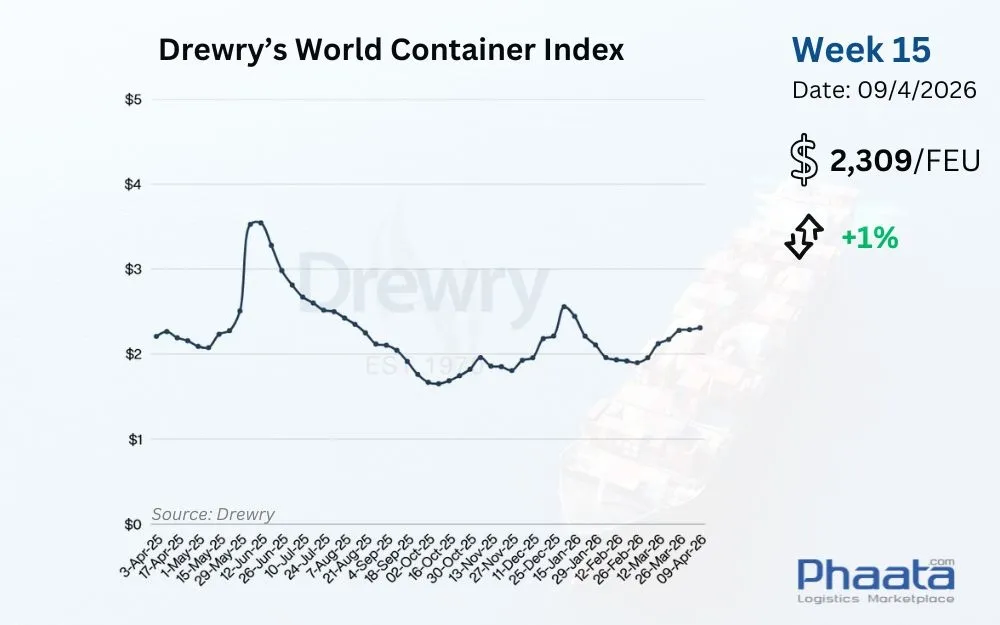
Drewry’s World Container Index (WCI) for Week 15/2026 (from April 6 to April 12, 2026) increased slightly compared to the previous week, settling at $2,309/FEU. This marks the fifth week of gains following a single week of leveling off.
Drewry's World Container Index Week 15/2026 (Photo: Phaata)
2. Asia-North America Ocean Freight Rates
Supply and Demand:
Demand Side:
Total import cargo volumes into the North American market have continued to record actual growth momentum in recent weeks.
Supply Side:
Carriers are aggressively pushing blank sailing programs with schedules extending from April through the first half of May. The focus of this capacity withdrawal is directly aimed at services discharging on the US East Coast (USEC) and the Pacific Northwest (PNW).
Operations:
The combination of growing cargo volumes (demand) and the proactive tightening of space (supply) has markedly improved vessel utilization rates on active sailings.
Rate Developments:
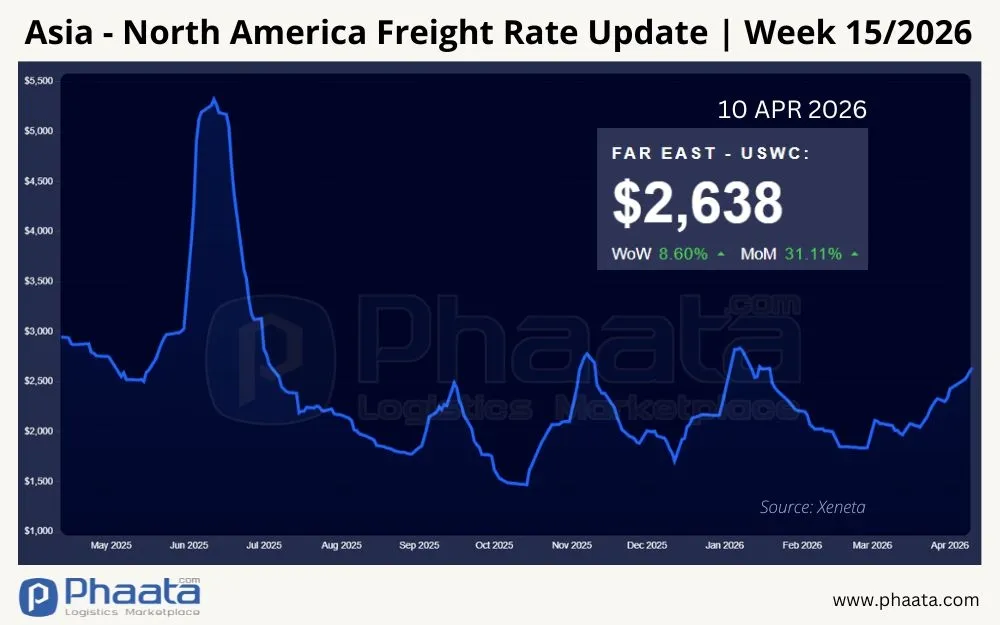
Ocean Freight rates from Asia to the North America West Coast in Week 15/2026 increased by 8.6% week-on-week, reaching $2,638/FEU. This rate is up 31.11% month-on-month, according to Xeneta data.
Carriers continue to apply a raft of new surcharges:
General Rate Increase (GRI): Carriers officially enforced the second round of GRI surcharges for the month on April 8, following on the heels of the previous rate hike on April 1.
Bunker Surcharges (EBS & IFS): The Emergency Bunker Surcharge (EBS), offsetting costs for the ocean freight leg, has officially taken effect. Concurrently, carriers will activate the Intermodal Fuel Surcharge (IFS) to offset diesel price differentials for intermodal movements (rail/truck), officially applying from April 17.
Peak Season Surcharge (PSS) Delayed: The simultaneous application of fuel surcharges (EBS and IFS) has pushed total transport costs in April to exceptionally high levels. Consequently, carriers are forced to postpone the activation of the PSS to May 1.
Stay tuned to Phaata International Logistics Marketplace for in-depth and fast market updates.
Asia-North America Freight Rates | Week 15/2026 (Photo: Phaata.com)
US Tariff Updates:
1. Risk of Prolonged IEEPA Refund Timelines
Change in Core Legal Profile: The Court of International Trade (CIT) has switched the lead plaintiff in the IEEPA refund lawsuit to Euro-Notions Florida (following the withdrawal of the previous plaintiff on April 6). Judge Richard Eaton re-issued the order compelling Customs and Border Protection (CBP) to refund IEEPA duties across all entry groups: unliquidated, not finally liquidated, and finally liquidated.
Appeal Deadline Reset: The re-issuance of this court order creates a major risk. The 60-day window for the US Government to file an appeal has been reset. The new deadline has been pushed from May 6 to June 7, 2026. This grants the administration an additional month to prepare legal filings aimed at narrowing the scope of refunds.
CAPE System Progress: CBP will utilize Euro-Notions Florida's entry data to beta-test Phase 1 of the automated refund system (CAPE), slated to launch as early as April 20. Current module progress: Filing Portal (85%); Mass Recalculation (60%); Liquidation (80%); and Disbursement Processing (75% - undergoing testing).
Mandatory Operations: Due to the elevated appeal risk and the fact that a wide range of entry types (Drawback, AD/CVD entries) are excluded from CAPE Phase 1, the import-export department MUST maintain the manual filing of Protests for all entries to lock in refund rights. Simultaneously, immediately set up an Automated Clearing House (ACH) account in the ACE system.
2. Official Application of Amended Section 232 Tariffs (Steel, Aluminum, Copper)
Starting April 6, 2026, the new tariff structure for metals and derivative products officially takes effect, completely altering the Landed Cost:
Core Change: The tariff rate is calculated on 100% of the total import value of the finished product, no longer assessed solely on the proportion of metal content.
Applicable Rates:
-
Flat 50%: Applied to the majority of metal items under Chapters 72 through 76 (HTSUS).
-
25%: Applied to derivative products listed in Annex I. (Many items under Chapters 1-71 have been excluded from this list).
-
Russian Goods: Russian-origin aluminum continues to face a 200% punitive tariff on total value.
Exemptions and Preferences:
-
100% Exemption: Derivative products outside Chapters 72, 73, 74, and 76 where the total metal weight (steel, aluminum, copper) constitutes less than 15%.
-
15% Rate (Through 2027): Applied to industrial equipment with high metal content and power grid equipment (this rate is inclusive of the Most Favored Nation - MFN tariff).
-
10% Rate: Applied to finished goods processed overseas utilizing 95% or more US-origin metal raw materials.
-
UK Origin Goods: If metal smelted/cast in the UK accounts for 95% or more, the tariff drops from 50% to 25%; and from 25% to 15% for derivative products.
-
Tightened Drawback Regime: Duty drawback is only permitted if the goods originate from, and are smelted/cast in, a country holding a Free Trade Agreement (FTA) with the US.
3. Roadmap for Section 232 Tariffs on the Pharmaceutical Industry
Section 232 tariffs applied to pharmaceuticals will take effect on July 31, 2026 (for major corporations) and September 29, 2026 (for small enterprises):
100% Punitive Tariff: Targets patented drugs from companies that have not signed the Most Favored Nation (MFN) drug pricing agreement.
Reshoring Policies:
-
Commitment to reshore production to the US: Subject to a 20% tariff during the factory construction phase (reverting to 100% in April 2030).
-
Commitment to reshore + Signing MFN pricing agreement: Enjoys a 0% rate during factory construction.
Preferential Rates: Japan, EU, South Korea, Switzerland/Liechtenstein (15%); UK (10%). Drawback mechanisms are permitted.
4. New Risk: Warning of 50% Geopolitical Tariff
On April 8, President Trump issued a notice stating he will immediately apply a 50% tariff on goods from countries "supplying military weapons to Iran." No specific country list or legal mechanism has been published yet, but the Procurement department must incorporate this factor into its geopolitical risk matrix when evaluating suppliers in implicated regions.
Stay tuned to articles on the Phaata International Logistics Marketplace for rapid and in-depth market updates.
3. Asia-Europe Ocean Freight Rates
Supply and Demand:
Demand:
Actual consumption in the European market continues to move sideways, failing to generate pull for total import volumes.
Origin Cargo Pressure (China): China's manufacturing Purchasing Managers' Index (PMI) for March bounced back past the 50.4% mark (up 1.4%). Factories simultaneously accelerating production pushed a massive volume of export cargo to the ports, causing direct backlogs at loading terminals in China.
Supply:
Following a period of aggressive capacity cuts in February and March, carriers have sharply reduced the frequency of blank sailings. Actual data shows only 4 voyages scheduled to be blanked across the entire Asia-Europe trade lane next week.
Operations:
Equipment Bottleneck Warning: Shortage of 40'HC Containers
- Increased Vessel Supply: New capacity from the slew of container ships delivered in 2026 has begun entering the market, supplementing static transport capacity.
- Ruptured Empty Turnaround: The fact that fleets are forced to maintain the prolonged routing via the Cape of Good Hope is breaking the equipment turnaround cycle. Empty containers cannot return to Asia on their scheduled timelines.
- Direct Consequence: This situation is directly causing a severe shortage of 40'HC (High Cube) containers at loading ports in the Chinese region, creating a massive hurdle for stuffing exports.
Freight Rate Developments:
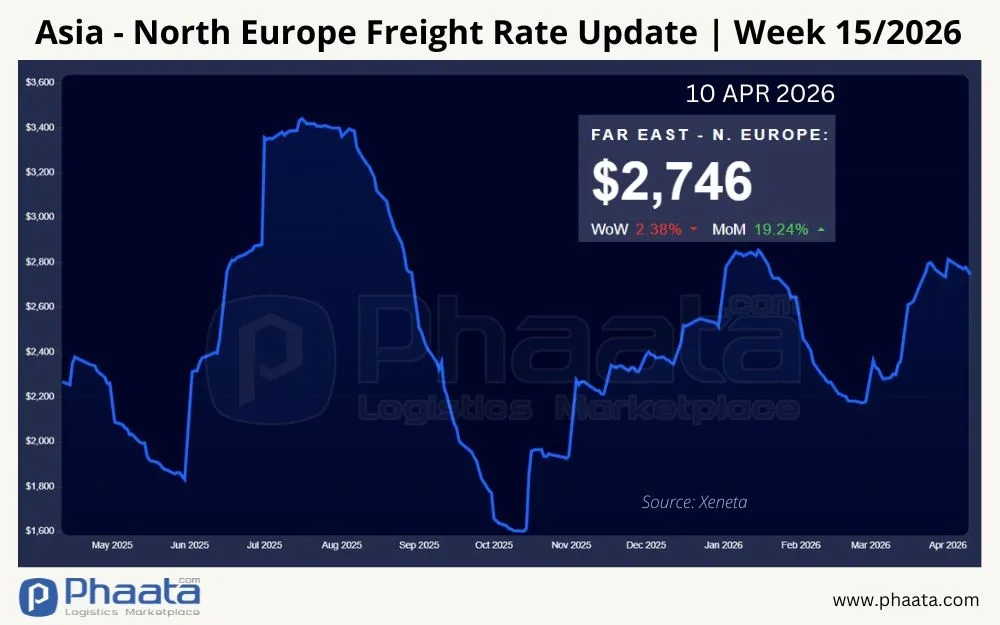
Ocean Freight rates from Asia to Europe in Week 15/2026 decreased by 2.38% week-on-week, down to $2,746/FEU. This rate is up 19.24% month-on-month, according to Xeneta data.
Spot Rates Cool Down: The Shanghai Containerized Freight Index (SCFI) recorded a decline last week. Weak purchasing power in Europe combined with the injection of newbuild vessel supply prevents carriers from sustaining a high base rate environment.
Application of Emergency Bunker Surcharge (EBS): To protect profit margins against costs incurred from the Cape of Good Hope detour, carriers are uniformly applying the EBS tool.
Rate Trend Forecast: Freight rates will continue to face downward pressure. To counter the sliding SCFI index, carriers will undoubtedly reactivate the blank sailing tool to tighten supply and re-establish the price floor.
Stay tuned to Phaata International Logistics Marketplace for in-depth and fast market updates.
Asia-Europe Freight Rates | Week 15/2026 (Photo: Phaata.com)
4. North America - Asia Ocean Freight Rates
Ocean Freight rates from North America (West Coast) to Asia in Week 15/2026 continued to increase by 2.75% week-on-week, up to $598/FEU. This rate is up slightly by 0.84% month-on-month, according to Xeneta data.
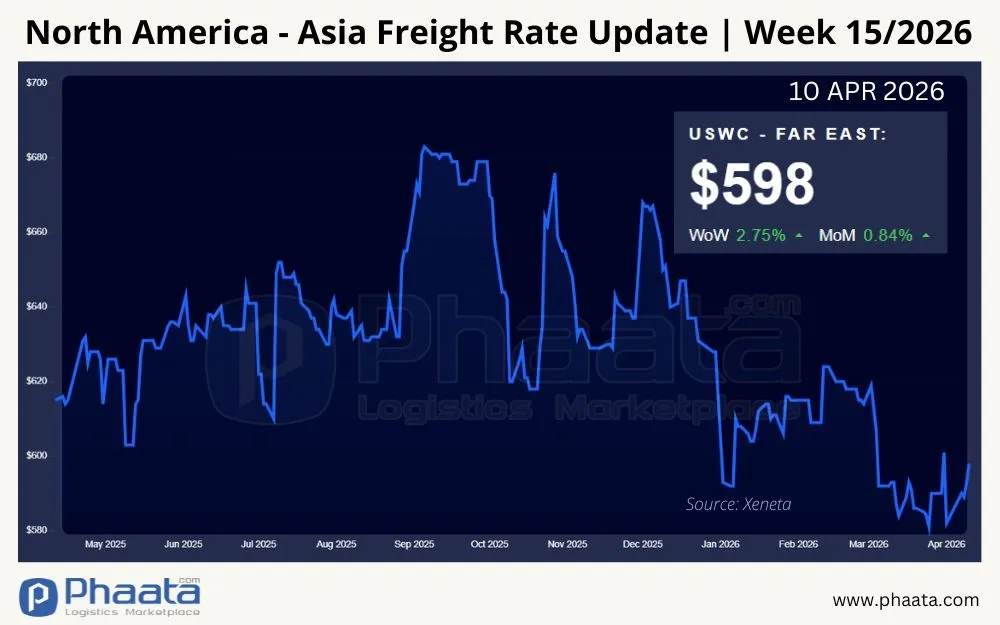
North America (West Coast) - Asia freight rates | Week 15/2026 (Photo: Phaata.com)
5. Northern Europe - Asia Ocean Freight Rates
Ocean Freight rates from North Europe to Asia in Week 15/2026 decreased by 2.19% week-on-week, down to $223/FEU. This rate is up 52.74% month-on-month, per Xeneta data.
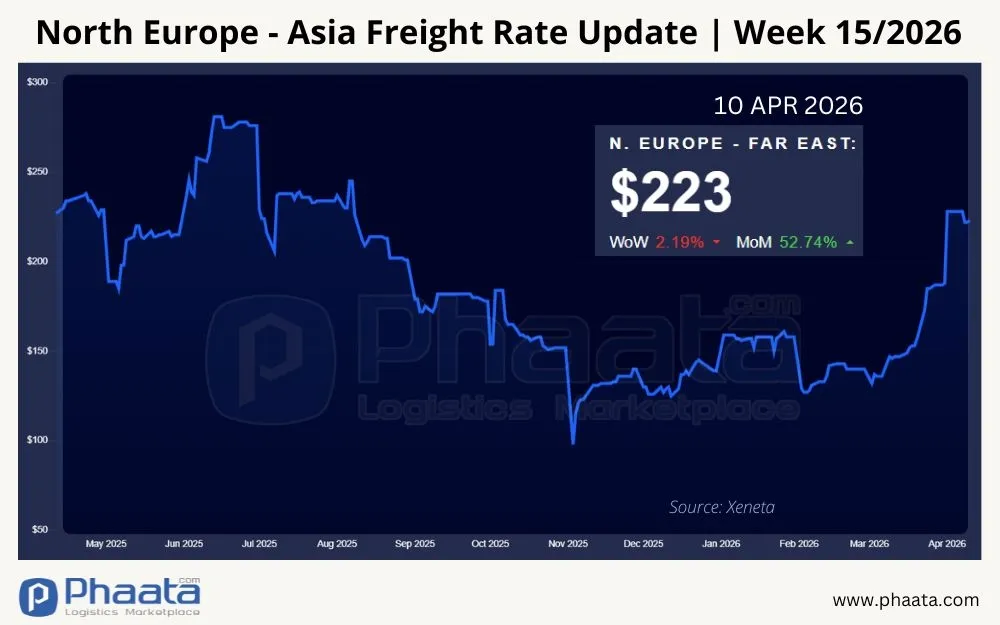
Container Freight rates from Northern Europe to Asia | Week 15/2026 (Photo: Phaata.com)
6. Conclusion and Recommendations from Phaata
Market data for Week 15/2026 records a distinct divergence in freight rate trends between the two main trade lanes, while financial risks escalate due to new US tariff policies:
- Asia-Europe vs. Asia-North America Rate Divergence: The Trans-Pacific Eastbound (TPEB) route has established a strong upward price trend (up 8.6%) thanks to recovering order volumes and strict carrier blank sailing discipline. Conversely, the Far East Westbound (FEWB) route is beginning to cool (down 2.38%) due to weak purchasing power and newbuild capacity entering the market.
- Ruptured 40'HC Supply Chain: China's rising PMI (50.4%) pushes heavy export volumes to ports, colliding with sluggish container turnarounds caused by the Cape of Good Hope detour. The shortage of 40'HCs at Chinese loading ports has become the biggest operational bottleneck right now.
- COGS Shock from Section 232 and IEEPA Risks: CBP beginning to calculate Section 232 tariffs on 100% of the total value of the finished product (effective April 6) completely alters the Cost of Goods Sold (COGS) structure for the metals group. Concurrently, the Court delaying the IEEPA appeal deadline to June 7 elevates legal risks, directly threatening importers' refund cash flows.
Recommendations from Phaata
Amidst a transport market tightening surcharges and fundamental shifts in US customs policies, businesses must prioritize the following:
1. Logistics and Order Management:
- North America Route (TPEB) - Lock Bookings Before May 1: Carriers will apply the Peak Season Surcharge (PSS) on May 1. The documentation department must immediately secure bookings and ship goods in the second half of April to dodge this PSS. It is mandatory to demand carriers clearly separate the Intermodal Fuel Surcharge (IFS - effective April 17) from the ocean freight to control intermodal leg costs.
- Europe Route (FEWB) - The Scramble for 40'HCs: Capitalize on the dip in Spot rates to negotiate short-term freight rates. However, the top priority right now is equipment. Require suppliers in China and forwarders to secure empty releases at least 10-14 days in advance. Activate a contingency plan to immediately substitute with two 20'DCs or a 40'DC if the yards run out of 40'HCs, preventing cargo from backing up at the factory.
2. Customs and Finance (US Market):
- Immediately Update Landed Cost for Metal Goods: The Finance and Sales departments must recalculate profit margins for the entire portfolio of goods subject to Section 232 tariffs (Chapters 72-76). Note that the 50% rate (or 25% for derivatives) is now assessed on the entire commercial invoice value, not stripped down to the metal value as before.
- Manually File IEEPA Protests: Absolutely do not rely on the automated CAPE system (expected April 20). The risk of the US Government filing an appeal before June 7 is very high. The Customs Declaration department must continue filing manual Protests to lock the legal status of IEEPA entries, preserving 100% of the right to receive refunds.
- Review Pharma Supply Chains and Geopolitical Risks: The Procurement department needs to plan supply shifts for the pharmaceutical group to get ahead of Section 232 tariffs (effective July 2026). Simultaneously, audit the origin of raw materials from suppliers in the Middle East region to hedge against the White House's sudden 50% tariff threat.
Stay tuned to articles on Phaata.com or Phaata fanpage for rapid and in-depth market updates.
Find Freight Rates Here
Find Logistics Companies Here
See more:
- Transit Toll Dispute Freezes Prospects for Hormuz Route Recovery
- Strait of Hormuz Maritime Routes Remain Restricted Despite Ceasefire Agreement
- Gulf Tensions: Iran Unilaterally Reconfigures Maritime Routes Through the Strait of Hormuz
- Panama Canal Dispute Escalates: Hutchison Officially Initiates Arbitration Against Maersk
- US Gulf to West Coast South America Trade: Maersk Officially Implements Peak Season Surcharge (PSS)
- Ocean Freight Market Stalls: Overcapacity Outweighs the 'Hormuz Shock'
- FMC Rejects Maersk's Emergency Bunker Surcharge Request for the Second Time
- CMA CGM Kribi: First Western Vessel to Transit Hormuz Amid US-Iran Tensions
- International Shipping and Logistics Market Update Week 14/2026 | Phaata
- COSCO updates Vietnam-Intra Asia sailing schedules in Apr 2026
- COSCO schedules: Vietnam - North America in Apr 2026
- SITC updates Vietnam-Intra Asia sailing schedules in Apr 2026
Source: Phaata - Vietnam's First International Logistics Marketplace
► Find Better Freight Rates & Logistics Service Providers!


Featured News
- Hapag-Lloyd applies Peak Season Surcharge from East Asia to USA and Canada
- The world\'s largest container ships MSC Irina and MSC Loreto floated
- MSC (Mediterranean Shipping Company) - The world\'s leading container shipping lines
- Information you need to know about Maersk Line
- Top 10 export and import goods between Vietnam - Philippines in the first 5 months of 2020

 Market News
See more
_-_Copy_-_Copy.webp)
.webp)

 HOT PROMO
See more
419
 FCL
FCL
 20 Days
 Freight cost

N.B.L INTERNATIONAL TRANSPORT CO., LTD
1330
FCL
21 Days
Freight cost
MG LOGISTICS JSC
3099
FCL
28 Days
Freight cost

CÔNG TY TRÁCH NHIỆM HỮU HẠN DT LOGISTICS (VN)
3718
FCL
28 Days
Freight cost

Công Ty TNHH Quanterm Logistics Vietnam
3067
FCL
33 Days
Freight cost

CÔNG TY TNHH TIẾP VẬN TOÀN CẦU KM
Why do thousands of businesses trust Phaata?
USERS/MONTH
LOGISTICS COMPANIES
REQUEST FOR QUOTEŚ
QUOTATIONS
VIETNAM LOGISTICS COMMUNITY
5 Steps to Get the Best Quote
Find a price quickly/Send a RFQ
Compare multiple options
Contact for Further Consultation
Negotiating prices/services
Management & rating
 Freight rates
Sea freight
- FCL
See more
244
7
Days Direct
- ₫529,260 / 20'GP
- ₫3,704,820 / 40'GP
- ₫3,704,820 / 40'HQ
- ₫4,631,025 / 45'HQ

MELODY LOGISTICS COMPANY LIMITED
293
40
Days Transit
- ₫303,557,073 / 40'RF

GIA LINH LOGISTICS SERVICES CO., LTD. (G LINK Logistics)
329
25
Days Transit
- ₫142,900,200 / 20'GP
- ₫195,826,200 / 40'GP
- ₫195,826,200 / 40'HQ

OPL LOGISTICS
367
 236
20
Days Transit
236
20
Days Transit
- ₫29,884,500 / 20'GP
- ₫31,189,500 / 40'GP
- ₫31,189,500 / 40'HQ

CÔNG TY CỔ PHẦN TIẾP VẬN INTERCARGO
Sea freight
- LCL
See more
651
3
Days Direct
- Refund ₫926,205 /cbm

CÔNG TY CỔ PHẦN GIAO NHẬN VẬN TẢI HỒNG SƠN
1,016
1,820
3
Days Direct
- ₫132,315 /cbm
CÔNG TY TRÁCH NHIỆM HỮU HẠN DT LOGISTICS (VN)
1,927
3
Days Direct
- ₫0 /cbm

CÔNG TY TNHH VẬN TẢI VÀ TIẾP VẬN TOÀN CẦU
3,871
 Air freight
- General cargo
Air freight
- General cargo
See more
2,106
1
Days Direct
- 46,310 ₫/kg
N.B.L INTERNATIONAL TRANSPORT CO., LTD
2,829
1
Days Direct
- 161,424 ₫/kg
CÔNG TY CỔ PHẦN GIAO NHẬN VẬN TẢI HỒNG SƠN
5,686
10
Days Transit
- 264,630 ₫/kg

Phoenix Logistics Vietnam - chi nhánh TP. Hồ Chí Minh (Phoenix International Forwarding Vietnam )
7,360
1
Days Direct
- 185,241 ₫/kg

CÔNG TY TNHH THƯƠNG MẠI VÀ DỊCH VỤ FASTRANS
8,797

 Rail freight
- FCL
Rail freight
- FCL
See more
3,458
5
Days Direct
- ₫44,987,100 / 40'HQ
- ₫44,987,100 / 45'HQ

CÔNG TY TNHH PHƯỚC TÁ
5,256
3
Days Direct
- ₫15,083,910 / 40'HQ

CÔNG TY CỔ PHẦN VẬN TẢI VÀ THƯƠNG MẠI ĐƯỜNG SẮT
15,592
7
Days Direct
- ₫48,956,550 / 20'GP

Công ty TNHH T&M Forwarding
14,358
5
Days Direct
- ₫7,145,010 / 20'GP

ASIAN EXPRESS LINE VIETNAM ( AEL VIET NAM )
9,864
10
Days Direct
- ₫9,262,050 / 20'GP

CÔNG TY CỔ PHẦN LOGISTICS QUỐC TẾ V&T
 Road freight
- FCL
Road freight
- FCL
See more
1,596
4
Day
- ₫5,000,000 / 40'GP

CÔNG TY CỔ PHẦN IGAP
4,207
1
Day
- ₫28,000,000 / 20'GP
- ₫28,000,000 / 40'GP

CÔNG TY TNHH THƯƠNG MẠI DỊCH VỤ VÀ KHO VẬN VIETTEL POST - TTC
105,527
2
Day
- ₫6,500,000 / 40'RF
- ₫6,500,000 / 40'RQ
- ₫6,500,000 / 45'RQ

CÔNG TY CP PROSHIP
 Premium
174,163
1
Day
Premium
174,163
1
Day
- ₫18,997,200 / 20'GP
- ₫18,997,200 / 40'GP

CÔNG TY CỔ PHẦN GIAO NHẬN VẬN TẢI CON ONG
263,673
3
Day
- ₫32,000,000 / 20'GP
- ₫64,000,000 / 40'GP
- ₫64,000,000 / 40'HQ
- ₫64,000,000 / 45'HQ

Công ty Cổ phần phát triển thương mại Thuận Đạt Việt Nam


