


Tuesday, 26/05/2026, 09:00 (GMT +7)
 1305
1305
International Shipping and Logistics Market Update Week 21/2026 | Phaata
International shipping and logistics market update - Week 21/2026
Table of Contents
-
World Container Index Week 21/2026
-
Asia - North America Ocean Freight Rates
-
Asia - Europe Ocean Freight Rates
-
Northern America - Asia Ocean Freight Rates
-
Northern Europe - Asia Ocean Freight Rates
-
Conclusions and Recommendations by Phaata
1. World Container Index Week 21/2026
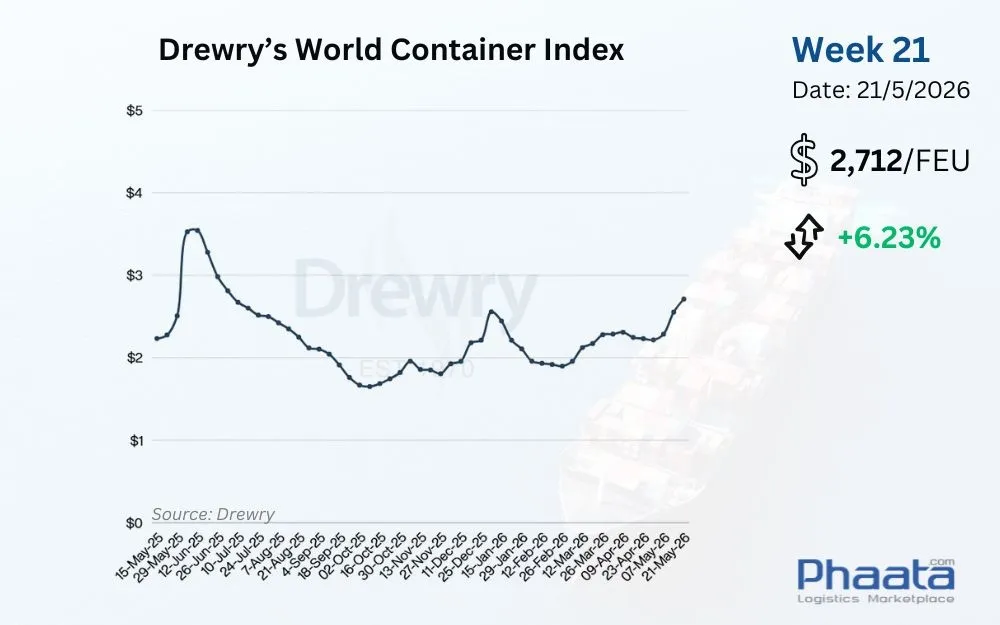
Drewry’s World Container Index (WCI) for Week 21/2026 (from May 18 to May 24, 2026) continued its upward trend, specifically increasing by 6.23% compared to the previous week, reaching $2,712/FEU.
Drewry's World Container Index Week 21/2026 (Photo: Phaata)
2. Asia-North America Ocean Freight Rates
Supply and Demand:
Following a sharp wave of sailing cancellations in the previous week, eastbound Trans-Pacific capacity has recovered to above 80% as the number of blank sailings gradually declined. However, the ripple effects from earlier cancellations continue to place pressure across the entire logistics chain, particularly as cargo demand remains strong.
At present, available capacity is tightening across most major gateways on the trade lane. Several services have already begun experiencing cargo rollovers as vessel utilization remains consistently high.
Most vessel space for late May has already been fully booked, while June allocations are filling up rapidly. For time-sensitive or seasonal cargoes, shippers are advised to secure bookings earlier than usual and consider utilizing FAK or premium services to ensure space availability.
Rate Developments:
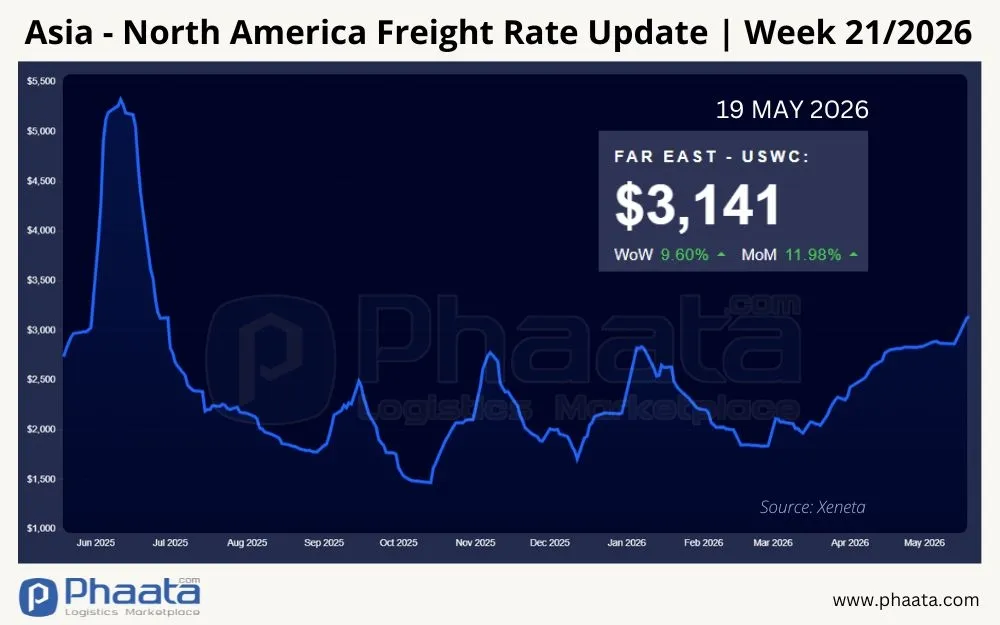
Ocean freight rates from Asia to the North America West Coast in Week 21/2026 increased by 9.6% week-on-week, reaching $3,141/FEU. This rate represents an 11.98% increase month-on-month, according to Xeneta data.
The General Rate Increase (GRI) implemented on May 15 continues to hold across the market. Amid surging cargo volumes and rapidly tightening June capacity, carriers have simultaneously announced another round of rate increases effective June 1.
FAK space on several services has become extremely limited, supporting further upward pressure on spot rates in the near term.
Emergency Bunker Surcharges (EBS) remain in effect. Carriers are expected to complete their June surcharge reviews by the end of May, with potential adjustments closely tied to fuel price fluctuations in the global energy market.
In addition, major carriers are widely expected to introduce Peak Season Surcharges (PSS) starting June 1. This move comes as spot rates continue to climb sharply while overall capacity on the trade lane remains constrained.
Stay tuned to Phaata International Logistics Marketplace for in-depth and fast market updates.
Asia-North America Freight Rates | Week 21/2026 (Photo: Phaata.com)
US Tariff Updates:
1. Section 122 (10%) Legal Dispute and Cash Flow Risks
Legal Proceedings Update: On May 20, the U.S. Court of International Trade (CIT) officially rejected the U.S. Government’s request for a stay of judgment. However, the administrative stay issued earlier by the Federal Court of Appeals on May 12 currently remains the highest effective legal authority.
Current Port-Level Enforcement: U.S. Customs and Border Protection (CBP) continues to impose and collect the 10% tariff under Section 122 on all applicable import shipments. This means that all three plaintiff companies, despite prevailing at the CIT level, are still required to continue paying the duty.
Expiration Timeline: The Section 122 tariff order is scheduled to expire automatically on July 24, 2026. This timeline somewhat reduces the urgency for expedited Supreme Court review. Based on current assessments, the appeals process is likely to continue for several more months.
Operational Recommendations for Importers:
- Do not suspend duty payments: Any unilateral decision to stop paying Section 122 duties at this stage may expose importers to administrative penalties from CBP.
- Audit tariff exposure: Accounting departments should review and quantify all Section 122 duty payments incurred since February 2026, while closely monitoring the liquidation date of each customs entry. If the CIT ruling invalidating the tariff is ultimately upheld, refunds will likely be processed automatically by CBP through the CAPE system.
2. Countdown to the EU Tariff Deadline
Progress of Negotiations: On May 20, the European Council and the European Parliament reached a preliminary agreement to remove tariffs on U.S. industrial goods while expanding market access for selected agricultural and seafood products, including lobster.
EU Safeguard Measures
Notably, the EU included several strict safeguard provisions in the agreement:
- The agreement will automatically expire at the end of 2029;
- The EU will immediately reinstate Most Favored Nation (MFN) tariffs if the U.S. continues imposing tariffs above 15% on derivative steel and aluminum products after December 31, 2026.
Supply Chain Risks
The European Parliament is expected to vote on the agreement in mid-June. Businesses should pay close attention to the July 4, 2026 deadline set by the White House. If the EU has not completed formal ratification and reduced tariffs to zero by that date, the U.S. may immediately activate stricter retaliatory tariffs.
Importers sourcing from Europe are therefore advised to accelerate cargo loading schedules and prepare contingency cost scenarios during June.
3. Section 232 Offset Mechanism for the Automotive and Trucking Industry
The U.S. Department of Commerce (DOC) officially opened applications for Section 232 tariff offsets on May 15, 2026, under the following framework:
Scope of Application: The mechanism applies to manufacturers of medium- and heavy-duty vehicle (MHDV) parts. Notably, buses and automotive/truck engines are currently excluded and will follow a separate process.
Offset Cap: The Section 232 offset is capped at a maximum of 3.75% of the total value of all MHDVs assembled in the United States.
Eligibility Period: The program applies to MHDVs assembled between November 1, 2025 and October 31, 2030.
At the same time, the DOC has extended the existing offset mechanism for traditional automotive parts manufacturers through April 30, 2030. Customs compliance teams should promptly complete filings to secure the associated financial benefits.
4. Leveraging IEEPA Duty Refund Data Through the CAPE System
CBP disclosures submitted to the CIT court (as of May 11) indicate that large-scale duty refunds are currently being disbursed, although technical issues on the importer side remain significant.
Refund Scale: Approximately 8.3 million customs entries have completed reliquidation and had IEEPA duties removed. Total refunds, including principal and interest, have reached approximately USD 35.46 billion and are currently being transferred to the U.S. Treasury for payment issuance.
Technical Rejection Rate: A total of 126,237 cases were uploaded to the CAPE system, but only around 68% (86,874 cases) passed the initial data structure validation process. Most rejected files failed due to mismatches with the ACE system.
Payment Bottleneck (Critical Warning): The system currently shows 1,880 approved refund payments still frozen because Importers of Record (IORs) either failed to provide or incorrectly submitted ACH electronic banking information.
Mandatory Action: All companies awaiting IEEPA refunds should immediately log into the ACE Portal to verify and update ACH account information. Businesses should avoid unnecessary refund delays caused by basic payment data errors.
Stay tuned to articles on the Phaata International Logistics Marketplace for rapid and in-depth market updates.
3. Asia-Europe Ocean Freight Rates
Supply and Demand:
Booking volumes on the Far East–Europe trade lane are increasing much earlier than the traditional seasonal cycle. The primary drivers are concerns over potential supply chain disruptions, rising fuel costs, and the risk of tighter vessel space during the second half of the year.
Many shippers are accelerating import schedules and front-loading inventory, placing substantial pressure on export gateways across Asia.
Although the market continues to face structural oversupply due to ongoing newbuilding deliveries, carriers are maintaining relatively tight capacity control through concentrated blank sailings across Asia–North Europe and Mediterranean services. This strategy is significantly reducing effective market capacity.
Operations:
Singapore
Congestion at the Port of Singapore continues to worsen. Vessel waiting times have now extended to up to seven days, with approximately 450,000 TEU currently queued for berth access. Yard utilization remains around 80%.
Chinese Origin Ports
A surge of vessel arrivals combined with terminal congestion is causing significant delays at several major Chinese export gateways.
At the Port of Shanghai and the Port of Qingdao, vessel waiting times are currently ranging from 72 to 96 hours.
Northern European Transshipment Ports
Simultaneous arrivals of multiple ultra-large container vessels are placing substantial pressure on terminal handling capacity across Northern Europe.
Yard utilization at the Port of Rotterdam, the Port of Hamburg, and the Port of Antwerp has risen to approximately 85–90%. As a result, inland connectivity systems, including barges and feeder services, are experiencing waiting times of up to 72 hours.
Freight Rate Developments:
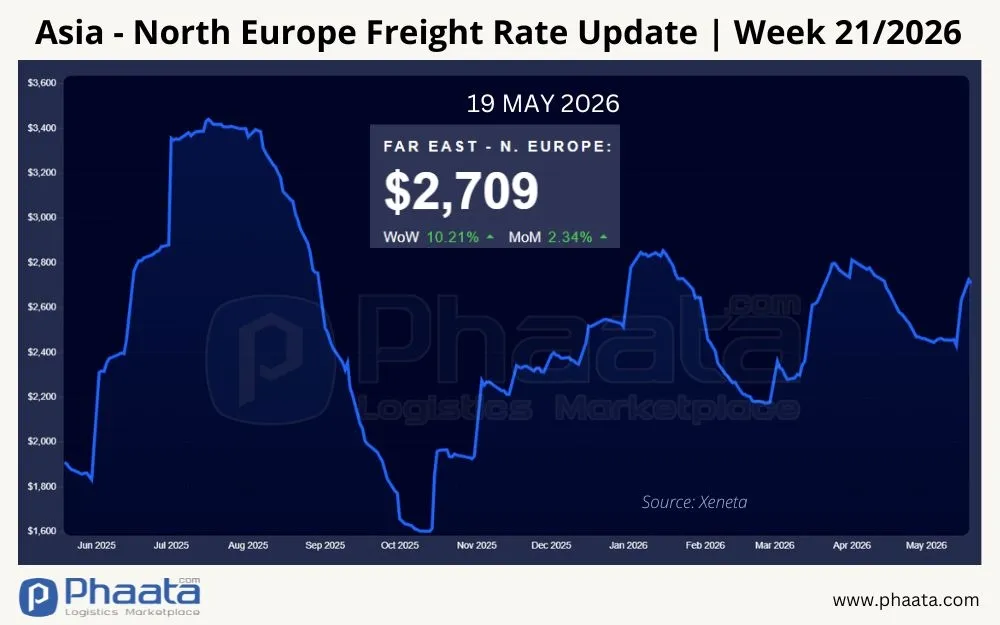
Ocean freight rates from Asia to Europe in Week 21/2026 surged by 10.21% week-on-week, reaching $2,709/FEU. This rate represents a 2.34% increase month-on-month, according to Xeneta data.
As capacity tightens rapidly and early-season booking activity intensifies, the Shanghai Containerized Freight Index (SCFI) for the North Europe trade recorded a significant increase over the past week.
This development indicates that the market has officially moved beyond its previous short-lived stabilization phase and has entered a new upward pricing cycle.
Carriers are now broadly implementing higher FAK rates during the second half of the month while simultaneously applying EBS and PSS surcharges.
As vessel space fills rapidly and capacity discipline remains strict, bargaining power is gradually shifting back toward the carriers.
For shippers that have not yet finalized long-term contracts, the spot market is expected to become increasingly volatile in the coming weeks, with higher risks of premium freight rates and unplanned surcharges.
Stay tuned to Phaata International Logistics Marketplace for in-depth and fast market updates.
Asia-Europe Freight Rates | Week 21/2026 (Photo: Phaata.com)
4. North America - Asia Ocean Freight Rates
Ocean freight rates from North America (West Coast) to Asia in Week 21/2026 decreased slightly by 0.48% week-on-week, settling at $622/FEU. This rate is up 0.48% month-on-month, according to Xeneta data.
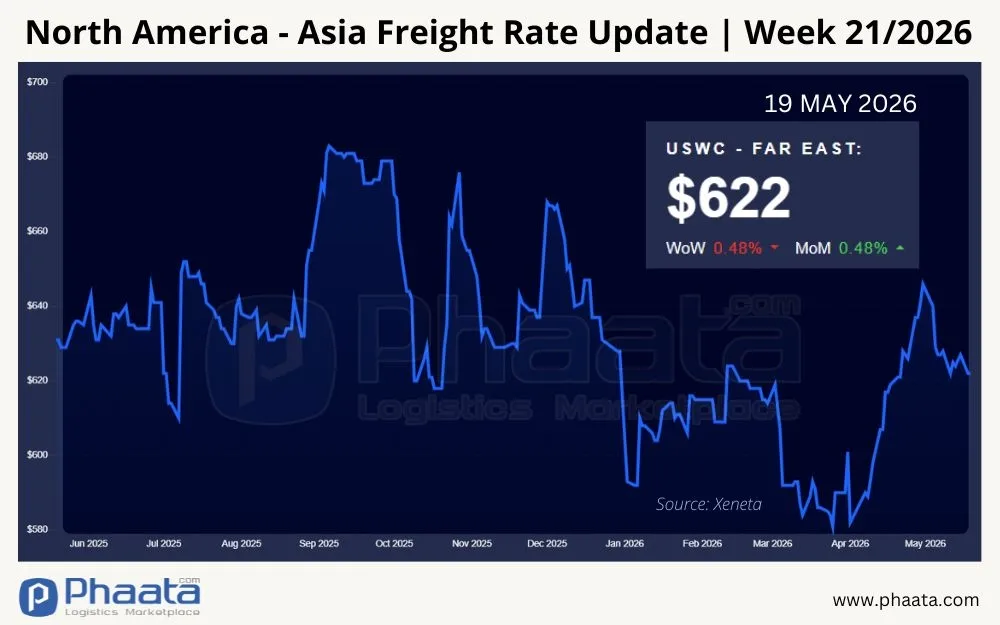
North America (West Coast) - Asia freight rates | Week 21/2026 (Photo: Phaata.com)
5. Northern Europe - Asia Ocean Freight Rates
Ocean freight rates from North Europe to Asia in Week 21/2026 increased by 5.29% week-on-week, reaching $239/FEU. This rate is down 0.83% month-on-month, per Xeneta data.
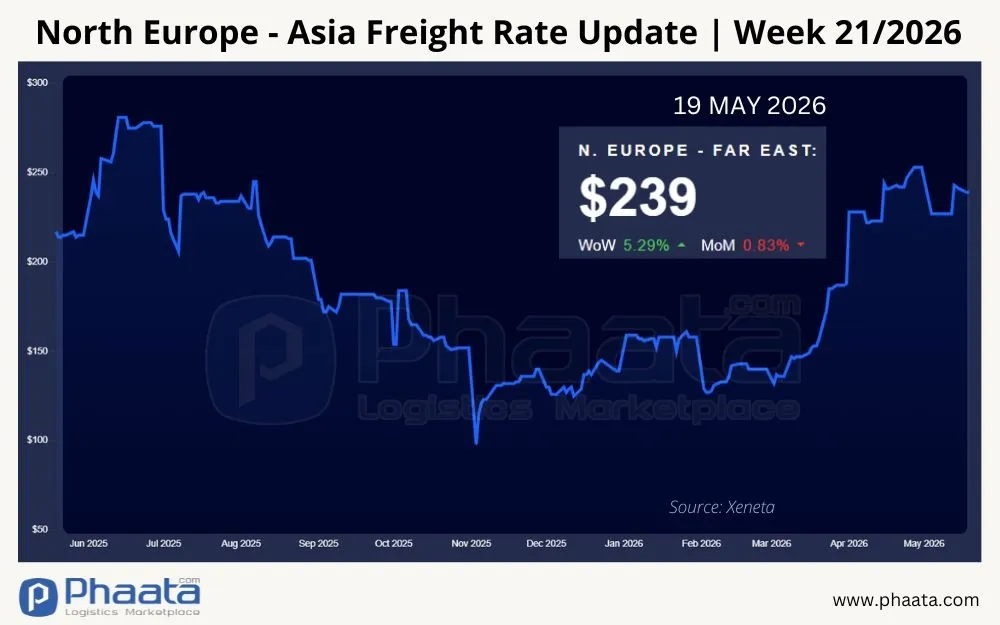
Container Freight rates from Northern Europe to Asia | Week 21/2026 (Photo: Phaata.com)
6. Conclusion and Recommendations from Phaata
Entering Week 21/2026, the international container shipping market continues to show signs of renewed tightening across the two key trade corridors: Asia–North America and Asia–Europe.
On the eastbound Trans-Pacific trade, although carriers have partially restored capacity following the earlier wave of large-scale sailing cancellations, the market remains under considerable pressure as cargo demand stays elevated while June vessel space fills rapidly. Cargo rollovers have already emerged across several services, while spot rates, FAK levels, EBS, and PSS surcharges continue to move upward simultaneously.
On the Far East–Europe route, strong early booking activity and widespread front-loading are placing significant strain across the entire supply chain, from Asian export gateways to Northern European transshipment hubs. Meanwhile, carriers continue to maintain strict capacity discipline through blank sailings in support of freight rate levels.
Alongside transportation pressures, the global trade environment is also becoming increasingly volatile due to evolving U.S. tariff policies. Importers into the U.S. are now facing not only rising logistics costs but also growing pressure to actively manage cash flow exposure related to Section 122 duties, Section 232 programs, and IEEPA refund procedures through the CAPE system.
Recommendations from Phaata
For Importers and Exporters:
Secure bookings early: As June vessel space fills rapidly across multiple trade lanes, companies should place bookings 2–4 weeks earlier than normal to reduce rollover risks and avoid premium space charges.
Review freight contract surcharge clauses: Additional charges such as EBS and PSS are being implemented broadly. Businesses should carefully review surcharge provisions in service contracts to avoid unplanned logistics costs.
Reassess inventory and import schedules: The front-loading trend is accelerating across many markets. Companies should rebalance safety stock levels and avoid concentrating cargo volumes within the same peak periods in order to reduce transportation and warehousing pressure.
Closely monitor port operational risks: Congestion at the Port of Singapore, the Port of Shanghai, the Port of Qingdao, and major Northern European ports continues without clear signs of easing. Businesses should closely track vessel schedules, transit times, and inland delivery plans to minimize downstream operational disruptions.
Review U.S. tariff exposure proactively: Companies importing into the United States should conduct a comprehensive review of all Section 122 tariff costs incurred to date while monitoring the liquidation status of each customs entry in preparation for potential future refund scenarios.
Complete CAPE refund payment data verification: Businesses awaiting IEEPA refunds should promptly verify and update ACH banking information through the ACE Portal to avoid refund delays caused by technical filing errors.
In the short term, the international container shipping market is expected to remain tight across several major trade lanes, accompanied by continued upward pricing pressure. Importers and exporters should prioritize flexible transportation planning, strict logistics cost management, and continuous weekly market monitoring to mitigate operational and financial risks effectively.
Stay tuned to articles on Phaata.com or Phaata fanpage for rapid and in-depth market updates.
Find Freight Rates Here
Find Logistics Companies Here
See more:
- SITC updates Vietnam-Intra Asia sailing schedules in Jun 2026
- CMA CGM Deploys Largest French-Flagged LNG Container Ship on Asia–Europe Trade Lane
- Global Schedule Reliability No Longer Fully Reflects Diverging Conditions Across Asia–Europe Trade Lanes
- COSCO SHIPPING Lines Restarts SKX1 Shuttle Service Connecting Singapore and Kolkata
- MSC Launches Ochna Service to Strengthen Direct China–Vietnam Connectivity
- Maersk Launches Qilin Service, Significantly Reducing China–Australia Transit Times
- Sea-Intelligence: Hormuz and Red Sea Crises Disrupt Global Supply Chains in Two Fundamentally Different Ways
- NAWC Q1/2026: Canadian Ports Gain Market Share in Trans-Pacific Trade Flows
- Trans-Pacific Rates Remain Elevated as the Market Prepares for Peak Season
- SAX/SAECS/SRX Service Adds Port of Algeciras to Europe – South Africa Rotation
- COSCO schedules: Vietnam - North America in May 2026
Source: Phaata - Vietnam's First International Logistics Marketplace
► Find Better Freight Rates & Logistics Service Providers!


Featured News
- Hapag-Lloyd applies Peak Season Surcharge from East Asia to USA and Canada
- The world\'s largest container ships MSC Irina and MSC Loreto floated
- MSC (Mediterranean Shipping Company) - The world\'s leading container shipping lines
- Information you need to know about Maersk Line
- Top 10 export and import goods between Vietnam - Philippines in the first 5 months of 2020

 Market News
See more
_-_Copy_-_Copy.webp)

.webp)


 HOT PROMO
See more
878
 FCL
FCL
 20 Days
 Freight cost

N.B.L INTERNATIONAL TRANSPORT CO., LTD
2080
FCL
21 Days
Freight cost
MG LOGISTICS JSC
3846
FCL
28 Days
Freight cost

CÔNG TY TRÁCH NHIỆM HỮU HẠN DT LOGISTICS (VN)
4465
FCL
28 Days
Freight cost

Công Ty TNHH Quanterm Logistics Vietnam
3409
FCL
33 Days
Freight cost

CÔNG TY TNHH TIẾP VẬN TOÀN CẦU KM
Why do thousands of businesses trust Phaata?
USERS/MONTH
LOGISTICS COMPANIES
REQUEST FOR QUOTEŚ
QUOTATIONS
VIETNAM LOGISTICS COMMUNITY
5 Steps to Get the Best Quote
Find a price quickly/Send a RFQ
Compare multiple options
Contact for Further Consultation
Negotiating prices/services
Management & rating
 Freight rates
Sea freight
- FCL
See more
554
7
Days Direct
- ₫529,260 / 20'GP
- ₫3,704,820 / 40'GP
- ₫3,704,820 / 40'HQ
- ₫4,631,025 / 45'HQ

MELODY LOGISTICS COMPANY LIMITED
620
40
Days Transit
- ₫303,557,073 / 40'RF

GIA LINH LOGISTICS SERVICES CO., LTD. (G LINK Logistics)
650
25
Days Transit
- ₫142,900,200 / 20'GP
- ₫195,826,200 / 40'GP
- ₫195,826,200 / 40'HQ

OPL LOGISTICS
673
 365
20
Days Transit
365
20
Days Transit
- ₫29,884,500 / 20'GP
- ₫31,189,500 / 40'GP
- ₫31,189,500 / 40'HQ

CÔNG TY CỔ PHẦN TIẾP VẬN INTERCARGO
Sea freight
- LCL
See more
921
3
Days Direct
- Refund ₫926,205 /cbm

CÔNG TY CỔ PHẦN GIAO NHẬN VẬN TẢI HỒNG SƠN
1,353
2,113
3
Days Direct
- ₫132,315 /cbm
CÔNG TY TRÁCH NHIỆM HỮU HẠN DT LOGISTICS (VN)
2,192
3
Days Direct
- ₫0 /cbm

CÔNG TY TNHH VẬN TẢI VÀ TIẾP VẬN TOÀN CẦU
3,967
 Air freight
- General cargo
Air freight
- General cargo
See more
2,354
1
Days Direct
- 46,310 ₫/kg
N.B.L INTERNATIONAL TRANSPORT CO., LTD
3,152
1
Days Direct
- 161,424 ₫/kg
CÔNG TY CỔ PHẦN GIAO NHẬN VẬN TẢI HỒNG SƠN
5,978
10
Days Transit
- 264,630 ₫/kg

Phoenix Logistics Vietnam - chi nhánh TP. Hồ Chí Minh (Phoenix International Forwarding Vietnam )
7,640
1
Days Direct
- 185,241 ₫/kg

CÔNG TY TNHH THƯƠNG MẠI VÀ DỊCH VỤ FASTRANS
8,879

 Rail freight
- FCL
Rail freight
- FCL
See more
3,708
5
Days Direct
- ₫44,987,100 / 40'HQ
- ₫44,987,100 / 45'HQ

CÔNG TY TNHH PHƯỚC TÁ
5,588
3
Days Direct
- ₫15,083,910 / 40'HQ

CÔNG TY CỔ PHẦN VẬN TẢI VÀ THƯƠNG MẠI ĐƯỜNG SẮT
15,890
7
Days Direct
- ₫48,956,550 / 20'GP

Công ty TNHH T&M Forwarding
14,635
5
Days Direct
- ₫7,145,010 / 20'GP

ASIAN EXPRESS LINE VIETNAM ( AEL VIET NAM )
9,942
10
Days Direct
- ₫9,262,050 / 20'GP

CÔNG TY CỔ PHẦN LOGISTICS QUỐC TẾ V&T
 Road freight
- FCL
Road freight
- FCL
See more
1,838
4
Day
- ₫5,000,000 / 40'GP

CÔNG TY CỔ PHẦN IGAP
4,637
1
Day
- ₫28,000,000 / 20'GP
- ₫28,000,000 / 40'GP

CÔNG TY TNHH THƯƠNG MẠI DỊCH VỤ VÀ KHO VẬN VIETTEL POST - TTC
105,918
2
Day
- ₫6,500,000 / 40'RF
- ₫6,500,000 / 40'RQ
- ₫6,500,000 / 45'RQ

CÔNG TY CP PROSHIP
 Premium
174,532
1
Day
Premium
174,532
1
Day
- ₫18,997,200 / 20'GP
- ₫18,997,200 / 40'GP

CÔNG TY CỔ PHẦN GIAO NHẬN VẬN TẢI CON ONG
263,902
3
Day
- ₫32,000,000 / 20'GP
- ₫64,000,000 / 40'GP
- ₫64,000,000 / 40'HQ
- ₫64,000,000 / 45'HQ

Công ty Cổ phần phát triển thương mại Thuận Đạt Việt Nam


