


Tuesday, 09/06/2026, 10:13 (GMT +7)
 1194
1194
International Shipping and Logistics Market Update Week 23/2026 | Phaata

International shipping and logistics market update - Week 23/2026
Table of Contents
-
World Container Index Week 23/2026
-
Asia - North America Ocean Freight Rates
-
Asia - Europe Ocean Freight Rates
-
Northern America - Asia Ocean Freight Rates
-
Northern Europe - Asia Ocean Freight Rates
-
Conclusions and Recommendations by Phaata
1. World Container Index Week 23/2026
Drewry’s World Container Index (WCI) for Week 23/2026 (from June 1 to June 7, 2026) continued to surge, specifically increasing by 22.61% compared to the previous week, reaching $3,433/FEU.
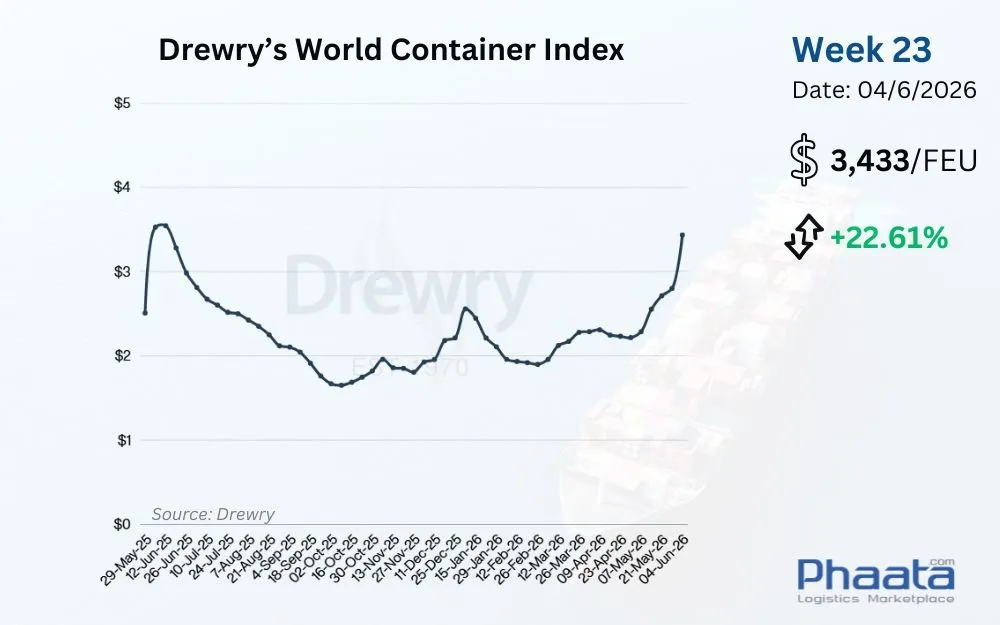
Drewry's World Container Index Week 23/2026 (Photo: Phaata)
2. Asia-North America Ocean Freight Rates
Supply and Demand:
Entering June, transport capacity on the Trans-Pacific Eastbound (TPEB) route has gradually stabilized. However, a continued surge in transport demand is pushing vessel utilization rates to high levels across the entire trade lane, causing several service loops to begin recording cargo rollovers.
To meet market demand, carriers have injected additional operational capacity, including the reinstatement of certain services like the MSC Pearl and the deployment of extra loaders to the Pacific Southwest (PSW) region.
Despite some improvement in capacity supply, space across all major gateways is filling up very rapidly and is expected to remain fully booked throughout June.
In the current context, shippers are strongly advised to roll out booking plans 3 to 4 weeks prior to the estimated time of departure. For urgent shipments or those with strict transit time requirements, utilizing Premium Services should be considered to improve the likelihood of space confirmation and vessel loading.
Rate Developments:
Ocean freight rates from Asia to the US West Coast in Week 23/2026 jumped by 25.37% week-on-week, reaching $4,047/FEU. This rate represents a 40.13% increase month-on-month, according to Xeneta data.
Maintaining the Baseline and New Adjustments: The rate baseline established on June 1 is being held firmly by carriers. Based on vessel utilization rates anchoring at high levels throughout June and forecast to extend into July, carriers have signaled another round of rate hikes effective June 15.
Emergency Bunker Surcharge (EBS): The EBS continues to be applied to June invoices. There is a high probability that carriers will announce an increase in this surcharge to offset actual fluctuations in operational costs.
Application of Peak Season Surcharge (PSS) on Long-Term Contracts: Starting June 1, carriers universally integrated the PSS into the pricing structure of fixed contracts. Given that capacity supply remains constrained and spot rates continue their upward momentum, there is a strong likelihood that carriers will upwardly adjust the PSS quantum on June 15. Businesses must promptly update these fees in their Landed Cost calculations.
Stay tuned to Phaata International Logistics Marketplace for in-depth and fast market updates.
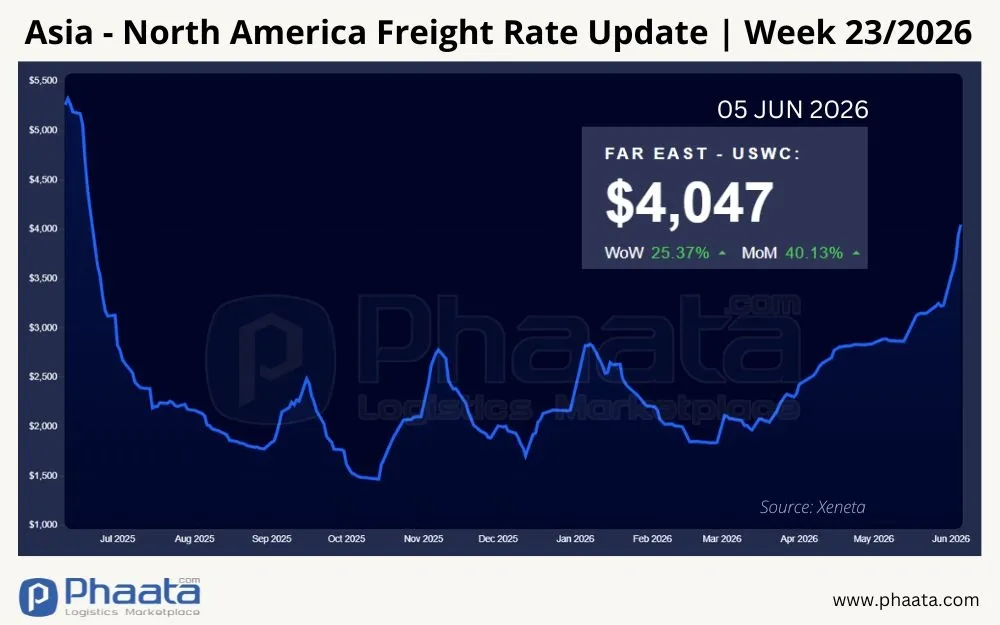
Asia-North America Freight Rates | Week 23/2026 (Photo: Phaata.com)
US Tariff Updates:
1. New Executive Order (June 3): Updates to Customs Enforcement Mechanisms The US President signed an executive order aimed at elevating standards for Importers of Record (IOR), expanding declaration requirements, and adjusting the penalty framework for violations. Documentation departments should note the following milestones for preparation:
-
Within 180 Days (Updating IOR Standards): The Department of Homeland Security (DHS) requires IORs to maintain a minimum level of domestic assets or bond limits. Businesses must also provide transparent information regarding beneficial ownership and affiliated companies. The system will screen and revoke inactive IORs while classifying risk levels.
-
Regulations for Foreign IORs: These importers will not be permitted to file informal entries. For formal entries, the use of continuous customs bonds will require a guarantee confirmation from Customs and Border Protection (CBP). Businesses need to obtain CTPAT certification or operate through a CTPAT-licensed customs broker.
-
Within 90 Days (Supply Chain Declarations): CBP will issue new declaration standards requiring detailed information on the supply chain, manufacturing methods, foreign entities' tax identification numbers, and copies of original export documents filed in the country of origin.
-
Penalty Adjustments: CBP is applying a penalty floor of 50% of the total fine for violations. Mitigation mechanisms for repeat corporate offenders will no longer apply. Customs brokers failing to fully comply with due diligence procedures may face maximum penalties.
-
Recommendation: Importing businesses and freight forwarders should allocate time in June to review their IOR structures and customs bond contracts to ensure compliance with the new standards.
2. IEEPA Refund Case Update: Department of Justice (DOJ) Appeals
-
Legal Proceedings: On June 2, the DOJ filed an appeal against the April 17 ruling by the Court of International Trade (CIT) requiring CBP to refund IEEPA duties, escalating the case to the Federal Court of Appeals. The DOJ also filed a motion to stay the subpoena calling CBP Acting Commissioner Rodney Scott to testify on June 9.
-
Disbursement Progress: CBP reported it has refunded $85 billion (out of the $166 billion collected under IEEPA). This refund cash flow is largely reaching major importers, while the CAPE system continues to undergo upgrades to process the remaining files.
-
Recommendation: For entries nearing their protest deadlines, businesses should continue filing protests to preserve their refund rights. The protest window spans 2 years, making comprehensive declarations a financially sound safety net.
3. Section 232 Tariff Adjustments for Machinery and Equipment From June 8, 2026, to December 31, 2027, the Section 232 tariff structure for derivative steel, aluminum, and copper products will undergo the following changes:
-
15% Tariff Rate: Applied to agricultural equipment (harvesters, combines) and residential HVAC equipment (reduced from the previous standard 25% rate).
-
15% All-in Rate: Applied to mobile industrial equipment (bulldozers, forklifts) imported from countries with US trade agreements (Japan, South Korea, Taiwan, UK, EU, etc.). This 15% rate is inclusive of the Most Favored Nation (MFN) tariff.
-
USMCA Rules of Origin: For mobile industrial equipment, the 25% tariff is only calculated on the value of non-US origin components, while maintaining a total tariff floor of 15%.
-
Domestic Content Adjustment: The threshold for domestic (US) metal content has been lowered from 95% to 85% for goods to qualify for the preferential 10% tariff rate.
-
Additions to the List: Steel racks and aluminum lithographic plates are officially included under the 25% derivative tariff scope.
4. Proposed Section 301 Tariffs on Brazilian Goods
-
Proposal Details: A June 1 report from USTR proposes a 25% tariff on Brazilian goods based on 6 factors: digital trade, tax incentives, intellectual property, the ethanol market, and environmental issues.
-
Exemption List: USTR proposes exempting over 1,600 HTS codes belonging to key export groups (petroleum, coal, coffee, beef, orange juice, aircraft parts, iron/steel already subject to Section 232, and heavy construction equipment) to help stabilize input costs.
-
Recommendation: Businesses importing from Brazil should cross-check their commodity portfolios against the exempted HTS codes. The deadline to submit public comments is July 1, 2026.
5. Proposed Section 301 Tariffs Regarding Labor Standards (Over 46 Countries) USTR is considering new trade measures against 46 partners based on labor standard control regulations:
-
Projected Tariff Rates: A 12.5% rate is expected to apply to countries lacking specific regulations on this issue (including China, India, Vietnam, Brazil). A 10% rate is expected to apply to countries with existing regulations or trade agreements with the US (Canada, Mexico, EU, Taiwan, Malaysia).
-
Exempted Goods: Includes USMCA and DR-CAFTA goods, critical minerals, civil aircraft components, chemicals, microchips, beef, and items already subject to Section 232 tariffs.
-
Mechanism for Textiles and Garments: These items may enjoy preferential tariff rates if the exporting partner utilizes an adequate percentage of US-origin cotton/yarn raw materials. Volumes exceeding quotas are expected to face the 10% or 12.5% tariff.
-
Recommendation: Supply chain managers should review the origins of their imported materials portfolio. These new tax regulations could be implemented starting July 24, 2026. Businesses can submit public comments before July 6, 2026.
Stay tuned to articles on the Phaata International Logistics Marketplace for rapid and in-depth market updates.
3. Asia-Europe Ocean Freight Rates
Supply and Demand:
Front-loading Trend: The strong surge in booking volumes on the Far East - North Europe route in recent weeks stems from more than just seasonal import demand. Many shippers are proactively accelerating their export schedules to dodge the Peak Season Surcharge (PSS) adjustments anticipated in the second half of June, as well as potential increases in Bunker Surcharges (BAF/EBS) starting early July.
Pressure on Vessel Space: Although the number of blank sailings in June has decreased compared to the previous period, slightly improving operational capacity, the robust surge in booking demand is exerting immense pressure on actual capacity supply. Many voyages have fallen into an overbooking situation, where booked slots exceed the allocated capacity for the sailing.
Operations:
Impact of the Cape of Good Hope Detour: Carriers continuing to route vessels around the Cape of Good Hope are currently absorbing approximately 5.3% to 6% of global container shipping capacity. Prolonged transit times are not only exacerbating empty container shortages at Asian export ports but also escalating the risk of rolled cargo, even on vessels operating on schedule.
Freight Rate Developments:
Ocean freight rates from Asia to Europe in Week 23/2026 surged by 28.41% week-on-week, reaching $3,648/FEU. This rate is up 48.59% month-on-month, according to Xeneta data.
Spot Rates Continue to Climb: A sharp, short-term spike in transport demand has driven the spot rate baseline up significantly within just a single week. With vessel utilization currently sustained at high levels, many carriers are proceeding with base rate hikes for sailings departing in the second half of June.
Upward Trend in Base Rates and Surcharges: The Peak Season Surcharge (PSS) has already been applied on several service loops and is expected to be rolled out more broadly in the latter half of June. As carriers continue to strictly control transport capacity through capacity management policies, total transport costs on the Far East - North Europe route are highly likely to remain elevated for the remainder of the month.
Stay tuned to Phaata International Logistics Marketplace for in-depth and fast market updates.
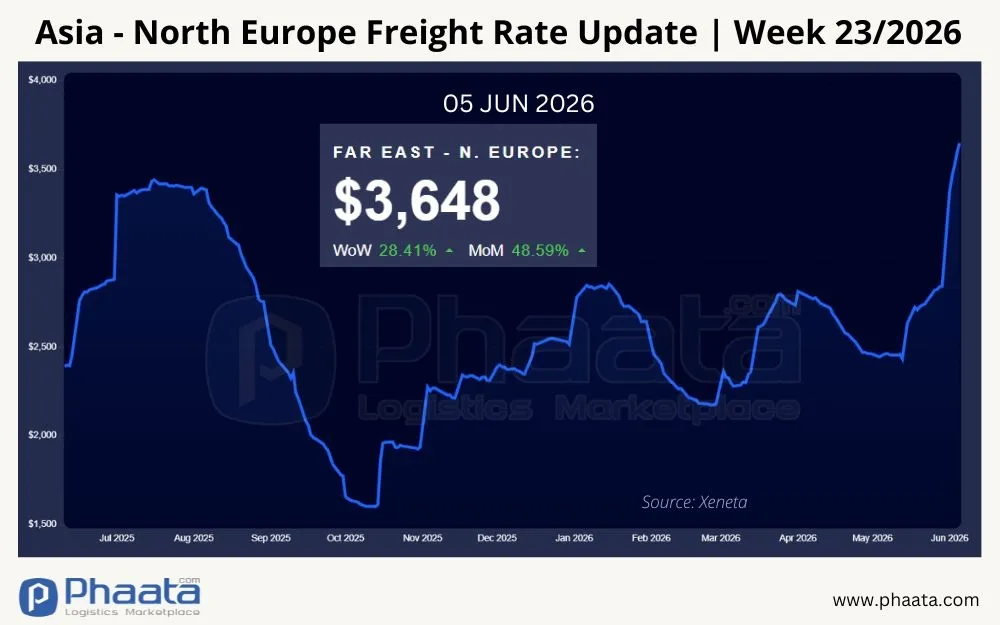
Asia-Europe Freight Rates | Week 23/2026 (Photo: Phaata.com)
4. North America - Asia Ocean Freight Rates
Ocean freight rates from North America (West Coast) to Asia in Week 23/2026 decreased by 2.2% week-on-week, settling at $623/FEU. This rate is down 0.95% month-on-month, according to Xeneta data.
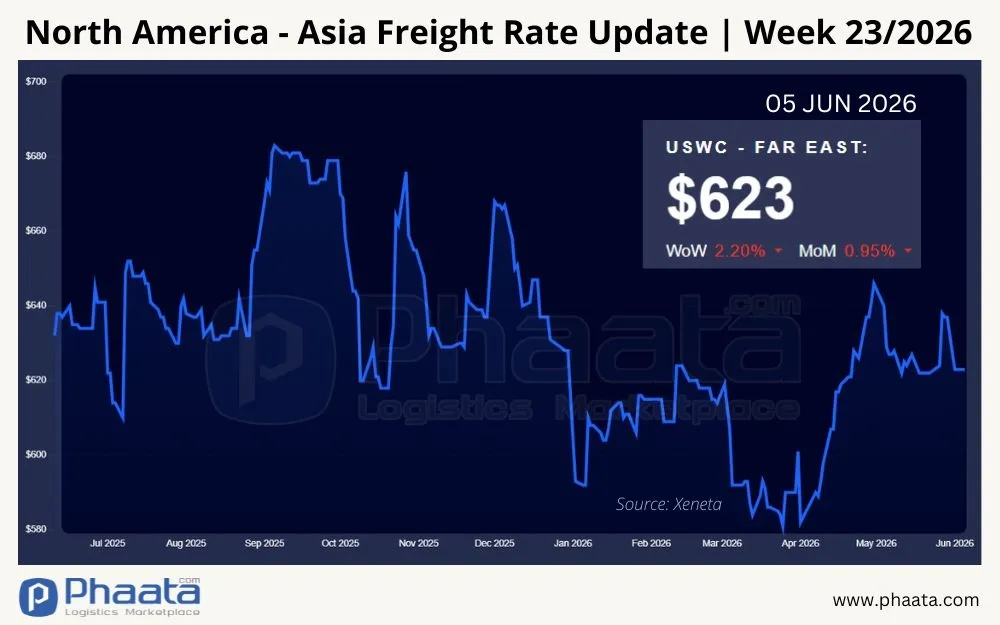
North America (West Coast) - Asia freight rates | Week 23/2026 (Photo: Phaata.com)
5. Northern Europe - Asia Ocean Freight Rates
Ocean freight rates from North Europe to Asia in Week 23/2026 increased by 0.84% week-on-week, up to $241/FEU. This rate is up 6.17% month-on-month, per Xeneta data.
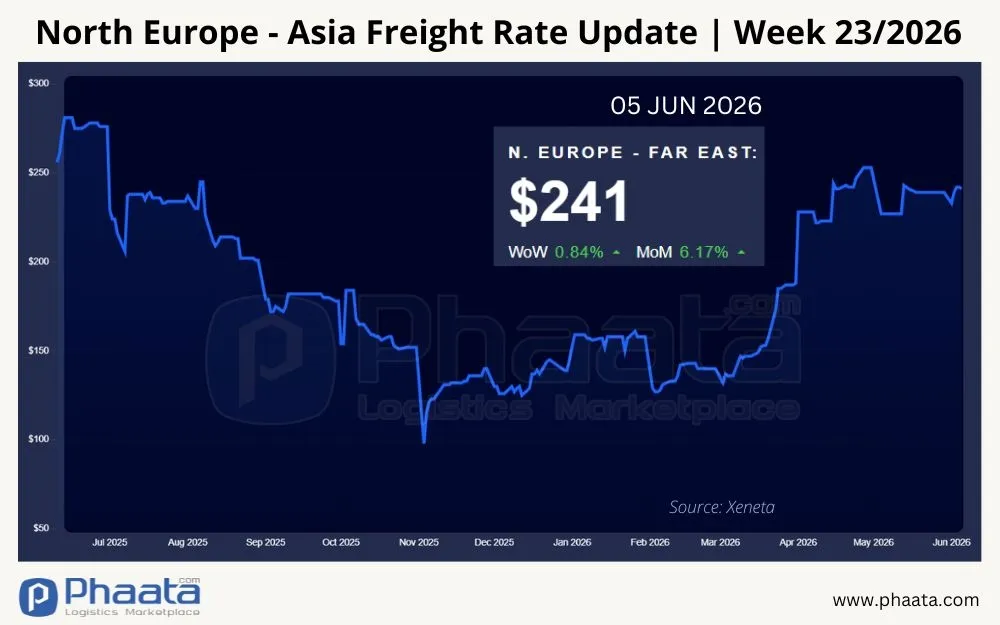
Container Freight rates from Northern Europe to Asia | Week 23/2026 (Photo: Phaata.com)
6. Conclusion and Recommendations from Phaata
The international logistics market in Week 23 continues to witness multiple factors simultaneously impacting global transport and trade operations.
In the container shipping market, freight rates continue to surge across major trade lanes. Drewry's WCI jumped 22.61% week-on-week, while rates on the Asia-Europe and Asia-North America routes surged by 28.41% and 25.37%, respectively. The primary driver is shippers' urge to front-load cargo ahead of surcharge adjustments in June and July, coupled with the fact that a portion of global transport capacity remains tied up by the Cape of Good Hope detours.
Operationally, empty container shortages continue to surface at select Asian export ports. Simultaneously, vessel utilization rates across multiple service loops remain high, elevating the risk of rolled cargo and extending wait times for late bookings.
Alongside transport volatility, the international trade environment is presenting additional factors that warrant close monitoring, particularly regarding US customs and tariff policy shifts. These adjustments could inflate compliance costs and directly impact import operations in the coming months.
Recommendations from Phaata
Amidst rapidly rising freight rates, shrinking capacity, and evolving trade regulations, import-export businesses must proactively review their transport plans and manage costs ahead of the upcoming peak season.
On Booking and Operations:
-
Proactively secure bookings earlier than standard practice, prioritizing reservations 3 to 4 weeks prior to the Estimated Time of Departure (ETD), especially on the Asia-North America and Asia-Europe routes.
-
For shipments with strict delivery requirements or those tied to continuous production schedules, businesses should consider utilizing Premium Services or selecting appropriate FAK rates to enhance the probability of space confirmation and empty container allocation.
-
When drafting delivery plans for June and July, account for the likelihood of rolled cargo, vessel delays, or prolonged transit times to mitigate risks affecting delivery schedules and commercial commitments.
On Customs Compliance and Tax Management:
-
Businesses importing into the United States should review their Importer of Record (IOR) structures and collaborate with customs brokers and relevant partners to assess compliance with the new requirements.
-
Proactively re-verify the HS/HTS codes of import/export items at risk of being impacted by new tariff measures. Concurrently, businesses should model cost scenarios to evaluate the impact of additional taxes on the Cost of Goods Sold (COGS) and business plans.
-
For IEEPA tax files, businesses should continue monitoring legal proceedings and maintain all protest or refund procedures as guided by authorities to safeguard financial interests once a final decision is reached.
Stay tuned to articles on Phaata.com or Phaata fanpage for rapid and in-depth market updates.
Find Freight Rates Here
Find Logistics Companies Here
See more:
- CMA CGM Hikes FAK Rates from the Indian Subcontinent to Latin America, Europe, and North Africa
- Q1 2026 Report: North American East Coast Ports Gain Market Share Despite Throughput Decline
- Container Freight Rates on Asia–U.S. Trades Surge as Importers Rush Shipments Ahead of New Tariff Measures
- Hapag-Lloyd Discontinues CCM Service Connecting Mexico and Central America from July 2026
- COSCO Orders Four LNG Carriers Worth USD 953 Million to Expand LNG Fleet
- Dry Bulk Shipping Market: Capesize Leads the Rally
- COSCO schedules: Vietnam - North America in Jun 2026
- COSCO updates Vietnam-Intra Asia sailing schedules in Jun 2026
- COSCO updates Vietnam-North Europe sailing schedules in Jun 2026
- SITC updates Vietnam-Intra Asia sailing schedules in Jun 2026
Source: Phaata - Vietnam's First International Logistics Marketplace
► Find Better Freight Rates & Logistics Service Providers!


Featured News
- Hapag-Lloyd applies Peak Season Surcharge from East Asia to USA and Canada
- The world\'s largest container ships MSC Irina and MSC Loreto floated
- MSC (Mediterranean Shipping Company) - The world\'s leading container shipping lines
- Information you need to know about Maersk Line
- Top 10 export and import goods between Vietnam - Philippines in the first 5 months of 2020

 Market News
See more
.webp)

.webp)
.webp)

.webp)

 HOT PROMO
See more
305
 FCL
FCL
 28 Days
 Freight cost

CÔNG TY TRÁCH NHIỆM HỮU HẠN DT LOGISTICS (VN)
863
FCL
28 Days
Freight cost

Công Ty TNHH Quanterm Logistics Vietnam
1102
FCL
33 Days
Freight cost

CÔNG TY TNHH TIẾP VẬN TOÀN CẦU KM
1213
 Other
Other

INTERLOG CORP - CÔNG TY CỔ PHẦN GIAO NHẬN TIẾP VẬN QUỐC TẾ
1044
FCL
35 Days
Freight cost

CÔNG TY TNHH INTERNATIONAL LOGISTICS GLORY (VIỆT NAM)
Why do thousands of businesses trust Phaata?
USERS/MONTH
LOGISTICS COMPANIES
REQUEST FOR QUOTEŚ
QUOTATIONS
VIETNAM LOGISTICS COMMUNITY
5 Steps to Get the Best Quote
Find a price quickly/Send a RFQ
Compare multiple options
Contact for Further Consultation
Negotiating prices/services
Management & rating
 Freight rates
Sea freight
- FCL
See more
8
20
Days Direct
- ₫320,202,300 / 40'RF

Ring International Transport JSC.
132
7
Days Direct
- ₫26,100,000 / 40'GP
- ₫26,100,000 / 40'HQ

CÔNG TY CỔ PHẦN TIẾP VẬN INTERCARGO
158
22
Days Transit
- ₫57,292,395 / 20'GP
- ₫111,806,175 / 40'GP
- ₫111,806,175 / 40'HQ
- ₫113,129,325 / 45'HQ

MELODY LOGISTICS COMPANY LIMITED
203
7
Days Transit
- ₫4,631,025 / 20'GP
- ₫10,585,200 / 40'HQ

GIA LINH LOGISTICS SERVICES CO., LTD. (G LINK Logistics)
722
28
Days Direct
- ₫76,345,755 / 20'GP
Công Ty TNHH Quanterm Logistics Vietnam
Sea freight
- LCL
See more
10
3
Days Direct
- ₫0 /cbm

CÔNG TY TNHH VẬN TẢI VÀ TIẾP VẬN TOÀN CẦU
1,316
4
Days Direct
- ₫0 /cbm

CÔNG TY CỔ PHẦN GIAO NHẬN VẬN TẢI HỒNG SƠN
2,078
5
Days Direct
- ₫0 /cbm
CÔNG TY TRÁCH NHIỆM HỮU HẠN DT LOGISTICS (VN)
2,519
 1,798
4
Days Direct
1,798
4
Days Direct
- ₫396,945 /cbm

CHI NHÁNH THÀNH PHỒ HỒ CHÍ MINH - CÔNG TY TNHH HECNY SHIPPING VIỆT NAM
 Air freight
- General cargo
Air freight
- General cargo
See more
551
1
Days Direct
- 46,310 ₫/kg

N.B.L INTERNATIONAL TRANSPORT CO., LTD
965
1
Days Direct
- 161,424 ₫/kg
CÔNG TY CỔ PHẦN GIAO NHẬN VẬN TẢI HỒNG SƠN
3,949
10
Days Transit
- 264,630 ₫/kg

Phoenix Logistics Vietnam - chi nhánh TP. Hồ Chí Minh (Phoenix International Forwarding Vietnam )
5,711
1
Days Direct
- 185,241 ₫/kg

CÔNG TY TNHH THƯƠNG MẠI VÀ DỊCH VỤ FASTRANS
8,439

 Rail freight
- FCL
Rail freight
- FCL
See more
1,942
5
Days Direct
- ₫44,987,100 / 40'HQ
- ₫44,987,100 / 45'HQ

CÔNG TY TNHH PHƯỚC TÁ
3,454
3
Days Direct
- ₫15,083,910 / 40'HQ

CÔNG TY CỔ PHẦN VẬN TẢI VÀ THƯƠNG MẠI ĐƯỜNG SẮT
13,923
7
Days Direct
- ₫48,956,550 / 20'GP

Công ty TNHH T&M Forwarding
12,730
5
Days Direct
- ₫7,145,010 / 20'GP

ASIAN EXPRESS LINE VIETNAM ( AEL VIET NAM )
9,520
10
Days Direct
- ₫9,262,050 / 20'GP

CÔNG TY CỔ PHẦN LOGISTICS QUỐC TẾ V&T
 Road freight
- FCL
Road freight
- FCL
See more
70
4
Day
- ₫5,000,000 / 40'GP

CÔNG TY CỔ PHẦN IGAP
2,049
1
Day
- ₫28,000,000 / 20'GP
- ₫28,000,000 / 40'GP

CÔNG TY TNHH THƯƠNG MẠI DỊCH VỤ VÀ KHO VẬN VIETTEL POST - TTC
3,926
4
Day
- ₫211,704 / 20'GP

CÔNG TY CỔ PHẦN KINH DOANH THƯƠNG MẠI VÀ DỊCH VỤ HỎA TỐC
46,823
1
Day
- ₫6,868,686 / 20'OT
- ₫6,868,686 / 40'OT
- ₫6,868,686 / 40'OT HQ

CÔNG TY TNHH LIÊN VẬN QUỐC TẾ SHINING OCEAN VIỆT NAM
104,188
2
Day
- ₫6,500,000 / 40'RF
- ₫6,500,000 / 40'RQ
- ₫6,500,000 / 45'RQ

CÔNG TY CP PROSHIP
 Premium


