


Monday, 23/02/2026, 09:16 (GMT +7)
 1313
1313
International Shipping and Logistics Market Update Week 8/2026 | Phaata

International shipping and logistics market update - Week 8/2026
Table of Contents
-
World Container Index Week 8/2026
-
Asia - North America Ocean Freight Rates
-
Asia - Europe Ocean Freight Rates
-
Northern America - Asia Ocean Freight Rates
-
Northern Europe - Asia Ocean Freight Rates
-
Conclusions and Recommendations by Phaata
1. World Container Index Week 8/2026
Drewry’s World Container Index (WCI) for Week 8/2026 (from Feb 16 to Feb 22, 2026) continued to decrease by 1% compared to the previous week, dropping to $1,919/FEU. This marks the sixth consecutive week of decline, albeit at a slower pace.
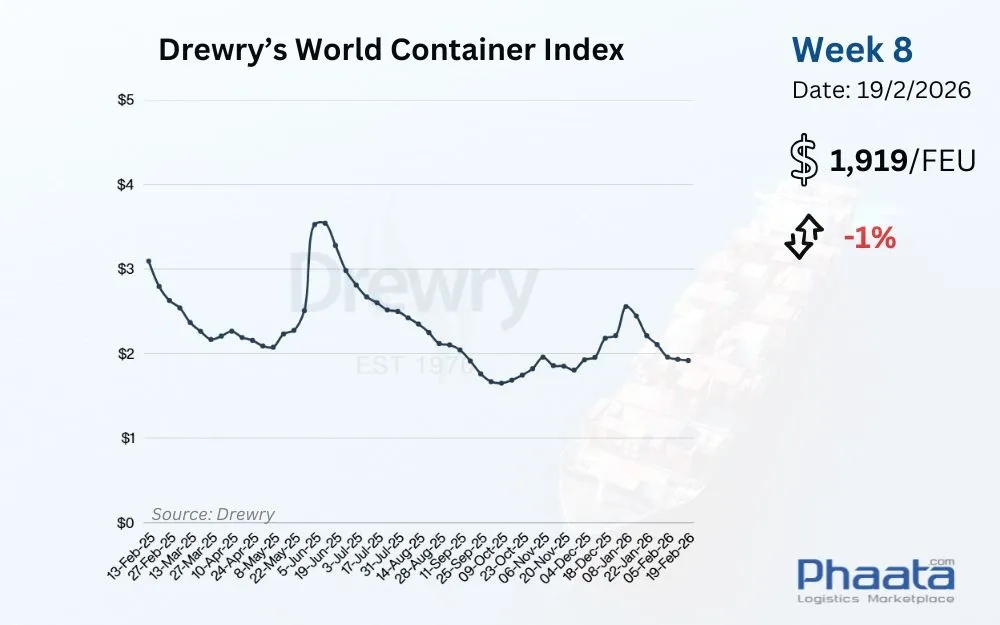
Drewry's World Container Index Week 8/2026 (Photo: Phaata)
2. Asia-North America Ocean Freight Rates
The Asia - North America West Coast market during the Lunar New Year week is at the bottom of its operational cycle. All activities, from production to vessel booking, are temporarily paused. However, beneath this tranquility, shipping lines are executing an extreme capacity-tightening campaign to protect freight rates. The biggest challenge for the market will arrive in the first half of March, when vessel supply recovers faster than the restart pace of factories, posing a risk of localized overcapacity.
Supply and Demand:
Demand Side:
Market demand is currently flat and has virtually bottomed out. The core reason is that most manufacturing plants across the Asian region have simultaneously closed for the Lunar New Year holiday. No new cargo volumes are being injected into the market.
Supply Side:
Post-Tet Capacity Tightening (Weeks 9 & 10): Carriers are strictly adhering to their previously outlined blank sailing programs. Total available capacity is being squeezed down to just 57% - 61% over the next two weeks. To optimize operational costs for the few remaining voyages, carriers are consolidating all rolled cargo from previous weeks to fill vessel space.
March Forecast (Oversupply Risk): Capacity is expected to see a V-shaped recovery, bouncing back to over 80% by the second week of March.
Warning: If factory demand does not recover at the same pace (it usually takes 2-4 weeks for factories to reach full capacity), the market will face localized oversupply in March. This will exert strong downward pressure on freight rates as soon as the market reopens.
Post-Tet Forecast: A large-scale blank sailing plan has been activated, starting from the last week of February and lasting through the first half of March. This is a capacity-tightening move aimed at preventing a sharp drop in freight rates while factories are closed.
Rate Developments:
Ocean Freight rates from Asia to the North America West Coast in Week 8/2026 (Feb 16–22) dropped sharply by 7.74% compared to the previous week, falling to $1,847/FEU. This rate is down 25.79% month-on-month, according to Xeneta data.
PSS Delayed to March: The Peak Season Surcharge (PSS) has been pushed back to March. However, given the oversupply forecast analyzed above, the successful implementation of the PSS in March remains a major question mark.
Stay tuned to Phaata International Logistics Marketplace for in-depth and fast market updates.

Asia-North America Freight Rates | Week 8/2026 (Photo: Phaata.com)
US Tariff Updates:
The market this week is heavily dominated by legal factors in Washington. The disruption from the partial US government shutdown is less concerning than the impending tariff rulings. If IEEPA tariffs are struck down, a massive stream of duty refunds will be unlocked. Conversely, transport costs risk ballooning due to the Trump administration's proposed new universal fee on foreign vessels.
1. IEEPA Ruling:
The US Supreme Court has ended its 4-week recess and is expected to rule on the legality of the IEEPA tariffs enacted by the Trump administration as early as Feb 20 (or Feb 24, 25).
Scenario 1 (US Government Loses): US Customs and Border Protection (CBP) will almost certainly stop collecting IEEPA duties immediately and must roll out a refund process. The Court may limit who is eligible for refunds. Meanwhile, the Trump administration could immediately deploy other legal tools (Section 301, 232, 338) to reimpose tariffs under a new guise.
Scenario 2 (US Government Wins or Partially Wins): The case could be remanded to a lower court for further review, or the Court might only strike down a portion of the tariff lists.
Commentary: During previous hearings, justices expressed skepticism about whether these tariffs were genuinely meant to "regulate imports" or merely an unauthorized form of "revenue raising" from the American public. Businesses need to immediately utilize duty refund calculation tools (like a Tariff Refund Calculator) to project cash flow scenarios.
2. Budget Crisis: CBP Still Operating Normally
The US government has been partially shut down since Feb 14 due to a budget impasse funding the Department of Homeland Security (DHS).
Fortunately, CBP operations are completely unaffected. Customs officers continue to process import/export clearances, handle Post Summary Corrections (PSCs), drawbacks, liquidations, and maintain the ACE system normally. Cargo will not be backlogged at ports due to this issue.
3. US - Taiwan Deal: Semiconductor Advantage but Auto Incentives Lost
The official trade agreement was signed on Feb 12 with notable changes from the initial memorandum:
15% Tariff: Taiwanese goods will be subject to a minimum total tariff of 15% (down from the previous 20% reciprocal tariff). Certain items under Annex III of Executive Order 14346 will be fully exempt from reciprocal tariffs.
Tech Advantage: Taiwan receives special preferential status in the Section 232 investigation on semiconductor chips, in exchange for a commitment to inject robust investments into the US electronics and AI supply chains.
Unfortunate "Drop-offs": The official text makes no mention of applying a 15% price cap (tariff ceiling) for Taiwanese auto parts and lumber (as promised in January). Auto parts enterprises must pay special attention to this detail.
4. Transport Cost Risks: New US Maritime Plan
On Feb 13, the Trump administration announced a "Maritime Action Plan," proposing a "Universal fee" on all foreign-built vessels calling at US ports. Though the final fee is not yet set, illustrative figures floated were $0.01/kg or $0.25/kg. If passed, this fee will undoubtedly be passed on by carriers directly into Ocean Freight rates or Port Dues/THC, sharply increasing the cost of landing goods in the US.
5. Other Key Updates
Europe (Ready to vote): The EU Parliament may vote to pass the trade agreement with the US on Feb 24. However, the EU has attached strict "safeguard clauses": It will cancel the agreement in 2028, or suspend it immediately if the US infringes on European territory, and will re-evaluate if the US does not reduce steel tariffs to 15% within 6 months.
"First Sale" Threat: The "Last Sale Valuation Act" (introduced Feb 11) continues to cast a shadow. If the First Sale rule is eliminated, the actual import tax burden on multi-tiered supply chains will skyrocket.
India (Tariff officially reduced): As of Feb 7, Indian goods have officially been freed from the 25% additional tariff. The US and India also announced a temporary framework agreement (Feb 6) to further reduce the reciprocal tariff to 18% and provide preferences for auto parts and pharmaceuticals.
Stay tuned to articles on the Phaata International Logistics Marketplace for rapid and in-depth market updates.
3. Asia-Europe Ocean Freight Rates
The Asia - North Europe market in Week 8 has entered the quietest phase of the cycle. Export volumes from Asia are temporarily "fractured" as factories close for Tet. To cope, shipping lines are fully utilizing this period to pull 40% of capacity out of the market. The paradox is that despite the lack of new cargo, the port network from Asia (Singapore) to North Europe (Rotterdam, Hamburg) remains on red alert for congestion.
On supply and demand:
Demand:
Export demand from Asia has completely halted due to the long holiday. The spot market is generating almost no new transactions.
Supply:
To prevent the risk of overcapacity when there is no cargo, carriers are managing this period very strictly. They are deploying an extremely aggressive blank sailing program, removing roughly 40% of weekly capacity to maintain vessel fill rates at a safe level.
This move serves two purposes: (1) Managing structural overcapacity and (2) Rebalancing the fleet against seasonal low demand, halting the freefall of freight rates.
On Operations:
The supply chain is choked at the two most critical ends, making transit times unpredictable.
At Asian Hub (Singapore):
Despite no new cargo, Singapore remains gridlocked. The cause is that the rolled cargo accumulated from the pre-Tet rush has not yet been fully cleared.
Yard utilization continues to linger at a critical level of over 90%.
At North Europe Hubs (Hamburg/Rotterdam):
Double Paralysis Severe winter weather continues to be the biggest barrier to operational flexibility. Both key ports report yard density at critical levels (>85%) and abnormally prolonged dwell times of 7 to 10 days.
Yard Utilization Details:
-
Rotterdam: The tension varies by terminal. APMT MVII has hit the 95% ceiling, RWG is at 85%, ECT at 80%, while Delta II still has buffer room at 45%.
-
Hamburg: Localized crisis with Eurogate CTH reaching 95% and HHLA CTA at 85%.
Freight Rate Developments:
Ocean freight rates from Asia to Europe in Week 8/2026 continued to decline by 3.66% week-on-week, down to $2,183/FEU. This rate is down 20.59% month-on-month, according to Xeneta data.
Spot rates are naturally softening in tandem with flat demand. However, the combination of blank sailing tactics and extended transit times via the Cape of Good Hope has successfully established a solid "price floor," significantly higher than the historical average.
Forecast: The market's post-Tet recovery speed will be the deciding variable for rate levels in March. Carriers are striving to anchor current rates to establish a higher baseline, creating an absolute advantage ahead of Q2 long-term contract negotiations if demand bounces back in early March.
Stay tuned to Phaata International Logistics Marketplace for in-depth and fast market updates.

Asia-Europe Freight Rates | Week 8/2026 (Photo: Phaata.com)
4. North America - Asia Ocean Freight Rates
Ocean freight rates from North America (West Coast) to Asia in Week 8/2026 reversed to decrease by 0.96% week-on-week, down to $618/FEU. This rate is up 0.65% month-on-month, per Xeneta data.

North America (West Coast) - Asia freight rates | Week 8/2026 (Photo: Phaata.com)
5. Northern Europe - Asia Ocean Freight Rates
Ocean freight rates from North Europe to Asia in Week 8/2026 reversed to decrease by 1.41%, down to $140/FEU compared to the previous week. This rate is down 11.39% month-on-month, according to Xeneta data.

Container Freight rates from Northern Europe to Asia | Week 8/2026 (Photo: Phaata.com)
6. Conclusion and Recommendations from Phaata
The logistics market in Week 8/2026 falls squarely within the Lunar New Year holiday. However, the calm in cargo volumes and spot rates (slight decrease) masks three underlying undercurrents that could reshape the entire cost structure in Q2:
Carrier "Capacity Squeeze": Even with no exports, the port network from Asia (Singapore) to North Europe (Rotterdam, Hamburg) is gridlocked (density >85-95%). Carriers are using this as an excuse, combined with blanking 40% of sailings, to create artificial scarcity, aiming to set a high "price floor" as a springboard for Q2 contract negotiations.
Localized Oversupply Risk (March): The phase mismatch in recovery speeds will be the Achilles' heel. Vessels will return to full capacity (over 80%) right in early March, while Asian factories need 2-4 weeks to reach 100% output. This will inevitably create a vacuum of "too many ships, too little cargo."
Legal Shock & US Tariff Volatility: If the US Supreme Court strikes down the IEEPA tariffs, a massive wave of duty refunds will be triggered. Conversely, the "Maritime Action Plan" universal fee on foreign vessels and the threat to eliminate the "First Sale" rule will push logistics costs for US imports to a new, expensive tier.
Recommendations from Phaata
Amidst this information noise, import-export businesses (Shippers/BCOs) should immediately apply the "Operational Defense - Negotiation Offense" tactic:
1. Delay Q2 Long-term Contract (NAC) Negotiations:
Do not rush to lock in long-term contract rates (NAC/Fixed Rates) in February while carriers are applying "artificial" price pressure.
Push the negotiation schedule back to mid-March. By then, the "localized oversupply" effect (when ships outnumber cargo) will reveal itself, giving you the upper hand to squeeze prices at the negotiating table and secure the best baseline rate for all of 2026.
2. Risk Management for Transshipment & Destination "Bottlenecks":
Any shipment requiring transshipment (transit) via Singapore over the next 3 weeks faces a risk of being stuck for 7-10 days. Boldly request your Forwarders to search the system for Direct Routing options or divert via Tanjung Pelepas/Port Klang.
With the paralysis at Hamburg and Rotterdam, the Documentation/CS departments must proactively notify European buyers, adding at least 10-14 days to the estimated Lead time to avoid violating late delivery penalty clauses.
3. Activate US Financial & Customs "Campaign" (Urgent):
This very week, Accounting and Legal teams must review all US import customs declarations that paid IEEPA tariffs. Put your Customs Broker on "standby" to file PSCs (Post Summary Corrections) the moment a favorable Supreme Court ruling is issued.
Given the risk of the US imposing a "universal fee" on foreign vessels, consider negotiating additional Surcharges exclusion clauses into your freight contracts so carriers/forwarders cannot "push" this fee into your enterprise's Local Charges.
Stay tuned to articles on Phaata.com or Phaata fanpage for rapid and in-depth market updates.
Find Freight Rates Here
Find Logistics Companies Here
See more:
- APM Terminals Expands Middle East Footprint via Strategic Investment in Jeddah Port
- Trump Triggers 'Plan B': 10% Global Tariff Imposed After Supreme Court Strikes Down Emergency Trade Powers
- US Supreme Court Strikes Down Trump's Global Tariffs, Leaving Supply Chains at a Crossroads
- International Shipping and Logistics Market Update Week 7/2026 | Phaata
- MSC Sets New Record with 7.2 Million TEU, Capturing 21.4% of Global Market Share
- FedEx Targets $98 Billion Revenue and 14% Profit Growth by 2029
- CK Hutchison Warns Maersk of Legal Repercussions Over Potential Balboa and Cristobal Takeover
- COSCO Shipping Launches New CPV Service: Slashing Transit Time from Yangpu Port to North America by 10 Days
- SITC Lines Launches VTX8 Express Service: Direct Ho Chi Minh – Moji Connection in Just 8 Days
- HMM 2025: Maintaining 'Solid' Margins Amidst Rate Plunge and Oversupply Pressure
- COSCO schedules: Vietnam - North America in Feb 2026
- SITC updates Vietnam-Intra Asia sailing schedules in Feb 2026
- COSCO updates Vietnam-North Europe sailing schedules in Feb 2026
Source: Phaata - Vietnam's First International Logistics Marketplace
► Find Better Freight Rates & Logistics Service Providers!


Featured News
- Hapag-Lloyd applies Peak Season Surcharge from East Asia to USA and Canada
- The world\'s largest container ships MSC Irina and MSC Loreto floated
- MSC (Mediterranean Shipping Company) - The world\'s leading container shipping lines
- Information you need to know about Maersk Line
- Top 10 export and import goods between Vietnam - Philippines in the first 5 months of 2020

 Market News
See more
.webp)
.webp)

.webp)
.webp)
_-_Copy_-_Copy.webp)

 HOT PROMO
See more
96
 FCL
FCL
 12 Days
 Freight cost

ASIAN EXPRESS LINE VIETNAM ( AEL VIET NAM )
290
FCL
24 Days
Freight cost

Compass Logistics
 Premium
1112
FCL
6 Days
Freight cost
Premium
1112
FCL
6 Days
Freight cost

CÔNG TY CỔ PHẦN TIẾP VẬN INTERCARGO
1916
FCL
5 Days
Freight cost

CÔNG TY TNHH VẬN CHUYỂN QUỐC TẾ N.B.L
3484
FCL
20 Days
Freight cost

N.B.L INTERNATIONAL TRANSPORT CO., LTD
Why do thousands of businesses trust Phaata?
USERS/MONTH
LOGISTICS COMPANIES
REQUEST FOR QUOTEŚ
QUOTATIONS
VIETNAM LOGISTICS COMMUNITY
5 Steps to Get the Best Quote
Find a price quickly/Send a RFQ
Compare multiple options
Contact for Further Consultation
Negotiating prices/services
Management & rating
 Freight rates
Sea freight
- FCL
See more
96
38
Days Transit
- ₫64,834,350 / 20'GP
- ₫120,406,650 / 40'GP
- ₫120,406,650 / 40'HQ

Công Ty TNHH Quanterm Logistics Vietnam
137
11
Days Direct
- ₫3,837,135 / 20'GP
- ₫6,880,380 / 40'GP
- ₫6,880,380 / 40'HQ

CÔNG TY TNHH SEAIR LINKS
184
12
Days Transit
- ₫6,120,960 / 20'GP
- ₫7,651,200 / 40'GP
- ₫7,651,200 / 40'HQ
ASIAN EXPRESS LINE VIETNAM ( AEL VIET NAM )
194
7
Days Direct
- ₫39,694,500 / 20'GP
- ₫39,694,500 / 40'GP

SUNIMEX logistics
119
14
Days Direct
- ₫58,218,600 / 40'HQ

CÔNG TY CỔ PHẦN DỊCH VỤ VÀ HẠ TẦNG Ô TÔ THÀNH CÔNG
Sea freight
- LCL
See more
1,009
 1,694
5
Days Direct
1,694
5
Days Direct
- ₫26,463 /cbm

CÔNG TY TNHH T&M FORWARDING - CHI NHÁNH HÀ NỘI
3,094
3
Days Direct
- Refund ₫926,205 /cbm

CÔNG TY CỔ PHẦN GIAO NHẬN VẬN TẢI HỒNG SƠN
3,614
3,661
3
Days Direct
- ₫132,315 /cbm

CÔNG TY TRÁCH NHIỆM HỮU HẠN DT LOGISTICS (VN)
 Air freight
- General cargo
Air freight
- General cargo
See more
4,131
1
Days Direct
- 46,310 ₫/kg
N.B.L INTERNATIONAL TRANSPORT CO., LTD
5,493
1
Days Direct
- 161,424 ₫/kg
CÔNG TY CỔ PHẦN GIAO NHẬN VẬN TẢI HỒNG SƠN
8,115
10
Days Transit
- 264,630 ₫/kg

Phoenix Logistics Vietnam - chi nhánh TP. Hồ Chí Minh (Phoenix International Forwarding Vietnam )
9,712
1
Days Direct
- 185,241 ₫/kg

CÔNG TY TNHH THƯƠNG MẠI VÀ DỊCH VỤ FASTRANS
9,507

 Rail freight
- FCL
Rail freight
- FCL
See more
5,457
5
Days Direct
- ₫44,987,100 / 40'HQ
- ₫44,987,100 / 45'HQ

CÔNG TY TNHH PHƯỚC TÁ
7,885
3
Days Direct
- ₫15,083,910 / 40'HQ

CÔNG TY CỔ PHẦN VẬN TẢI VÀ THƯƠNG MẠI ĐƯỜNG SẮT
17,948
7
Days Direct
- ₫48,956,550 / 20'GP

Công ty TNHH T&M Forwarding
16,634
5
Days Direct
- ₫7,145,010 / 20'GP
ASIAN EXPRESS LINE VIETNAM ( AEL VIET NAM )
10,499
10
Days Direct
- ₫9,262,050 / 20'GP

CÔNG TY CỔ PHẦN LOGISTICS QUỐC TẾ V&T
 Road freight
- FCL
Road freight
- FCL
See more
1,327
 7,880
1
Day
7,880
1
Day
- ₫28,000,000 / 20'GP
- ₫28,000,000 / 40'GP

CÔNG TY TNHH THƯƠNG MẠI DỊCH VỤ VÀ KHO VẬN VIETTEL POST - TTC
108,920
2
Day
- ₫6,500,000 / 40'RF
- ₫6,500,000 / 40'RQ
- ₫6,500,000 / 45'RQ

CÔNG TY CP PROSHIP
Premium
177,431
1
Day
- ₫18,997,200 / 20'GP
- ₫18,997,200 / 40'GP

CÔNG TY CỔ PHẦN GIAO NHẬN VẬN TẢI CON ONG
265,760
3
Day
- ₫32,000,000 / 20'GP
- ₫64,000,000 / 40'GP
- ₫64,000,000 / 40'HQ
- ₫64,000,000 / 45'HQ

Công ty Cổ phần phát triển thương mại Thuận Đạt Việt Nam


