


Monday, 16/02/2026, 11:14 (GMT +7)
 740
740
International Shipping and Logistics Market Update Week 7/2026 | Phaata

International shipping and logistics market update - Week 7/2026
Table of Contents
-
World Container Index Week 7/2026
-
Asia - North America Ocean Freight Rates
-
Asia - Europe Ocean Freight Rates
-
Northern America - Asia Ocean Freight Rates
-
Northern Europe - Asia Ocean Freight Rates
-
Conclusions and Recommendations by Phaata
1. World Container Index Week 7/2026
Drewry’s World Container Index (WCI) for Week 7/2026 (Feb 9 – Feb 15, 2026) continued to decline by 1% week-on-week, dropping to $1,933/FEU. This marks the fifth consecutive week of decline, driven primarily by softening rates on the Transpacific and Asia-Europe trade lanes.
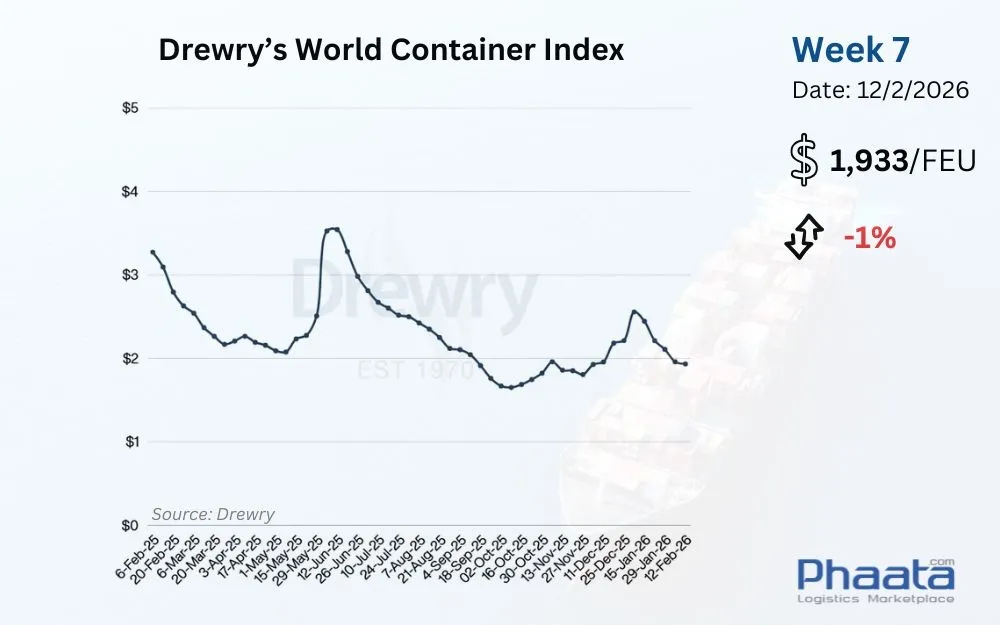
Drewry's World Container Index Week 7/2026 (Photo: Phaata)
2. Asia-North America Ocean Freight Rates
The Asia to North America West Coast market in the week leading up to Tet (Lunar New Year) is operating strictly according to seasonal patterns: Demand has bottomed out, and rates are flat. The strategic highlight of this week lies on the Supply side, where carriers have activated their most aggressive defensive options: cutting approximately ~40% of capacity over the next two weeks to cope with the post-Tet demand trough. The biggest risk is shifting to March, where an asynchronous recovery between vessels (fast) and cargo (slow) could create a short-term oversupply.
Supply and Demand:
Demand Side:
Demand is decelerating rapidly as factories across Asia begin closing production lines for the Tet holiday.
The final shipments have left port. The market is currently reduced to warehouse clearing activities.
Supply Side:
Post-Tet Phase (Weeks 9 & 10): Carriers have aggressively slashed capacity to just 57-61%. This is a deep cut achieved through blank sailings to "prop up prices" during the period of near-zero demand after the holiday.
Carriers are actively pooling rolled cargo and remaining inventory to fill the few vessels left on the schedule.
March Forecast (Oversupply Risk): Capacity is expected to see a V-shaped recovery, bouncing back to over 80% by the second week of March.
Warning: If factory demand does not recover at the same pace (it typically takes 3-4 weeks for factories to reach full capacity), we will face localized Oversupply in March. This would exert strong downward pressure on rates as soon as the market reopens.
Post-Tet Forecast: Large-scale blank sailing plans have been activated, starting from the last week of February and extending through the first half of March. This is a "belt-tightening" measure to prevent a rate collapse while factories are closed.
Rate Developments:
Ocean Freight rates from Asia to the North America West Coast in Week 7/2026 (Feb 9–15) continued to decrease but at a slower pace, dropping just 1.14% week-on-week to $2,002/FEU. This represents a 21.24% decrease month-on-month, according to Xeneta data.
Overall, the market shows no volatility. Rates have found a low equilibrium point before the holiday. All last-minute attempts to increase prices have been abandoned due to a lack of demand support.
PSS Delayed to March: The Peak Season Surcharge (PSS) has been pushed back to March. However, given the oversupply forecast analyzed above, the successful implementation of a PSS in March remains a major question mark.
Stay tuned to Phaata International Logistics Marketplace for in-depth and fast market updates.

Asia-North America Freight Rates | Week 7/2026 (Photo: Phaata.com)
US Tariff Updates:
This week, the sourcing map for textiles and industrial goods is shifting aggressively toward South Asia as the US rolls out successive tax incentives for India and Bangladesh. This creates direct competitive pressure on Vietnam and China. Simultaneously, in Washington, lawmakers are targeting customs valuation "loopholes," threatening to increase import costs across the board.
1. South Asian Boost: India & Bangladesh Receive US "Gifts"
This is a clear signal of the "Friend-shoring" strategy aimed at isolating China.
- India: Immediate Tax Cuts & Refund Opportunities
Under an agreement effective from Feb 7, the US officially removed the 25% additional tariff (previously applied due to India's purchase of Russian oil). The total effective tax rate drops to 25%. The next target is a reduction to 18% under the newly announced framework.
Refund Opportunity: For shipments imported into the US from Feb 7 onwards, US importers can file a PSC (Post Summary Correction) or Protest (within 180 days of liquidation) to claim refunds on excess duties paid.
The temporary framework dated Feb 6 promises preferential quotas for Indian auto parts and pharmaceuticals. Expected to be finalized by late March.
- Bangladesh: A New Textile Rival
Under an agreement dated Feb 9, the US reduced reciprocal tariffs for Bangladesh from 20% to 19%.
More important than the 1% cut, the US committed to waiving reciprocal tariffs for a specific textile quota. As the 4th largest textile supplier to the US, this gives Bangladesh a massive competitive advantage over Vietnam. In return, Bangladesh committed to purchasing $15 billion in energy and $3.5 billion in US agricultural products over 15 years.
2. Major Legal Risk: The Fate of the "First Sale" Rule
A legal "bomb" has just been activated in the US Senate, potentially changing how import duties have been calculated for decades.
On Nov 11, Senators Whitehouse and Cassidy introduced the "Last Sale Valuation Act."
Goal: To eliminate the "First Sale" rule.
-
Current: Importers pay tax based on the first purchase price from the factory (lower price), excluding the middleman's profit.
-
Proposal: Tax must be calculated based on the final transaction price before export to the US (usually much higher due to middleman markups).
Consequence: If passed, actual import duties will skyrocket even if tax rates remain unchanged. Multi-tiered supply chains, common in Asia, will suffer the heaviest damage.
3. US - Europe Relations: A "Conditional" Deal
The European Parliament has reached a consensus, with a vote expected on Feb 24.
EU Defensive Conditions:
-
Sunset Clause: The agreement automatically expires in March 2028 if not renewed.
-
Steel Ultimatum: If the US does not reduce derivative steel tariffs from 50% to 15% within 6 months, the EU will re-evaluate the entire deal.
-
Suspension Clause: The deal will be cancelled if the US acts against European territorial integrity (a reaction to the Greenland incident).
4. Geopolitical Tensions: Iran & Cuba
Iran Sanctions (Targeting China): An Executive Order on Feb 6 threatens punitive tariffs (expected 25%) on countries trading with Iran. China (buyer of 80% of Iranian oil) is Target #1.
Mexico "Backs Down": On Feb 9, the Mexican President announced a complete halt of oil exports to Cuba following US tariff threats. Cuba plunges into a severe energy crisis. This demonstrates that the US is using the "tariff stick" extremely effectively to coerce neighbors.
Stay tuned to articles on the Phaata International Logistics Marketplace for rapid and in-depth market updates.
3. Asia-Europe Ocean Freight Rates
The Asia - North Europe market in Week 7 (Feb 9 – Feb 15, 2026) has passed its demand peak. Now, the carrier's dilemma is managing the post-Tet demand trough and structural overcapacity. Carriers have aggressively cut up to 40% of total weekly capacity. However, a paradox exists: despite fewer ships, cargo is moving slowly due to severe congestion at key transshipment hubs (Singapore) and destination ports (North Europe).
On supply and demand:
Demand:
Spot demand is decelerating sharply. The final urgent shipments have left port. Manufacturing activity in China is slowing down in preparation for holiday closures.
Supply:
To respond to plummeting demand, carriers have activated an aggressive blank sailing program for February. Strategic objectives have shifted entirely from maximizing volume to managing utilization rates. At transshipment hubs like Singapore, carriers are proactively accumulating a rolling pool to ensure sufficient load factors for the few remaining vessels on the reduced schedule.
The market has immediately entered a phase of strong supply correction. Carriers are expected to cut approximately 40% of total weekly capacity. This move serves two purposes: (1) Managing structural overcapacity and (2) Rebalancing the fleet against seasonal low demand, preventing a freefall in rates.
On Operations:
The supply chain is being choked at both critical ends, making transit times unpredictable.
- Asian Hub (Singapore): Transshipment Hotspot
Transshipment pressure is rising dizzily due to accumulated rolled cargo and vessel bunching.
Warning Indicators: Dwell times have exceeded 7 days. Yard density has hit the critical 95% threshold. The ability to accept new containers is under threat.
- North Europe Hub (Hamburg/Rotterdam): Double Paralysis
Operational restrictions at destination ports are reducing actual efficiency. Harsh winter weather combined with vessel bunching is slashing berth productivity.
Warning Indicators: Yard density exceeds 85%. Dwell times have skyrocketed to 7–10 days, far above normal levels. Clearing cargo from the port is facing major difficulties.
Freight Rate Developments:
Ocean Freight rates from Asia to Europe in Week 7/2026 continued to decline but at a slower pace, dropping 3.70% week-on-week to $2,266/FEU. This represents a 20.13% decrease month-on-month, according to Xeneta data. Overall, rates are showing signs of softening as the demand peak passes.
Despite falling demand, rates are expected to remain stable because the dense blank sailing program (cutting 40% supply) combined with destination port congestion has absorbed the excess capacity, creating a "floor" for rates.
March Forecast: Carriers have announced significant FAK (Freight All Kinds) rate increases for March. This does not necessarily reflect real demand but is a technical move to establish a higher baseline price. Carriers want to use the March rate as leverage for upcoming Q2 long-term contract negotiations.
Stay tuned to Phaata International Logistics Marketplace for in-depth and fast market updates.
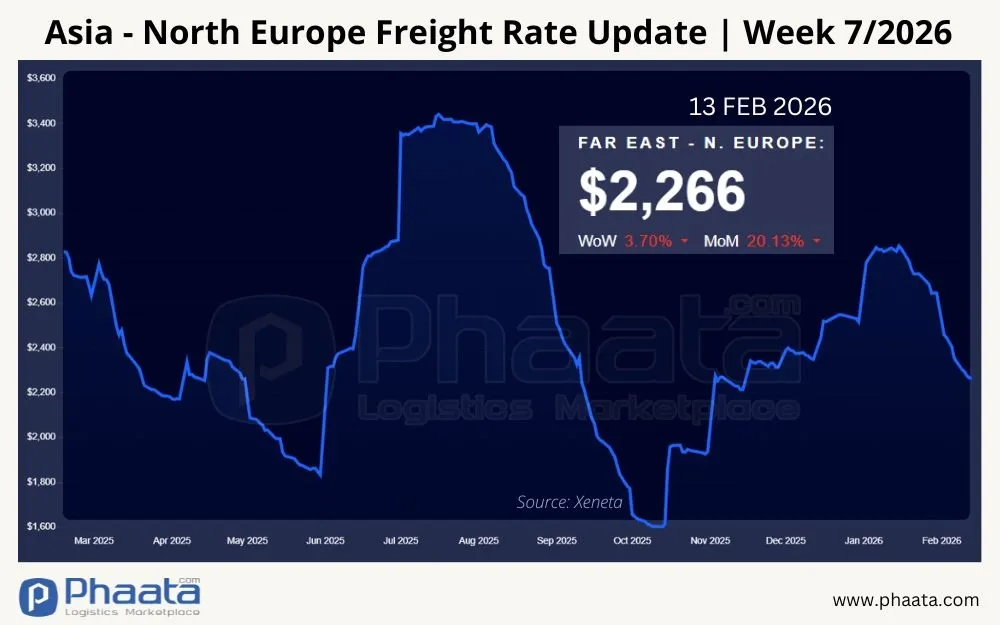
Asia-Europe Freight Rates | Week 7/2026 (Photo: Phaata.com)
4. North America - Asia Ocean Freight Rates
Ocean Freight rates from North America (West Coast) to Asia in Week 7/2026 reversed course to increase by 2.46% week-on-week, reaching $624/FEU. This represents a 3.31% increase month-on-month, according to Xeneta data.
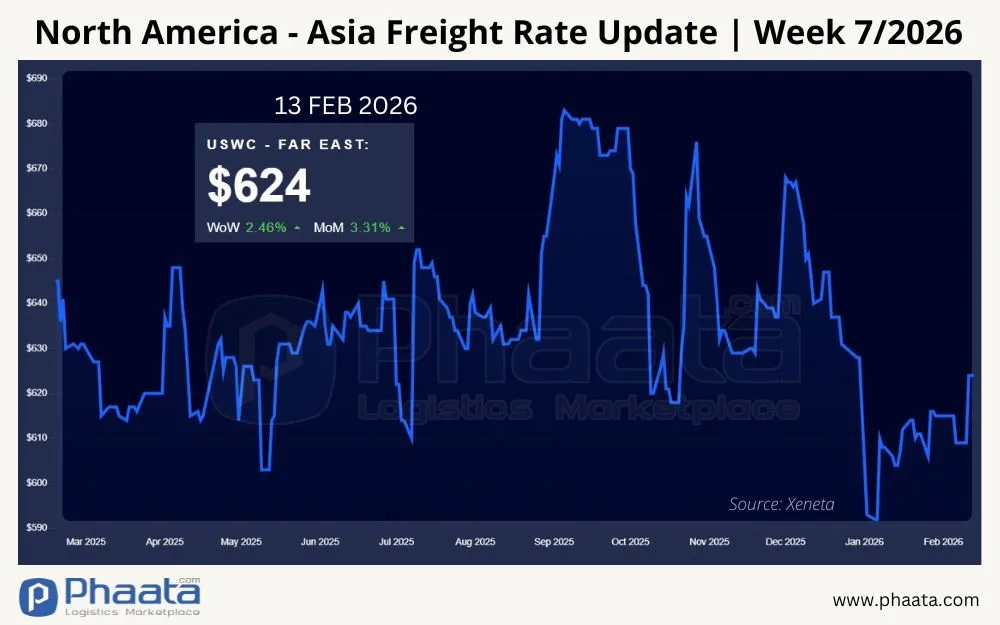
North America (West Coast) - Asia freight rates | Week 7/2026 (Photo: Phaata.com)
5. Northern Europe - Asia Ocean Freight Rates
Ocean Freight rates from North Europe to Asia in Week 7/2026 reversed course to increase sharply by 8.40%, reaching $142/FEU week-on-week. This represents a 9.55% decrease month-on-month, according to Xeneta data.
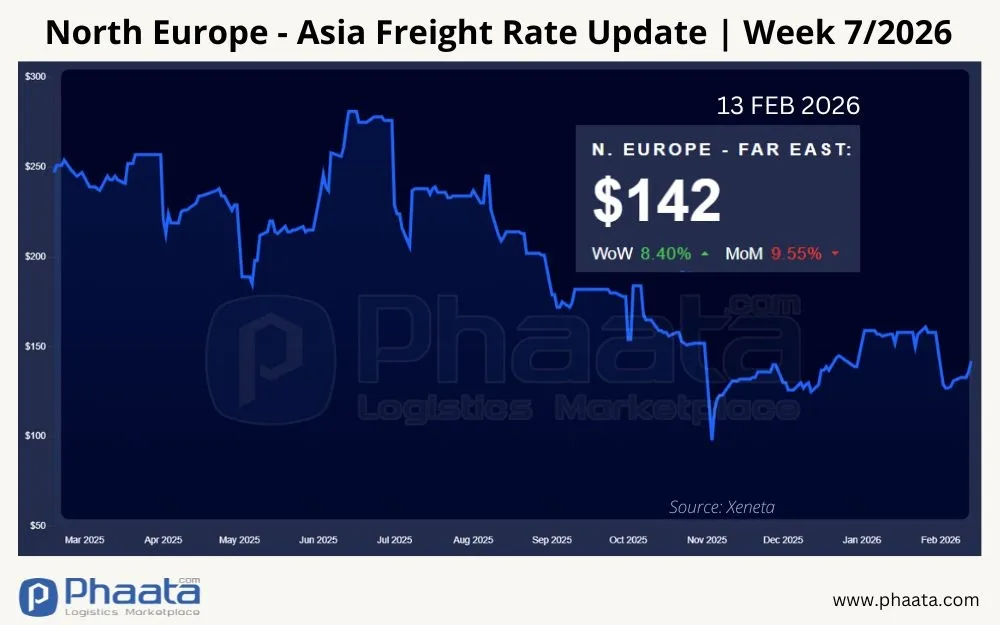
Container Freight rates from Northern Europe to Asia | Week 7/2026 (Photo: Phaata.com)
6. Conclusion and Recommendations from Phaata
The international logistics market in Week 7/2026 is defined by three core trends:
Active Supply "Bottlenecking": Carriers cutting up to 40% of capacity in the next two weeks (Weeks 9-10) is an extreme defensive move. They are accepting missed voyages to maintain prices. This means that immediately after Tet, even with low cargo volumes, securing space will be difficult.
"Double" Operational Congestion: Although rates are falling, service quality is deteriorating. With Singapore congested (dwell time >7 days) and North Europe paralyzed (density >85%), the Asia-Europe supply chain faces cumulative delays of up to 15-20 days.
South Asian Geopolitical Boost: The US removing punitive tariffs for India and offering textile incentives to Bangladesh poses a major challenge to the competitiveness of Vietnamese and Chinese goods. The global sourcing map is shifting decisively toward South Asia.
Recommendations from Phaata
1. Transport Tactics (Beware the March "Trap"):
Do not sign long-term contracts right now: Carriers are intentionally pushing March FAK rates high to anchor Q2 contract negotiations. Wait until mid-March, when the actual oversupply pressure becomes apparent; shippers will have a much better negotiating position.
Risk Management for Europe Bound Cargo: Given the congestion in Singapore and North Europe, add at least 15 days to the Lead time committed to customers. If possible, request logistics providers to book Direct services to avoid transshipment via Singapore next month.
2. Financial Tactics (Opportunities & Risks):
Refund Opportunity (India): US importers with goods from India clearing customs from Feb 7 should immediately file a PSC (Post Summary Correction) for a chance to reclaim the 25% excess duty.
"First Sale" Risk: US importers currently using the "First Sale" rule to optimize US import duties should immediately trigger meetings with legal experts. If the "Last Sale Valuation Act" passes, it will significantly increase tax costs. An alternative scenario needs to be prepared.
3. Competitive Strategy (Textile & Footwear):
Vietnamese exporters need to recognize that Bangladesh and India will be direct competitors with heightened competitive pressure due to these nations receiving new tax incentives from the US.
Focus on orders requiring Fast Fashion speed or high ESG standards—areas where South Asian competitors have not yet adapted—rather than competing purely on cheap prices.
Stay tuned to articles on Phaata.com or Phaata fanpage for rapid and in-depth market updates.
Find Freight Rates Here
Find Logistics Companies Here
See more:
- FedEx Targets $98 Billion Revenue and 14% Profit Growth by 2029
- CK Hutchison Warns Maersk of Legal Repercussions Over Potential Balboa and Cristobal Takeover
- COSCO Shipping Launches New CPV Service: Slashing Transit Time from Yangpu Port to North America by 10 Days
- SITC Lines Launches VTX8 Express Service: Direct Ho Chi Minh – Moji Connection in Just 8 Days
- HMM 2025: Maintaining 'Solid' Margins Amidst Rate Plunge and Oversupply Pressure
- Asia-US Container Rates Plummet, Signaling Prolonged Market Lull
- Maersk and Hapag-Lloyd Resume Suez Transits After 6-Month Lull
- International Shipping and Logistics Market Update Week 6/2026 | Phaata
- MSC, Zhonggu, and SITC Ramp Up Newbuilding Orders Across Multiple Size Segments
- SITC Increases Strong Profit and Market Share Growth in Intra-Asia Market
- International Shipping and Logistics Market Update Week 5/2026 | Phaata
- COSCO schedules: Vietnam - North America in Feb 2026
- SITC updates Vietnam-Intra Asia sailing schedules in Feb 2026
- COSCO updates Vietnam-North Europe sailing schedules in Feb 2026
Source: Phaata - Vietnam's First International Logistics Marketplace
► Find Better Freight Rates & Logistics Service Providers!


Featured News
- Hapag-Lloyd applies Peak Season Surcharge from East Asia to USA and Canada
- The world\'s largest container ships MSC Irina and MSC Loreto floated
- MSC (Mediterranean Shipping Company) - The world\'s leading container shipping lines
- Information you need to know about Maersk Line
- Top 10 export and import goods between Vietnam - Philippines in the first 5 months of 2020

 Market News
See more
.webp)

.webp)
.webp)

.webp)

 HOT PROMO
See more
106
 FCL
FCL
 25 Days
 Freight cost

N.B.L INTERNATIONAL TRANSPORT CO., LTD
547
FCL
28 Days
Freight cost

CÔNG TY TRÁCH NHIỆM HỮU HẠN DT LOGISTICS (VN)
1173
FCL
28 Days
Freight cost

Công Ty TNHH Quanterm Logistics Vietnam
1412
FCL
33 Days
Freight cost

CÔNG TY TNHH TIẾP VẬN TOÀN CẦU KM
1434
 Other
Other

INTERLOG CORP - CÔNG TY CỔ PHẦN GIAO NHẬN TIẾP VẬN QUỐC TẾ
Why do thousands of businesses trust Phaata?
USERS/MONTH
LOGISTICS COMPANIES
REQUEST FOR QUOTEŚ
QUOTATIONS
VIETNAM LOGISTICS COMMUNITY
5 Steps to Get the Best Quote
Find a price quickly/Send a RFQ
Compare multiple options
Contact for Further Consultation
Negotiating prices/services
Management & rating
 Freight rates
Sea freight
- FCL
See more
32
 119
13
Days Direct
119
13
Days Direct
- ₫64,834,350 / 20'GP
- ₫67,480,650 / 40'HQ

Compass Logistics
 Premium
107
25
Days Transit
Premium
107
25
Days Transit
- ₫63,140,718 / 20'GP
- ₫113,420,418 / 40'GP
- ₫113,420,418 / 40'HQ

CÔNG TY TNHH GRAND OCEAN LINE VIỆT NAM
102
36
Days Transit
- ₫82,696,875 / 20'GP
- ₫112,467,750 / 40'HQ

GIA LINH LOGISTICS SERVICES CO., LTD. (G LINK Logistics)
156
3
Days Direct
- ₫793,890 / 20'GP

CÔNG TY TNHH THƯƠNG MẠI VÀ DỊCH VỤ LƯU PHƯỚC LỘC
Sea freight
- LCL
See more
29
3
Days Direct
- ₫132,315 /cbm
CÔNG TY TRÁCH NHIỆM HỮU HẠN DT LOGISTICS (VN)
153
3
Days Direct
- ₫0 /cbm

CÔNG TY TNHH VẬN TẢI VÀ TIẾP VẬN TOÀN CẦU
1,481
4
Days Direct
- ₫0 /cbm

CÔNG TY CỔ PHẦN GIAO NHẬN VẬN TẢI HỒNG SƠN
2,672
 1,860
4
Days Direct
1,860
4
Days Direct
- ₫396,945 /cbm

CHI NHÁNH THÀNH PHỒ HỒ CHÍ MINH - CÔNG TY TNHH HECNY SHIPPING VIỆT NAM
 Air freight
- General cargo
Air freight
- General cargo
See more
649
1
Days Direct
- 46,310 ₫/kg
N.B.L INTERNATIONAL TRANSPORT CO., LTD
1,096
1
Days Direct
- 161,424 ₫/kg
CÔNG TY CỔ PHẦN GIAO NHẬN VẬN TẢI HỒNG SƠN
4,072
10
Days Transit
- 264,630 ₫/kg

Phoenix Logistics Vietnam - chi nhánh TP. Hồ Chí Minh (Phoenix International Forwarding Vietnam )
5,824
1
Days Direct
- 185,241 ₫/kg

CÔNG TY TNHH THƯƠNG MẠI VÀ DỊCH VỤ FASTRANS
8,474

 Rail freight
- FCL
Rail freight
- FCL
See more
2,028
5
Days Direct
- ₫44,987,100 / 40'HQ
- ₫44,987,100 / 45'HQ

CÔNG TY TNHH PHƯỚC TÁ
3,575
3
Days Direct
- ₫15,083,910 / 40'HQ

CÔNG TY CỔ PHẦN VẬN TẢI VÀ THƯƠNG MẠI ĐƯỜNG SẮT
14,035
7
Days Direct
- ₫48,956,550 / 20'GP

Công ty TNHH T&M Forwarding
12,834
5
Days Direct
- ₫7,145,010 / 20'GP

ASIAN EXPRESS LINE VIETNAM ( AEL VIET NAM )
9,550
10
Days Direct
- ₫9,262,050 / 20'GP

CÔNG TY CỔ PHẦN LOGISTICS QUỐC TẾ V&T
 Road freight
- FCL
Road freight
- FCL
See more
169
4
Day
- ₫5,000,000 / 40'GP

CÔNG TY CỔ PHẦN IGAP
2,213
1
Day
- ₫28,000,000 / 20'GP
- ₫28,000,000 / 40'GP

CÔNG TY TNHH THƯƠNG MẠI DỊCH VỤ VÀ KHO VẬN VIETTEL POST - TTC
4,078
4
Day
- ₫211,704 / 20'GP

CÔNG TY CỔ PHẦN KINH DOANH THƯƠNG MẠI VÀ DỊCH VỤ HỎA TỐC
46,968
1
Day
- ₫6,868,686 / 20'OT
- ₫6,868,686 / 40'OT
- ₫6,868,686 / 40'OT HQ

CÔNG TY TNHH LIÊN VẬN QUỐC TẾ SHINING OCEAN VIỆT NAM
104,278
2
Day
- ₫6,500,000 / 40'RF
- ₫6,500,000 / 40'RQ
- ₫6,500,000 / 45'RQ

CÔNG TY CP PROSHIP
Premium


