


Monday, 02/02/2026, 09:07 (GMT +7)
 1368
1368
International Shipping and Logistics Market Update Week 5/2026 | Phaata
International shipping and logistics market update - Week 5/2026
Table of Contents
-
World Container Index Week 5/2026
-
Asia - North America Ocean Freight Rates
-
Asia - Europe Ocean Freight Rates
-
Northern America - Asia Ocean Freight Rates
-
Northern Europe - Asia Ocean Freight Rates
-
Conclusions and Recommendations by Phaata
1. World Container Index Week 5/2026
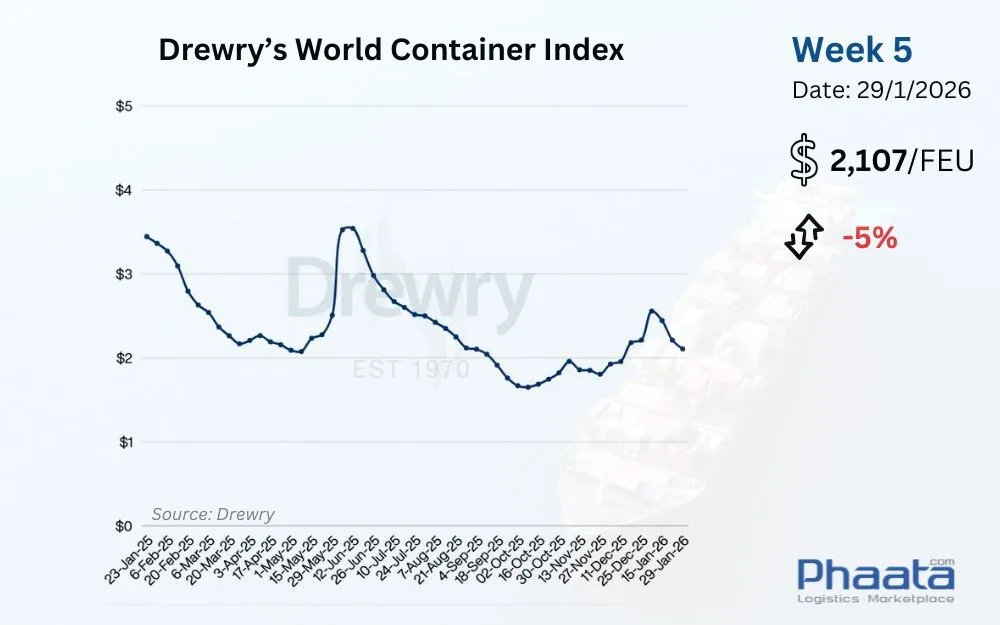
Drewry’s World Container Index (WCI) for Week 5/2026 (January 26 – February 1, 2026) continued to decline by 5% week-on-week, dropping to $2,107/FEU. This marks the third consecutive week of decline, primarily driven by falling rates on Transpacific and Asia-Europe trade lanes.
Drewry's World Container Index Week 5/2026 (Photo: Phaata)
2. Asia-North America Ocean Freight Rates
The Asia to North America West Coast market in the final week of January continues to operate in a state of "oversupply and lack of momentum." Despite being in the final sprint before the Lunar New Year, shipping pressure is virtually non-existent. The dispersion of demand over recent weeks, combined with the late arrival of Tet, has heavily impacted carriers' rate hike efforts. This is a golden time for shippers to negotiate good rates, but vigilance is required regarding the expected supply tightening immediately after the holiday.
Supply and Demand:
Demand Side:
Cargo volumes have maintained a steady pace since the post-holiday period in December, showing no signs of a boom.
This year, the pre-Tet peak followed a distinct script: it was pushed forward by 3-4 weeks and "spread out" due to the late holiday. Instead of creating volume spikes that cause congestion like in previous years, demand this year was distributed evenly, leaving the market devoid of the urgent pressure needed to maintain heat.
Supply Side:
Available capacity has been maintained at a high stable level, reaching 80-85% throughout January. This figure is expected to inch up to 90% in early February to serve last-minute bookings.
Currently, space is readily available at most major gateway ports. Cargo rolling is virtually non-existent, creating maximum favorable conditions for booking vessels.
However, shippers must pay special attention to the post-Tet capacity adjustment plan. A widespread blank sailing campaign is expected to begin from late February and extend to the first week of March. This is a technical move by carriers to cut excess capacity when demand plummets after the holiday.
Rate Developments:
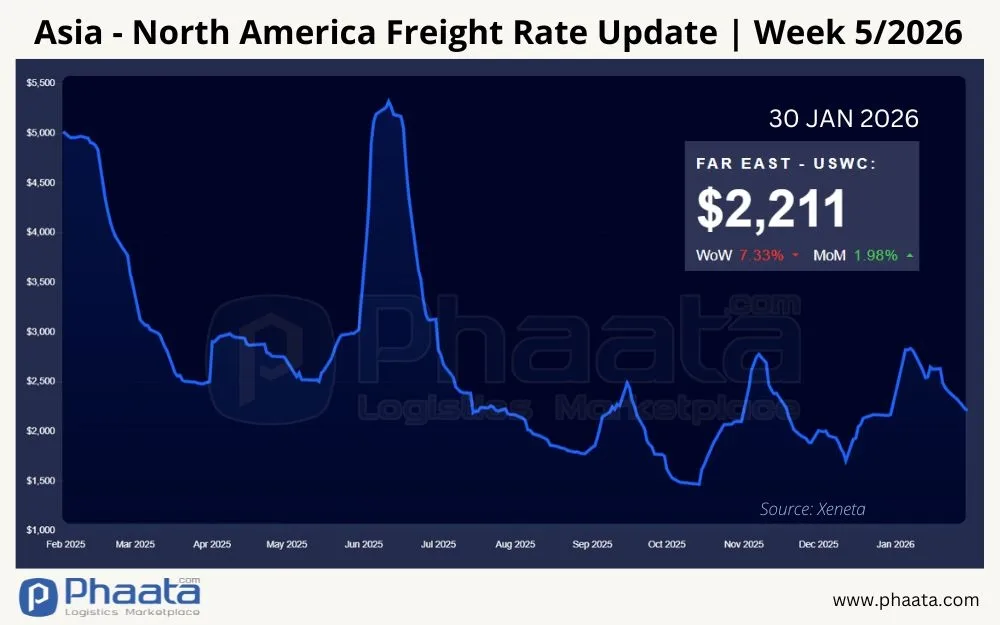
Ocean Freight rates from Asia to the North America West Coast in Week 5/2026 (Jan 26–Feb 1) continued to drop sharply by 7.33% week-on-week, falling to $2,211/FEU. This represents a 1.98% increase month-on-month, according to Xeneta data. The rate index is faithfully reflecting the "oversupply - lack of heat" condition.
February GRI Cancelled: The most notable move is that all carriers have withdrawn their General Rate Increase (GRI) announcements for February. Some carriers have even begun implementing additional rate reductions to attract cargo. This reflects a clear oversupply situation in the market, where space remains widely open even with Tet imminent.
PSS Delayed to March: Carriers have confirmed pushing the Peak Season Surcharge (PSS) back to March.
Phaata's Assessment: With Tet only about 2 weeks away, these actions show that there is no peak season in the current phase. Upward price pressure has been virtually eliminated.
Stay tuned to Phaata International Logistics Marketplace for in-depth and fast market updates.
Asia-North America Freight Rates | Week 5/2026 (Photo: Phaata.com)
US Tariff Updates:
This week, the market witnessed the formation of a new commercial pole: EU - India. This agreement is a resounding response from Brussels and New Delhi to rising protectionism from Washington. Conversely, US trade policy under President Trump remains unpredictable with threats of tariff hikes on South Korea and maintaining punitive tariffs on Canada, forcing supply chains to constantly remain on the "defensive."
1. Focal Event: Historic EU - India Trade Agreement
After 20 years of negotiations, on Jan 27, the two giants reached an agreement, expected to take effect in late 2026. This is a "game-changer" for the supply chain.
Deep Tariff Cuts:
-
India: Cuts/eliminates tariffs on 96.6% of EU exports. Highlights include reducing car tariffs from 110% to 10% (for a 250,000 vehicle quota) and opening the door for EU wine, olive oil, and machinery.
-
EU: Cuts/eliminates tariffs on 99.5% of Indian exports.
Immediate Impact: As soon as the agreement takes effect, the EU will eliminate tariffs on Indian Textiles, Footwear, Tea, and Coffee. This creates immense competitive pressure for Vietnamese textiles and agricultural products in the European market, as India enjoys equivalent preferences but possesses a larger production scale.
This deal helps India reduce reliance on the US market (where they face punitive tariffs up to 50% for buying Russian oil) and helps the EU diversify supply sources beyond China.
2. US - Allies Relations: "Carrot and Stick"
With Europe (EU): The 10% tariff risk (Greenland case) has been defused, but the US-EU trade agreement remains "frozen" by the European Parliament. The EU is expected to extend the suspension of retaliatory tariffs (worth €93 billion) for another 6 months. Businesses on both sides of the Atlantic have more breathing room.
With South Korea: President Trump accused South Korea of delaying investment disbursement ($20B cash + $150B shipbuilding). Risk of tariff hike from 15% to 25% on Korean cars, lumber, and general goods. Korean furniture (currently enjoying 15% duty) may also lose this advantage.
With Canada: Prime Minister Mark Carney publicly denied trade plans with China (regarding EVs and canola) after the US threatened an additional 100% tariff. Currently, Canadian goods entering the US are still subject to 35% IEEPA tariffs.
3. Compliance: Electronic Drawback "Deadline" (Feb 6)
There is less than 1 week left (next Friday, Feb 6) until US Customs and Border Protection (CBP) stops issuing paper drawback checks. Importers must activate their ACE Portal accounts immediately. Otherwise, drawback cash flow will be blocked indefinitely.
4. Other Updates
French Wine: Still in the crosshairs of a 200% tariff if France does not join the US "Board of Peace."
Taiwan (China): Remains a bright spot with a 15% preferential tariff and flexible import mechanism for the semiconductor industry (per the Jan 15 agreement).
High-end Chips: 25% tariff applied since Jan 15; businesses need to carefully review exemption cases (for Data Centers/R&D).
Stay tuned to articles on the Phaata International Logistics Marketplace for rapid and in-depth market updates.
3. Asia-Europe Ocean Freight Rates
The Asia - North Europe market in Week 5 (Jan 26 – Feb 1, 2026) is shifting from an "accelerating" state to an "accumulating" one. Urgent bookings for Tet cargo are basically complete. At this point, the carriers' game shifts to risk management: Accumulating backup cargo to fill vessels amidst the dense blank sailing schedule of February. However, supply chain efficiency is being held back by severe congestion at key transshipment hubs.
On supply and demand:
The market has passed the immediate pre-holiday peak. The current market focus is no longer "pushing cargo immediately" but rather schedule stability.
With most urgent orders finalized, carriers are prioritizing the accumulation of a rolling pool. This is an essential preparation step to ensure utilization rates do not drop throughout the widespread Blank Sailing program scheduled for February. This move aims to minimize the impact of Asian factory closures during the holiday.
February & Post-Tet Strategy (Weeks 8-9): Capacity is expected to drop from 1.15 million TEU to over 1 million TEU in February. Carriers have confirmed an aggressive blank sailing schedule for Weeks 8 and 9 (immediately post-Tet). This move aims to: (1) Manage the post-holiday demand void and (2) Anchor rates at high levels for leverage in upcoming long-term contract negotiations.
On Operations and Container Equipment Situation:
Network fluidity is being severely challenged by objective factors and overload conditions:
- Asian Hubs:
-
Singapore - Congestion Hotspot: Suffering knock-on effects from previous network incidents, Singapore is facing high-level congestion. Average dwell times increased to 7.1 days. Yard density remains at a critical 80%.
-
China - Weather Factor: Dense fog in the Yangtze River Delta is causing interruptions and delays of 2 to 3 days at the two gateway ports of Shanghai and Ningbo.
- North Europe Hubs: Density Crisis
Harsh winter weather combined with a flood of imports has paralyzed destination ports, slowing down landside flows.
Rotterdam (Netherlands) - Alarm Level:
-
ECT Terminal: Yard density at 95% (Gridlock threshold).
-
Maasvlakte II (APMT MVII): 90-95%.
-
RWG Terminal: 80-85%.
-
Consequence: Barge and feeder operations are severely restricted.
Hamburg (Germany) - Saturated: Density at Eurogate Container Terminal (CTH) has exceeded 95%. Evacuation speed is heavily impacted.
Freight Rate Developments:
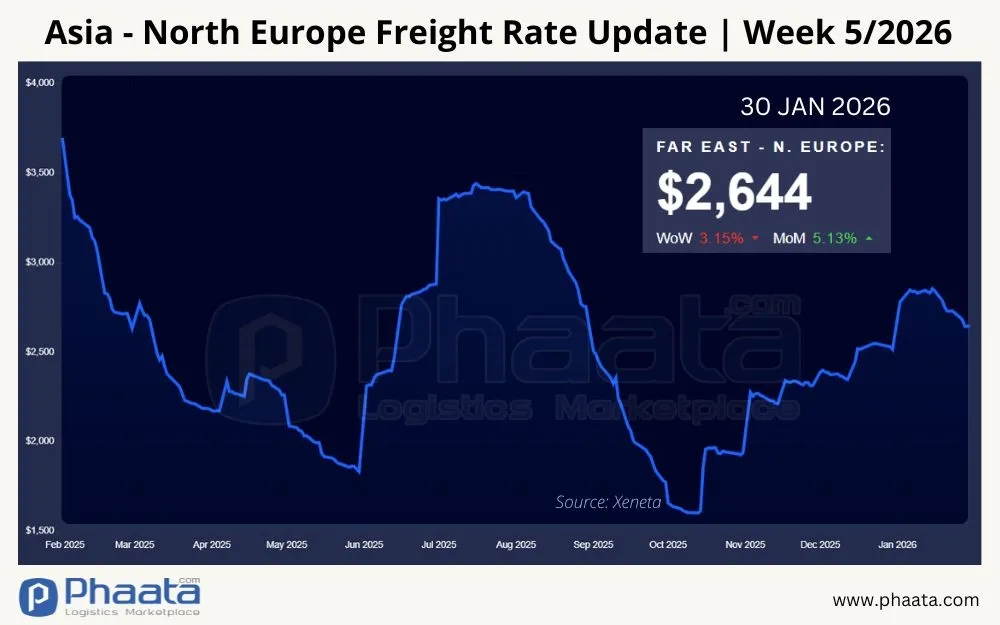
Ocean Freight rates from Asia to Europe in Week 5/2026 continued to decline by 3.15% to $2,644/FEU. This represents a 5.13% increase month-on-month, according to Xeneta data. This is a natural correction as demand urgency has passed and the market looks toward bookings for mid-February shipments (post-Tet).
Pricing Strategy: Carriers have shifted from a "hot price hike" strategy to "rate defense." Instead of trying to push prices higher, major carriers are adjusting rates to a stable baseline to retain customers and ensure stable volume for the low-volume month of February.
Short-term Forecast: Sharp volatility will give way to stability. With February supply sharply cut through blank sailings, Phaata predicts rates are likely to be anchored; a deep rate collapse is unlikely.
Stay tuned to Phaata International Logistics Marketplace for in-depth and fast market updates.
Asia-Europe Freight Rates | Week 5/2026 (Photo: Phaata.com)
4. North America - Asia Ocean Freight Rates
Ocean Freight rates from North America (West Coast) to Asia in Week 5/2026 reversed to an increase of 0.65% week-on-week, reaching $615/FEU. This represents a 2.07% decrease month-on-month, according to Xeneta data.
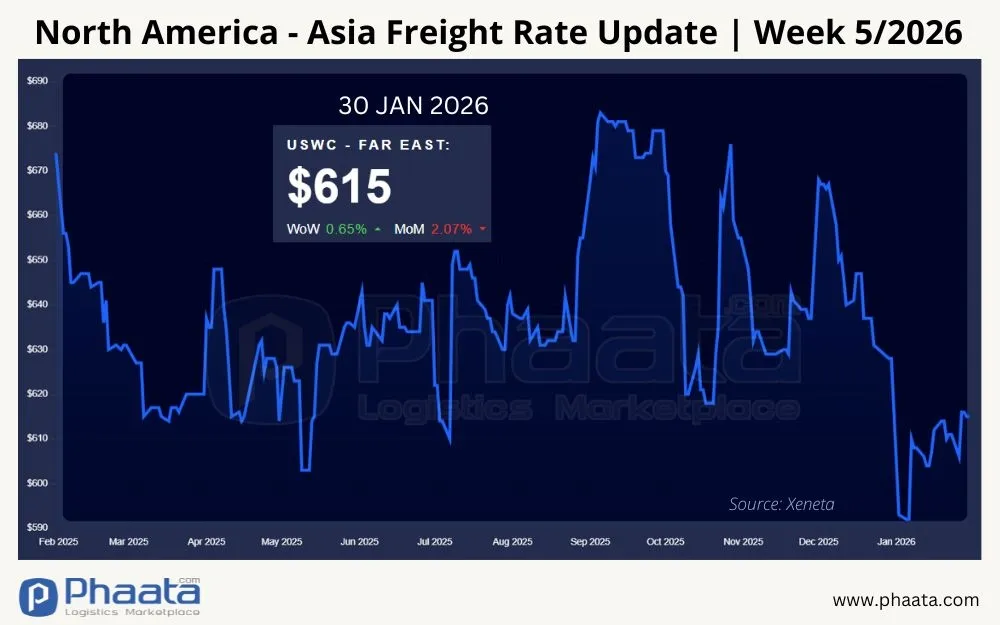
North America (West Coast) - Asia freight rates | Week 5/2026 (Photo: Phaata.com)
5. Northern Europe - Asia Ocean Freight Rates
Ocean Freight rates from North Europe to Asia in Week 5/2026 reversed to a slight increase of 0.64%, reaching $158/FEU week-on-week. This represents a 13.67% increase month-on-month, according to Xeneta data.

Container Freight rates from Northern Europe to Asia | Week 5/2026 (Photo: Phaata.com)
6. Conclusion and Recommendations from Phaata
The international logistics market in Week 5/2026 is defined by 3 core trends:
Negotiating Power Belongs to Shippers (Short Term): The WCI dropping for the 3rd consecutive week and the cancellation of the February GRI confirm that the 2026 Tet peak season has "died young." Excess capacity has triumphed over carrier rate hike efforts. This is the best opportunity in the last 6 months to lock in low rates.
Touchpoint Crisis: Although rates are falling, cargo movement is slowing. Congestion in Singapore (7-day dwell) and North Europe (95% density) creates severe delivery delay risks. "Cheap rates" are coming with "high risks."
Supply Chain Restructuring: The EU-India agreement is an early warning for Vietnamese exporters. A direct competitor (India) is about to be "unshackled" from tariffs into the world's largest market, requiring us to upgrade competitive strategies immediately.
Recommendations from Phaata
1. US Trade Tactics:
With PSS moved to March, require your logistics service provider/freight forwarder to remove all peak season surcharges (if any). Leverage the oversupply status to ask for extra Free Time at the destination port to hedge against future port congestion.
Post-Tet Plan: Do not be complacent. Carriers will implement blank sailings aggressively from the second half of February. Book space for shipments departing in Weeks 8 and 9 right now to avoid getting rolled when supply suddenly drops.
2. Europe Trade Tactics:
Avoid Singapore: If possible, prioritize Direct services from Vietnam to Europe, avoiding transshipment via Singapore for the next 2 weeks to avoid getting stuck for 7 days there.
Destination Risk Management: With 95% yard density at Hamburg/Rotterdam, add 7 days to the expected Lead time when committing to customers.
3. Long-Term Competitive Strategy (EU - India):
Vietnamese Textile, Footwear, and Agricultural businesses need to closely monitor the tariff reduction roadmap of the EU-India Agreement. Shift focus to Green Certificates (ESG) and traceability, as these are non-tariff barriers that India may not catch up with immediately, helping Vietnamese businesses maintain market share.
4. Financial Compliance (Feb 6 Deadline):
There are only a few days left until CBP stops issuing drawback checks. US importers need to ask their accounting department to check the ACE Portal account today. Do not let corporate cash flow be blocked simply due to administrative delays.
Stay tuned to articles on Phaata.com or Phaata fanpage for rapid and in-depth market updates.
Find Freight Rates Here
Find Logistics Companies Here
See more:
- Port of Savannah Wraps Up 2025 with Second-Highest Throughput in History
- COSCO schedules: Vietnam - North America in Feb 2026
- SITC updates Vietnam-Intra Asia sailing schedules in Feb 2026
- COSCO updates Vietnam-North Europe sailing schedules in Feb 2026
- Port of Singapore 2025: Setting Double Records in Container Throughput and Bunkering
- International Shipping and Logistics Market Update Week 4/2026 | Phaata
- Indian Logistics Sector Eyes Policy Stability and Infrastructure Push in 2026
- CNC Enhances JTX Service: Direct Call to Sihanoukville and Optimized Transshipment via Vung Tau
- DHL Global Forwarding Launches Multimodal 'Truck-Air' Service: A New Bridge for the Asia-Europe Route
Source: Phaata - Vietnam's First International Logistics Marketplace
► Find Better Freight Rates & Logistics Service Providers!


Featured News
- Hapag-Lloyd applies Peak Season Surcharge from East Asia to USA and Canada
- The world\'s largest container ships MSC Irina and MSC Loreto floated
- MSC (Mediterranean Shipping Company) - The world\'s leading container shipping lines
- Information you need to know about Maersk Line
- Top 10 export and import goods between Vietnam - Philippines in the first 5 months of 2020

 Market News
See more
.webp)
.webp)
.webp)
.webp)
_-_Copy_-_Copy.webp)

 HOT PROMO
See more
115
 FCL
FCL
 12 Days
 Freight cost

ASIAN EXPRESS LINE VIETNAM ( AEL VIET NAM )
312
FCL
24 Days
Freight cost

Compass Logistics
 Premium
1133
FCL
6 Days
Freight cost
Premium
1133
FCL
6 Days
Freight cost

CÔNG TY CỔ PHẦN TIẾP VẬN INTERCARGO
1936
FCL
5 Days
Freight cost

CÔNG TY TNHH VẬN CHUYỂN QUỐC TẾ N.B.L
3489
FCL
20 Days
Freight cost

N.B.L INTERNATIONAL TRANSPORT CO., LTD
Why do thousands of businesses trust Phaata?
USERS/MONTH
LOGISTICS COMPANIES
REQUEST FOR QUOTEŚ
QUOTATIONS
VIETNAM LOGISTICS COMMUNITY
5 Steps to Get the Best Quote
Find a price quickly/Send a RFQ
Compare multiple options
Contact for Further Consultation
Negotiating prices/services
Management & rating
 Freight rates
Sea freight
- FCL
See more
118
38
Days Transit
- ₫64,834,350 / 20'GP
- ₫120,406,650 / 40'GP
- ₫120,406,650 / 40'HQ

Công Ty TNHH Quanterm Logistics Vietnam
160
11
Days Direct
- ₫3,837,135 / 20'GP
- ₫6,880,380 / 40'GP
- ₫6,880,380 / 40'HQ

CÔNG TY TNHH SEAIR LINKS
207
12
Days Transit
- ₫6,120,960 / 20'GP
- ₫7,651,200 / 40'GP
- ₫7,651,200 / 40'HQ
ASIAN EXPRESS LINE VIETNAM ( AEL VIET NAM )
218
7
Days Direct
- ₫39,694,500 / 20'GP
- ₫39,694,500 / 40'GP

SUNIMEX logistics
130
14
Days Direct
- ₫58,218,600 / 40'HQ

CÔNG TY CỔ PHẦN DỊCH VỤ VÀ HẠ TẦNG Ô TÔ THÀNH CÔNG
Sea freight
- LCL
See more
1,028
 1,715
5
Days Direct
1,715
5
Days Direct
- ₫26,463 /cbm

CÔNG TY TNHH T&M FORWARDING - CHI NHÁNH HÀ NỘI
3,112
3
Days Direct
- Refund ₫926,205 /cbm

CÔNG TY CỔ PHẦN GIAO NHẬN VẬN TẢI HỒNG SƠN
3,628
3,666
3
Days Direct
- ₫132,315 /cbm

CÔNG TY TRÁCH NHIỆM HỮU HẠN DT LOGISTICS (VN)
 Air freight
- General cargo
Air freight
- General cargo
See more
4,146
1
Days Direct
- 46,310 ₫/kg
N.B.L INTERNATIONAL TRANSPORT CO., LTD
5,510
1
Days Direct
- 161,424 ₫/kg
CÔNG TY CỔ PHẦN GIAO NHẬN VẬN TẢI HỒNG SƠN
8,129
10
Days Transit
- 264,630 ₫/kg

Phoenix Logistics Vietnam - chi nhánh TP. Hồ Chí Minh (Phoenix International Forwarding Vietnam )
9,724
1
Days Direct
- 185,241 ₫/kg

CÔNG TY TNHH THƯƠNG MẠI VÀ DỊCH VỤ FASTRANS
9,508

 Rail freight
- FCL
Rail freight
- FCL
See more
5,470
5
Days Direct
- ₫44,987,100 / 40'HQ
- ₫44,987,100 / 45'HQ

CÔNG TY TNHH PHƯỚC TÁ
7,899
3
Days Direct
- ₫15,083,910 / 40'HQ

CÔNG TY CỔ PHẦN VẬN TẢI VÀ THƯƠNG MẠI ĐƯỜNG SẮT
17,960
7
Days Direct
- ₫48,956,550 / 20'GP

Công ty TNHH T&M Forwarding
16,645
5
Days Direct
- ₫7,145,010 / 20'GP
ASIAN EXPRESS LINE VIETNAM ( AEL VIET NAM )
10,500
10
Days Direct
- ₫9,262,050 / 20'GP

CÔNG TY CỔ PHẦN LOGISTICS QUỐC TẾ V&T
 Road freight
- FCL
Road freight
- FCL
See more
1,344
 7,905
1
Day
7,905
1
Day
- ₫28,000,000 / 20'GP
- ₫28,000,000 / 40'GP

CÔNG TY TNHH THƯƠNG MẠI DỊCH VỤ VÀ KHO VẬN VIETTEL POST - TTC
108,943
2
Day
- ₫6,500,000 / 40'RF
- ₫6,500,000 / 40'RQ
- ₫6,500,000 / 45'RQ

CÔNG TY CP PROSHIP
Premium
177,448
1
Day
- ₫18,997,200 / 20'GP
- ₫18,997,200 / 40'GP

CÔNG TY CỔ PHẦN GIAO NHẬN VẬN TẢI CON ONG
265,769
3
Day
- ₫32,000,000 / 20'GP
- ₫64,000,000 / 40'GP
- ₫64,000,000 / 40'HQ
- ₫64,000,000 / 45'HQ

Công ty Cổ phần phát triển thương mại Thuận Đạt Việt Nam


