


Tuesday, 30/06/2026, 08:00 (GMT +7)
 1222
1222
International Shipping and Logistics Market Update Week 26/2026 | Phaata
International shipping and logistics market update - Week 26/2026
Table of Contents
-
World Container Index Week 26/2026
-
Asia - North America Ocean Freight Rates
-
Asia - Europe Ocean Freight Rates
-
Northern America - Asia Ocean Freight Rates
-
Northern Europe - Asia Ocean Freight Rates
-
Conclusions and Recommendations by Phaata
1. World Container Index Week 26/2026
Drewry’s World Container Index (WCI) for Week 26/2026 (from June 22 to June 28, 2026) maintained its upward trajectory, increasing by 4.96% compared to the previous week to reach $4,166/FEU.
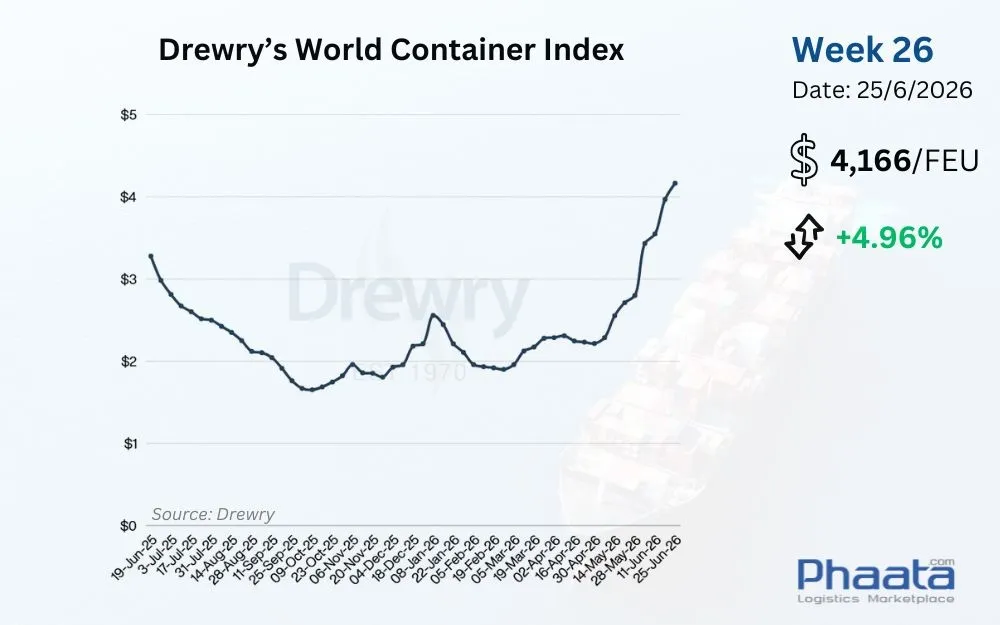
Drewry's World Container Index Week 26/2026 (Photo: Phaata)
2. Asia-North America Ocean Freight Rates
Supply and Demand:
Operational Capacity and Space Availability: The blank sailing ratio on the Trans-Pacific route dropped to around 7% in Week 26, down from 9% the previous week, indicating that carriers are gradually injecting capacity back into the market. However, space remains tightly constrained across most gateways. Notably, services to the U.S. East Coast (USEC) and the Gulf Coast continue to record higher fill rates than the U.S. West Coast (USWC), keeping the risk of cargo rollovers present on certain sailings.
Panama Canal Operational Updates: The Panama Canal Authority is scheduled to adjust the operational draft limit for Neopanamax vessels starting July 3. To adapt, many carriers have begun imposing cargo weight restrictions on vessels transiting the Canal. This adjustment will reduce the effective payload capacity of select sailings, particularly on loops connecting to the U.S. East Coast.
Transport Demand and Export Trends: Trans-Pacific demand remained robust throughout June. The mid-month rate hikes implemented by carriers prompted many shippers to front-load their delivery schedules and secure bookings before the new rates took effect. Consequently, space on USEC and Gulf Coast routes filled up rapidly, with many late-June departures reaching or nearing full operational capacity.
Rate Developments:
Ocean freight rates from Asia to the North America West Coast in Week 26/2026 increased by 7.41% week-on-week, reaching $5,958/FEU. This represents an 84.86% surge compared to the previous month, according to Xeneta data.
Ocean Freight Rate Trends: The Shanghai Containerized Freight Index (SCFI) continued to climb in Week 26. On the USWC route, the index rose by approximately 10% week-on-week, marking the sixth consecutive week of gains. The USEC route recorded a similar 10% increase. These movements align with other benchmark indices in the market, demonstrating that the freight rate baseline remains highly elevated.
Base Rates and Surcharges: Since June 15, carriers have maintained the newly established spot rates while implementing the Peak Season Surcharge (PSS) on various service contracts, exactly as announced. To date, these base rates and surcharges have remained relatively stable across most Trans-Pacific trade lanes.
Stay tuned to Phaata International Logistics Marketplace for in-depth and fast market updates.
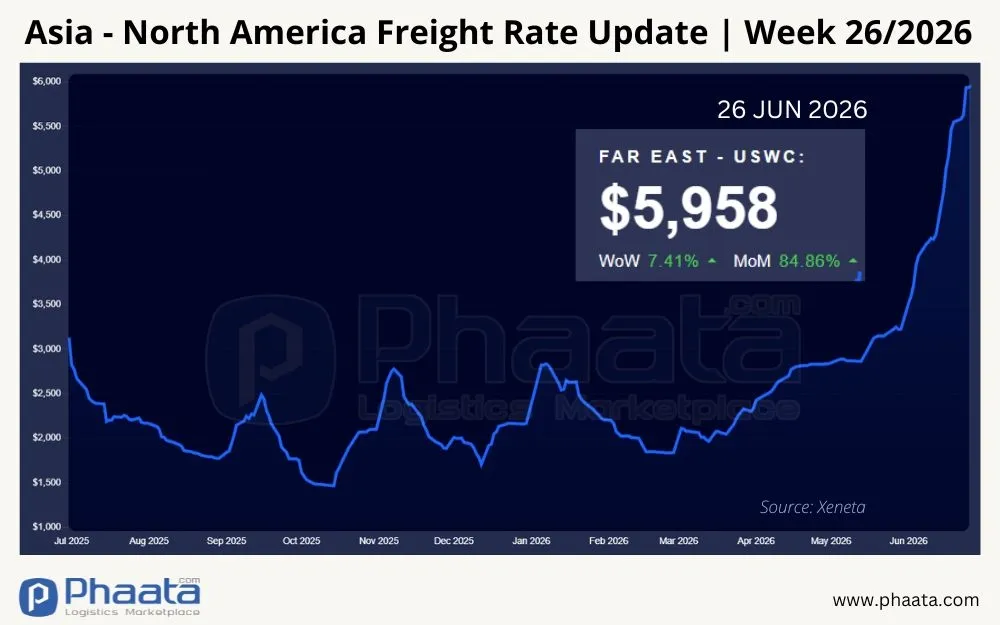
Asia-North America Freight Rates | Week 26/2026 (Photo: Phaata.com)
US Tariff Updates:
1. Launch of CAPE Refund System (IEEPA) Phase 2 starting June 29 U.S. Customs and Border Protection (CBP) officially announced the rollout of Phase 2 for the Centralized Account Processing and Management Environment (CAPE) for IEEPA tax refunds. This update expands the system's scope to accept a new batch of eligible entries.
-
Applicable Scope: Phase 2 will begin accepting reconciliation-flagged entries (types 01, 02, and 06) for which a reconciliation entry (type 09) has not yet been filed. Similar to Phase 1, the system currently only processes unliquidated entries or those within an 80-day window from their liquidation date.
-
Process Coordination Note: Reconciliation-flagged entries that already have an associated type 09 entry in the system will be temporarily excluded from Phase 2 processing. When CAPE accepts an entry, the system automatically unbundles the IEEPA tax calculation from the original entry, allowing the importer to file the reconciliation entry subsequently. CAPE's acceptance of the entry serves as confirmation that related declaration obligations are fulfilled once the reconciliation is submitted.
-
Operational Recommendation: For importers with reconciliation entries due within the next 30 days, documentation teams should prioritize finalizing the reconciliation filings before pushing data to the CAPE system.
2. USMCA Review Progress Between the US and Mexico Following three days of bilateral discussions in Washington, the U.S. and Mexico issued a joint statement on June 18, acknowledging substantive progress ahead of the formal review session scheduled for July 1.
-
Negotiation Focus: Both parties conducted in-depth discussions on Rules of Origin (ROO) for specific industrial goods and provisions related to economic security. Concurrently, preliminary exchanges regarding agriculture, labor, environment, and trade for the steel, aluminum, and automotive sectors were initiated.
-
Upcoming Roadmap: The two nations agreed to establish a committee to review the implementation of Chapter 12 (Sectoral Annexes) to enhance regulatory compatibility. It should be noted that July 1 marks the beginning of the review process to refine the agreement, not its expiration date.
-
Extension Outlook: Currently, both Canada and Mexico have expressed support for extending the agreement by another 16 years; however, the U.S. is still deliberating. Should the U.S. withhold its consensus, a 10-year window will open for the parties to continue negotiating amendments. The next round of talks is scheduled for late July in Mexico City.
3. CBP Updates International Mail Import Procedures and Formalizes the Suspension of De Minimis On June 23, CBP issued two interim final rules introducing significant changes to the clearance process for low-value international mail shipments entering the U.S. These regulations will officially take effect on July 24.
-
New Requirements for Informal Entries: As of July 24, the process of filing informal entries for international mail shipments valued under $2,500 must be executed exclusively by licensed customs brokers or fully authorized legal entities. Crucially, shipments subject to Chapter 99 tariffs (including Section 232, 122, or 301 tariffs) will not be eligible for this procedure.
-
Suspension of De Minimis Exemption: CBP has officially amended its regulations to legalize the suspension of the duty-free exemption for shipments valued under $800 (in practice, this executive order has been operational since August 2025).
-
Data Reconciliation Process Update: Under the new rules, customs filers must submit an Excel-formatted data report (including HTS code, origin, tariff rate, value, tracking number, etc.) to CBP no later than the 7th day of the month following the cargo's arrival. Payment of accrued duties must also be processed via the Pay.gov portal within this exact timeframe. To operate this workflow, businesses must maintain a basic importation and entry bond.
-
Pilot Program and Transition Period: Starting September 22, CBP will pilot Entry Type 13 for postal shipments subject to Partner Government Agency (PGA) requirements or Chapter 98/99. However, for goods subject to Anti-Dumping/Countervailing Duties (AD/CVD) or quotas, documentation teams must still file formal entries. To facilitate adaptation, CBP will provide a 90-day grace period (through October 22) for businesses to recalibrate their operational systems.
4. Operational Recommendations for Importers To ensure a swift, transparent, and reliable clearance process, corporate documentation and customs compliance departments should prioritize reviewing their internal workflows:
-
For International Mail: Businesses should consult with and re-evaluate the capabilities of their current customs brokers to ensure their data systems can export Excel reports exactly to CBP standards. Additionally, verify that Pay.gov accounts and Customs Bonds are in active status prior to the July 24 deadline.
-
For IEEPA Refund Operations: Accounting and documentation departments are advised to jointly audit the entire portfolio of unliquidated entries. Proactively establish priority processing for entries maturing within the next 30 days to optimize refund cash flows via the CAPE system.
Stay tuned to articles on the Phaata International Logistics Marketplace for rapid and in-depth market updates.
3. Asia-Europe Ocean Freight Rates
Supply and Demand:
Supply:
Capacity Regulation: Following a period of keeping blank sailings low, carriers increased the number of blank sailings on the Far East - Westbound (FEWB) route to approximately 8% in Week 26. Compared to the ~4% rate seen in Weeks 24 and 25, this development indicates that carriers are reverting to capacity control policies to balance supply with market demand.
Demand:
Sustained Strong Demand: Global container shipping volumes continued to set record highs in April 2026. On the Asia-Europe trade, demand remains stable, while fill rates on most June departures have hit extremely high levels. This suggests that pressure on vessel space shows no signs of easing in the short term.
Operations:
Impact of Routing on Vessel Turnarounds: Continuing to route vessels around the Cape of Good Hope adds roughly 10 days to each voyage compared to the standard Suez Canal route. This physical factor directly reduces the number of round trips each vessel can execute annually, impacting carriers' capacity supply.
Pressure at Transshipment Hubs and Empty Container Supply: Berthing wait times at several transshipment hubs along the Cape routing remain high, dragging down vessel and container turnaround speeds. Consequently, the supply of empty containers continues to shrink at major export ports across China and Southeast Asia, adding further stress to stuffing and export schedules.
Suez Canal Outlook: The framework agreement between the U.S. and Iran has injected optimism regarding the potential resumption of maritime operations through the Suez Canal in the near future. However, the vast majority of carriers are maintaining the Cape of Good Hope detour, as more time is needed to assess the safety and stability of the maritime corridor before realigning their operational networks.
Freight Rate Developments:
Ocean freight rates from Asia to Europe in Week 26/2026 rose by 3.97% week-on-week, reaching $4,763/FEU. This represents a 68.96% increase compared to the previous month, per Xeneta data.
Spot Rates Maintained at Elevated Levels: After 7 consecutive weeks of increases, the Shanghai Containerized Freight Index (SCFI) on the Far East - North Europe route recorded a jump of roughly 20% in Week 25 before shifting to a stabilized trend in Week 26. A similar pattern was observed on the Far East - Mediterranean route. Other benchmark indices indicate that the rate baseline remains high, reflecting the equilibrium between constrained capacity supply and steady transport demand.
Surcharge Updates: Alongside current base rates, many carriers have announced upward adjustments to the Peak Season Surcharge (PSS), slated for implementation starting July 1. This move signals that carriers are continuing to tweak their pricing structures to offset operational costs amid a supply environment that has yet to normalize.
Stay tuned to Phaata International Logistics Marketplace for in-depth and fast market updates.
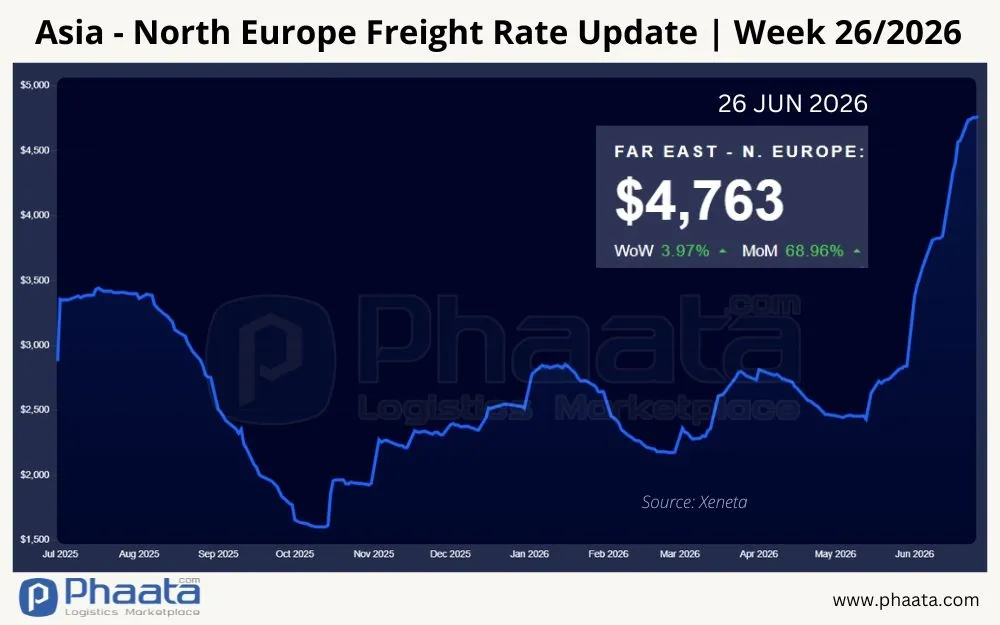
Asia-Europe Freight Rates | Week 26/2026 (Photo: Phaata.com)
4. North America - Asia Ocean Freight Rates
Ocean freight rates from North America (West Coast) to Asia in Week 26/2026 increased slightly by 0.46% week-on-week, settling at $660/FEU. This rate is up 5.77% month-on-month, according to Xeneta data.
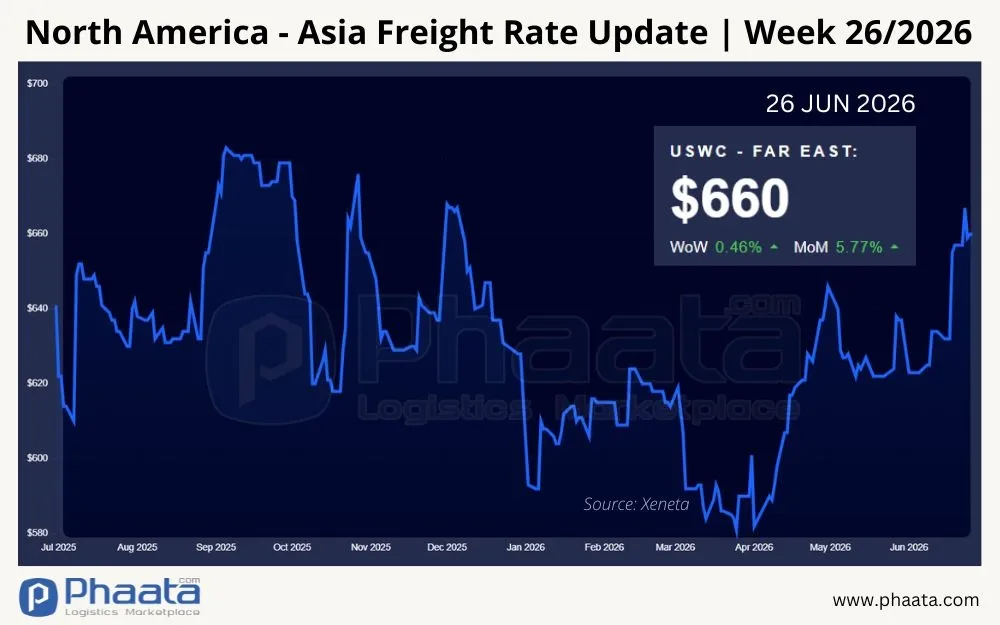
North America (West Coast) - Asia freight rates | Week 26/2026 (Photo: Phaata.com)
5. Northern Europe - Asia Ocean Freight Rates
Ocean freight rates from North Europe to Asia in Week 26/2026 increased by 6.83% week-on-week, reaching $266/FEU. This rate is up 11.30% month-on-month, per Xeneta data.
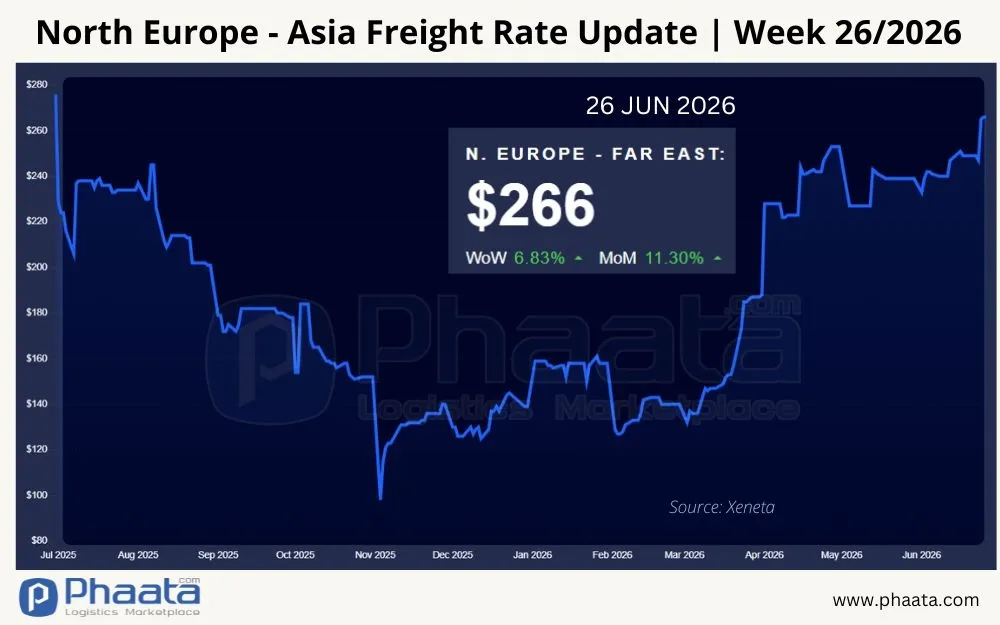
Container Freight rates from Northern Europe to Asia | Week 26/2026 (Photo: Phaata.com)
6. Conclusion and Recommendations from Phaata
The international logistics market in Week 26 continues to sustain an elevated freight rate baseline, while pressure on operational capacity and shifts in customs policies remain critical factors for businesses to monitor closely.
-
Freight Rates and Transport Capacity: The WCI index rose by 4.96% week-on-week, hitting $4,166/FEU. Across the two main arteries—Asia-North America and Asia-Europe—freight rates remained stubbornly high following a 6 to 7-week consecutive streak of increases. Carriers continue to dictate supply via blank sailings, with ratios hovering around 7-8%, while transport demand remains robust. This sustains tight space conditions, particularly on routes bound for the U.S. East Coast and the Gulf Coast.
-
Operational Caveats: The carriers' continued reliance on the Cape of Good Hope routing is prolonging vessel turnaround times, increasing pressure on transshipment hubs, and impacting the supply of empty containers at various Asian export ports. Furthermore, the Panama Canal's scheduled downward adjustment of the static draft limit for Neopanamax vessels starting July 3 will diminish the payload capacity of several U.S. East Coast-bound services transiting this waterway.
-
Customs Policy Updates: U.S. Customs and Border Protection (CBP) is rolling out multiple import management overhauls, including the expansion of the CAPE refund system into Phase 2, the review of the USMCA's implementation, and the adjustment of clearance protocols for international mail following the termination of the De Minimis mechanism. These changes will require importers and customs brokers to intensify their operational reviews and ensure the accuracy and consistency of declaration data to mitigate clearance risks.
Recommendations from Phaata
To proactively navigate market dynamics and maintain supply chain operational efficiency, businesses should consider deploying the following solutions:
-
Proactive Booking and Cargo Prep: The Documentation/Customer Service (CS) department should continue executing booking plans 4 to 6 weeks in advance for North America and Europe routes to maximize the chances of securing space. For USEC-bound exports via the Panama Canal, warehousing teams must strictly control stuffed cargo weights to comply with carriers' new payload limit regulations, thereby minimizing the risk of cargo being rolled to subsequent sailings. For shipments with rigid delivery timelines, businesses should consider utilizing Premium Services to elevate the likelihood of space confirmation and curb risks during transit.
-
Ensure Customs Compliance and Optimize Cash Flow: Legal and documentation departments need to proactively coordinate with customs brokers to audit processing workflows for international postal shipments. Ensure internal systems can export data in the exact Excel format mandated by CBP, and verify that Pay.gov accounts are fully active prior to the July 24 deadline. Additionally, businesses should prioritize finalizing reconciliation entries (Entry Type 09) for files nearing their deadlines to expedite the IEEPA refund processing via the CAPE system, thereby improving cash flow and mitigating refund delays.
-
Cost Optimization via Digital Platforms: Amid continuously fluctuating freight rates and surcharges (such as the PSS), businesses should proactively leverage digital platforms to monitor the market and source suitable transport options. Through the Phaata International Logistics Marketplace platform, Procurement departments can search and compare quotes from multiple logistics companies, communicate directly with suppliers, and select the optimal transport solution for each specific shipment. This approach empowers businesses to easily benchmark options, select the right vendors, optimize logistics costs, and proactively secure space for individual shipments, ultimately contributing to a stable and efficient supply chain operation.
Stay tuned to articles on Phaata.com or Phaata fanpage for rapid and in-depth market updates.
Find Freight Rates Here
Find Logistics Companies Here
See more:
- SITC updates Vietnam-Intra Asia sailing schedules in Jul 2026
- CMA CGM Megaship Successfully Transits the Strait of Hormuz as IMO Suspends Evacuation Operation
- Port of Long Beach Invests $58.2 Million to Expand Zero-Emission Cargo Handling Fleet
- Strait of Hormuz Gradually Resumes Operations: Positive Signals Amid Regulatory Disputes
- IMO Launches Plan to Evacuate Over 11,000 Seafarers Stranded in the Strait of Hormuz
- Northwest Seaport Alliance (NWSA): Import and Export Volumes Simultaneously Rally in May
- Container Shipping Resilience: A Deeper Look Behind Faster Recovery Times
- US–Iran 'Hotline' Established for the Strait of Hormuz: Diplomatic Progress Meets Maritime Challenges
- Port of Melbourne Reports Positive Container Throughput Growth in May
- COSCO schedules: Vietnam - North America in Jun 2026
- COSCO updates Vietnam-Intra Asia sailing schedules in Jun 2026
- COSCO updates Vietnam-North Europe sailing schedules in Jun 2026
Source: Phaata - Vietnam's First International Logistics Marketplace
► Find Better Freight Rates & Logistics Service Providers!


Featured News
- Hapag-Lloyd applies Peak Season Surcharge from East Asia to USA and Canada
- The world\'s largest container ships MSC Irina and MSC Loreto floated
- MSC (Mediterranean Shipping Company) - The world\'s leading container shipping lines
- Information you need to know about Maersk Line
- Top 10 export and import goods between Vietnam - Philippines in the first 5 months of 2020

 Market News
See more
.webp)
.webp)

.webp)


 HOT PROMO
See more
30
 FCL
FCL
 28 Days
 Freight cost

CÔNG TY TRÁCH NHIỆM HỮU HẠN DT LOGISTICS (VN)
406
FCL
28 Days
Freight cost

Công Ty TNHH Quanterm Logistics Vietnam
659
FCL
33 Days
Freight cost

CÔNG TY TNHH TIẾP VẬN TOÀN CẦU KM
764
 Other
Other

INTERLOG CORP - CÔNG TY CỔ PHẦN GIAO NHẬN TIẾP VẬN QUỐC TẾ
812
FCL
35 Days
Freight cost

CÔNG TY TNHH INTERNATIONAL LOGISTICS GLORY (VIỆT NAM)
Why do thousands of businesses trust Phaata?
USERS/MONTH
LOGISTICS COMPANIES
REQUEST FOR QUOTEŚ
QUOTATIONS
VIETNAM LOGISTICS COMMUNITY
5 Steps to Get the Best Quote
Find a price quickly/Send a RFQ
Compare multiple options
Contact for Further Consultation
Negotiating prices/services
Management & rating
 Freight rates
Sea freight
- FCL
See more
56
7
Days Transit
- ₫4,631,025 / 20'GP
- ₫10,585,200 / 40'HQ

GIA LINH LOGISTICS SERVICES CO., LTD. (G LINK Logistics)
69
3
Days Direct
- ₫1,323,150 / 20'GP
- ₫3,969,450 / 40'GP
- ₫3,969,450 / 40'HQ

CÔNG TY CỔ PHẦN TIẾP VẬN INTERCARGO
578
28
Days Direct
- ₫76,345,755 / 20'GP
Công Ty TNHH Quanterm Logistics Vietnam
849
4
Days Direct
- ₫5,689,545 / 20'GP
- ₫10,982,145 / 40'GP
- ₫10,982,145 / 40'HQ
- ₫11,908,350 / 45'HQ

MELODY LOGISTICS COMPANY LIMITED
969
11
Days Direct
- ₫1,984,725 / 20'GP
- ₫3,043,245 / 40'HQ

Compass Logistics
 Premium
Sea freight
- LCL
See more
1,203
4
Days Direct
- ₫0 /cbm

CÔNG TY CỔ PHẦN GIAO NHẬN VẬN TẢI HỒNG SƠN
1,938
5
Days Direct
- ₫0 /cbm
CÔNG TY TRÁCH NHIỆM HỮU HẠN DT LOGISTICS (VN)
2,271
6
Days Direct
- ₫523,180 /cbm

CÔNG TY TNHH VẬN TẢI VÀ TIẾP VẬN TOÀN CẦU
2,401
 1,746
4
Days Direct
1,746
4
Days Direct
- ₫396,945 /cbm

CHI NHÁNH THÀNH PHỒ HỒ CHÍ MINH - CÔNG TY TNHH HECNY SHIPPING VIỆT NAM
 Air freight
- General cargo
Air freight
- General cargo
See more
441
1
Days Direct
- 46,310 ₫/kg

N.B.L INTERNATIONAL TRANSPORT CO., LTD
839
1
Days Direct
- 161,424 ₫/kg
CÔNG TY CỔ PHẦN GIAO NHẬN VẬN TẢI HỒNG SƠN
3,848
10
Days Transit
- 264,630 ₫/kg

Phoenix Logistics Vietnam - chi nhánh TP. Hồ Chí Minh (Phoenix International Forwarding Vietnam )
5,619
1
Days Direct
- 185,241 ₫/kg

CÔNG TY TNHH THƯƠNG MẠI VÀ DỊCH VỤ FASTRANS
8,403

 Rail freight
- FCL
Rail freight
- FCL
See more
1,843
5
Days Direct
- ₫44,987,100 / 40'HQ
- ₫44,987,100 / 45'HQ

CÔNG TY TNHH PHƯỚC TÁ
3,332
3
Days Direct
- ₫15,083,910 / 40'HQ

CÔNG TY CỔ PHẦN VẬN TẢI VÀ THƯƠNG MẠI ĐƯỜNG SẮT
13,831
7
Days Direct
- ₫48,956,550 / 20'GP

Công ty TNHH T&M Forwarding
12,644
5
Days Direct
- ₫7,145,010 / 20'GP

ASIAN EXPRESS LINE VIETNAM ( AEL VIET NAM )
9,493
10
Days Direct
- ₫9,262,050 / 20'GP

CÔNG TY CỔ PHẦN LOGISTICS QUỐC TẾ V&T
 Road freight
- FCL
Road freight
- FCL
See more
1,889
1
Day
- ₫28,000,000 / 20'GP
- ₫28,000,000 / 40'GP

CÔNG TY TNHH THƯƠNG MẠI DỊCH VỤ VÀ KHO VẬN VIETTEL POST - TTC
3,749
4
Day
- ₫211,704 / 20'GP

CÔNG TY CỔ PHẦN KINH DOANH THƯƠNG MẠI VÀ DỊCH VỤ HỎA TỐC
46,658
1
Day
- ₫6,868,686 / 20'OT
- ₫6,868,686 / 40'OT
- ₫6,868,686 / 40'OT HQ

CÔNG TY TNHH LIÊN VẬN QUỐC TẾ SHINING OCEAN VIỆT NAM
104,044
2
Day
- ₫6,500,000 / 40'RF
- ₫6,500,000 / 40'RQ
- ₫6,500,000 / 45'RQ

CÔNG TY CP PROSHIP
Premium
173,253
1
Day
- ₫18,997,200 / 20'GP
- ₫18,997,200 / 40'GP

CÔNG TY CỔ PHẦN GIAO NHẬN VẬN TẢI CON ONG


