


Tuesday, 23/06/2026, 10:00 (GMT +7)
 1634
1634
International Shipping and Logistics Market Update Week 25/2026 | Phaata
International shipping and logistics market update - Week 25/2026
Table of Contents
-
World Container Index Week 25/2026
-
Asia - North America Ocean Freight Rates
-
Asia - Europe Ocean Freight Rates
-
Northern America - Asia Ocean Freight Rates
-
Northern Europe - Asia Ocean Freight Rates
-
Conclusions and Recommendations by Phaata
1. World Container Index Week 25/2026
Drewry’s World Container Index (WCI) for Week 25/2026 (from June 15 to June 21, 2026) continued to surge significantly, specifically rising by 11.83% compared to the previous week to reach $3,969/FEU.
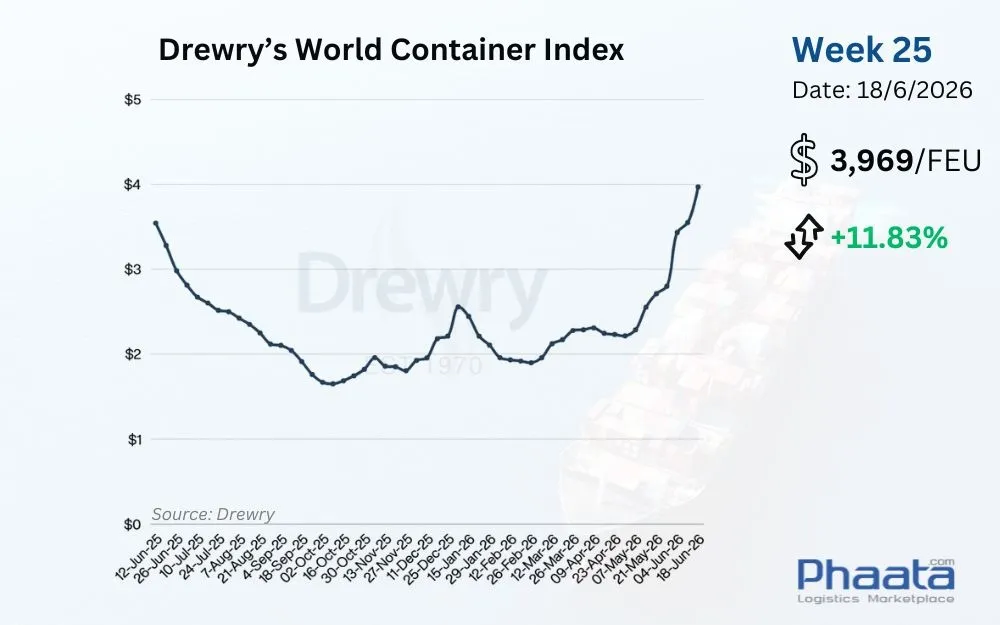
Drewry's World Container Index Week 25/2026 (Photo: Phaata)
2. Asia-North America Ocean Freight Rates
Supply and Demand:
Tightly Controlled Space Pressure on vessel space on the Asia - North America route remains exceptionally high. Market data indicates that the average available capacity ratio in June has dropped to approximately 83%, lower than the 87% recorded in the second half of May. This illustrates that the bulk of transport capacity has been absorbed by robustly growing demand during the peak season, making it increasingly difficult to secure space across numerous service loops.
Gateway Handling Capacity At the U.S. West Coast (USWC), the situation is somewhat more optimistic thanks to efforts to reinstate certain services and the deployment of extra loaders. Nevertheless, space pools remain generally constrained, and cargo rollovers continue to occur sporadically across service networks. At the U.S. East Coast (USEC) and Gulf Coast, operational strain remains elevated with no significant signs of capacity improvement recorded thus far.
Panama Canal Operational Caveats A crucial factor to monitor in the coming period is the Panama Canal Authority's continued downward adjustment of the draft limit for transiting vessels in July. To adapt to these new operational conditions, many carriers have begun imposing payload restrictions on services transiting the Panama Canal. This will effectively reduce the actual lifting capacity of vessels and impact cargo intake on Asia - U.S. East Coast routes.
Sustained High Transport Demand Transport demand on the Trans-Pacific route continues its positive momentum. Export volumes from Asia grew steadily throughout June and currently show no signs of deceleration. Multiple carriers and market analysts project that shipping volumes will remain elevated through July, particularly for consumer goods, retail, and peak year-end holiday merchandise.
Rate Developments:
Ocean freight rates from Asia to the North America West Coast in Week 25/2026 jumped by 29.39% week-on-week, reaching $5,547/FEU. This rate represents a 76.60% increase month-on-month, according to Xeneta data.
Upward Rate Trend: The ocean freight baseline remains on an upward trajectory. The Shanghai Containerized Freight Index (SCFI) updated on June 12 showed a relatively uniform increase of roughly 10% for routes bound for both the U.S. West Coast and East Coast.
Forecast: Current rate levels are expected to remain stable through the end of June. Concurrently, the market is bracing for the likelihood of spot rates undergoing further adjustments in the first half of July.
Stay tuned to Phaata International Logistics Marketplace for in-depth and fast market updates.
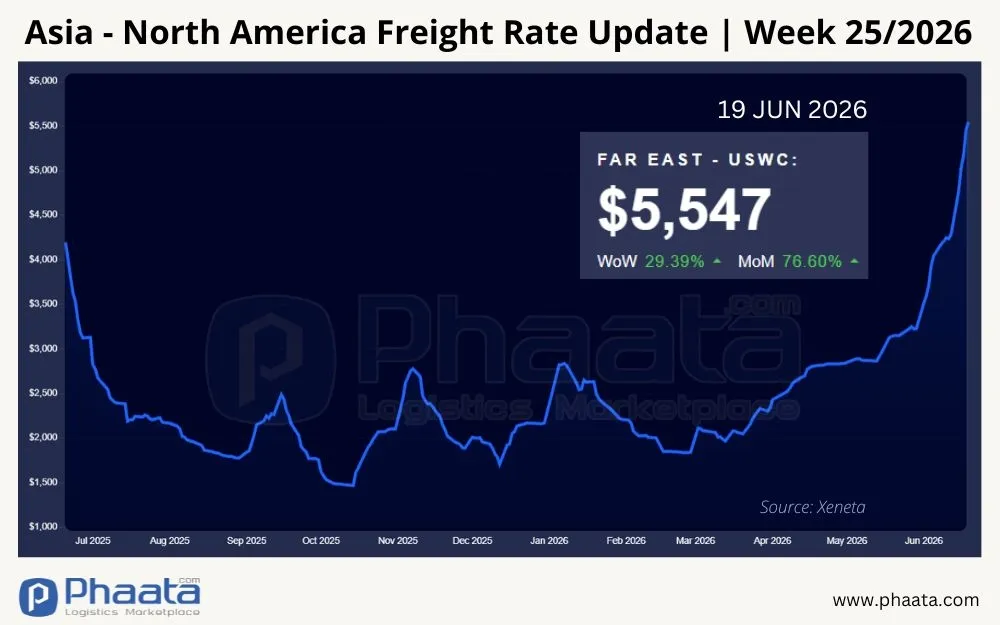
Asia-North America Freight Rates | Week 25/2026 (Photo: Phaata.com)
US Tariff Updates:
1. US Customs and Border Protection (CBP) Updates Labor Compliance Guidelines
CBP recently released a new operational guidance document that synthesizes and clarifies enforcement protocols under three primary legal frameworks: 19 U.S.C. 1307, the Uyghur Forced Labor Prevention Act (UFLPA), and the Countering America's Adversaries Through Sanctions Act (CAATSA).
-
Systematizing Operational Workflows: The document provides detailed process maps applicable to UFLPA, CAATSA, as well as Withhold Release Orders (WROs) and Findings. This equips importers with a clearer, more holistic view of how each review mechanism operates.
-
Coordinated Resolution Guidelines: Each section is accompanied by specific guidelines to untangle situations where shipments are detained or excluded, helping businesses understand exactly how to prepare and submit valid explanatory documentation.
-
Recommendation for Businesses: For supply chains linked to sensitive regions, legal and documentation departments should dedicate time to reviewing this document. Early reconciliation will ensure the company's internal compliance procedures are fully synchronized with CBP's latest requirements.
2. Note on Mandatory CPSC eFiling Requirements Effective July 8, 2026
Starting July 8, 2026, the Consumer Product Safety Commission (CPSC) will officially mandate eFiling. Under this regulation, importers of regulated consumer goods must submit electronic certification data via CBP's system precisely at the time of entry clearance. To ensure a smooth process, documentation departments can flexibly choose one of three filing methods below, depending on the product's registration status:
-
Method 1: Disclaim
-
Applicability: When the shipment's HTS code triggers a CPSC review warning, but the actual physical product does not fall under the agency's jurisdiction.
-
Action: The importer may choose to submit a disclaim code alongside an intended use code, or simply omit it. Although the CPSC notes that disclaim PGA message sets are not mandatory, comprehensive submission can help improve the business's customs risk assessment score.
-
Operational Note: CBP is currently uncertain whether the ACE system will fully integrate this "disclaim" feature in time for the implementation date (July 8). Therefore, businesses should be prepared to flexibly adjust their filing decisions based on the system's actual operational status.
-
-
Method 2: Filing of Reference Set
-
Applicability: For products pre-registered on the CPSC Product Registry.
-
Action: At the clearance stage, the documentation department only needs to submit 4 basic data fields, which include the reference number linking to the registered product.
-
Recommendation: This is the fastest and most cost-effective solution. Businesses frequently importing CPSC-regulated goods are strongly encouraged to prioritize this approach.
-
-
Method 3: Full PGA Message Set
-
Applicability: When the product has not been pre-registered on the CPSC Product Registry.
-
Action: This method requires submitting 20 to 30 data fields at the time of entry filing. This information is largely extracted from the Children’s Product Certificate (CPC) or General Certificate of Conformity (GCC).
-
Recommendation: This approach is time-consuming, increases cost pressures, and elevates the risk of cargo release delays. Businesses should minimize its use if pre-registration is an option.
-
-
General Note: The CPSC's jurisdictional scope remains unchanged. For new product lines where CPSC oversight is uncertain, import-export departments should proactively consult the CPSC's Business Education Library. This will facilitate the preparation of a more complete documentation set well before the vessel arrives at port.
Stay tuned to articles on the Phaata International Logistics Marketplace for rapid and in-depth market updates.
3. Asia-Europe Ocean Freight Rates
Supply and Demand:
Supply:
-
Capacity Pressure Unlikely to Ease Immediately: The achievement of a framework peace agreement between the US and Iran, along with the potential reopening of the Strait of Hormuz, offers a positive signal. However, this shift will require more time to genuinely alleviate capacity pressures within the container shipping industry.
-
Actual Capacity Leakage: Although blank sailing ratios have dropped to around 5%, a substantial amount of current available capacity is showing signs of lagging and getting bogged down within the network.
Demand:
-
Demand Momentum Sustained: Export demand in the market continues to maintain highly positive growth momentum.
-
Vessel Fill Rates: Pressure from surging demand means the vast majority of June sailings are operating at maximum fill capacity.
Operations:
-
Safe Routing: Operationally, it is highly likely that carriers will maintain the Cape of Good Hope routing as the default safe option until the security situation in the Red Sea and Suez Canal is confirmed to be entirely stable.
-
Turnaround Bottlenecks: Berthing wait times at the Singapore transshipment hub are occasionally extending up to 7 days, severely delaying the progress of vessels.
-
Equipment Shortage and Rollover Risks: Congestion at transshipment ports directly exacerbates empty container shortages at origin ports in China. Consequently, the risk of cargo rollovers remains a critical point of concern in current actual operations.
Freight Rate Developments:
Ocean freight rates from Asia to Europe in Week 25/2026 surged by 19.20% week-on-week, reaching $4,581/FEU. This rate is up 69.10% month-on-month, according to Xeneta data.
Spot Rate Momentum: The spot freight market continues to record an upward trajectory driven by peak season dynamics. As of June 12, the Shanghai Containerized Freight Index (SCFI) on the North Europe route had ticked up roughly 20% compared to the previous week, marking the 7th consecutive week of price hikes.
Lag in Rate Adjustments: The current rate baseline is primarily sustained by operational bottlenecks (port congestion, prolonged turnaround times) rather than organic demand growth. Therefore, even as geopolitical factors gradually subside, the rate-cooling process will likely be relatively slow and require a certain lag period.
Stay tuned to Phaata International Logistics Marketplace for in-depth and fast market updates.
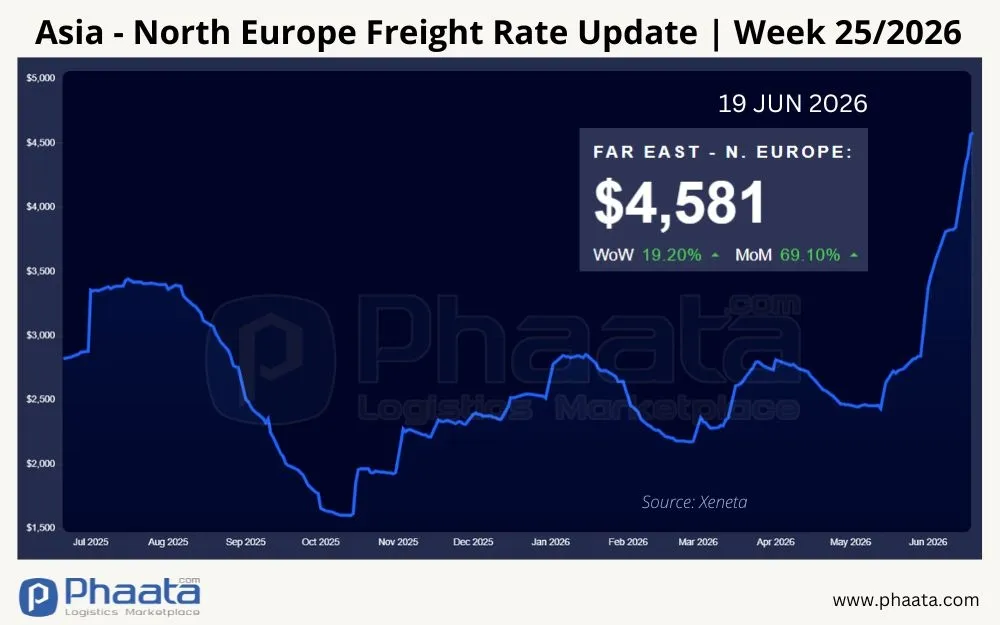
Asia-Europe Freight Rates | Week 25/2026 (Photo: Phaata.com)
4. North America - Asia Ocean Freight Rates
Ocean freight rates from North America (West Coast) to Asia in Week 25/2026 increased by 3.63% week-on-week, settling at $657/FEU. This rate is up 5.63% month-on-month, according to Xeneta data.
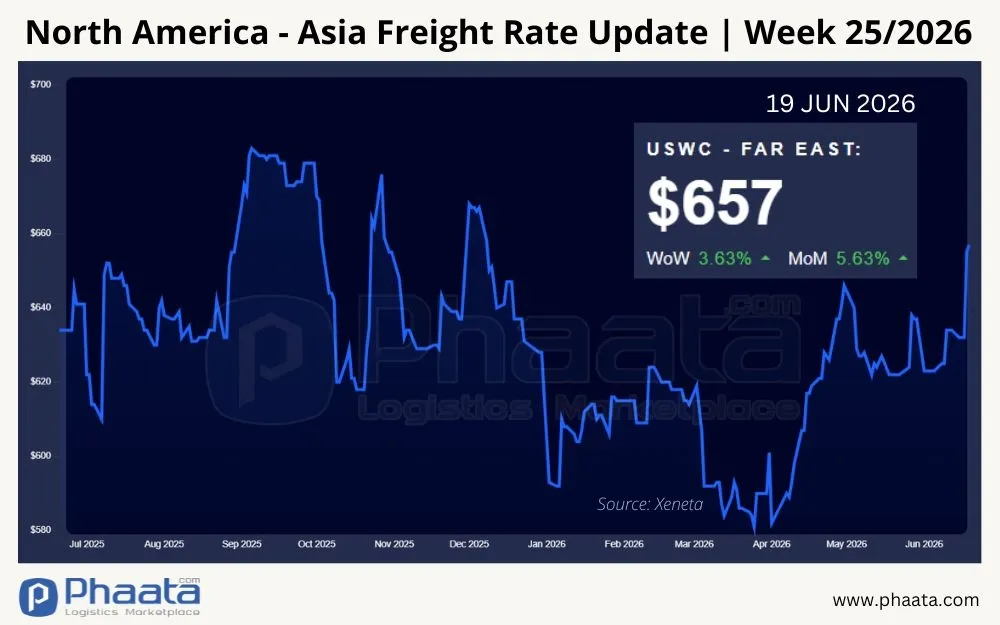
North America (West Coast) - Asia freight rates | Week 25/2026 (Photo: Phaata.com)
5. Northern Europe - Asia Ocean Freight Rates
Ocean freight rates from North Europe to Asia in Week 25/2026 increased by 0.81% week-on-week, reaching $249/FEU. This rate is up 4.18% month-on-month, per Xeneta data.
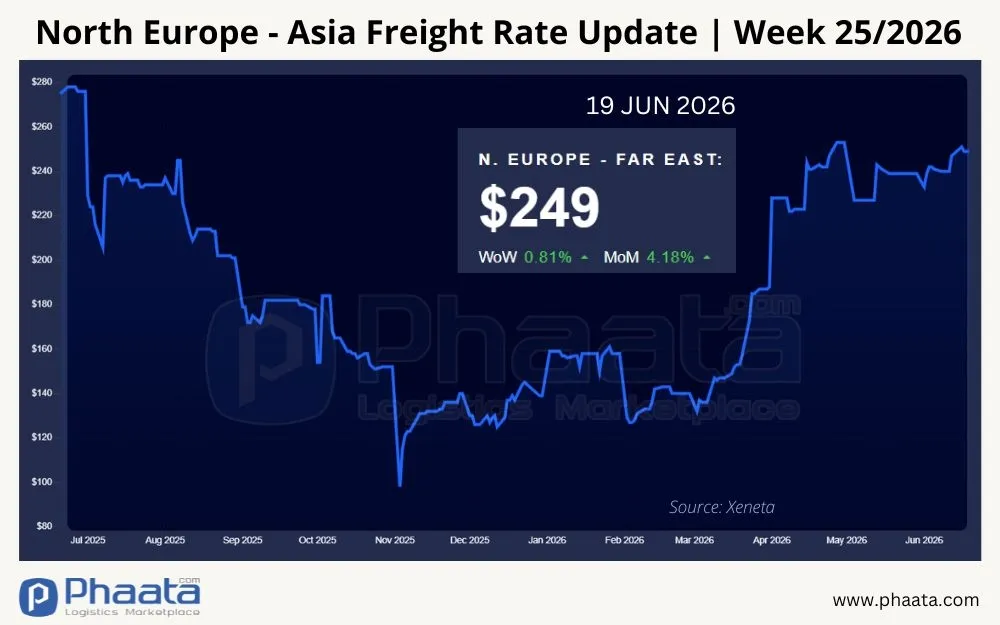
Container Freight rates from Northern Europe to Asia | Week 25/2026 (Photo: Phaata.com)
6. Conclusion and Recommendations from Phaata
The international transport market in Week 25 recorded a distinctly pronounced upward adjustment in spot rates, accompanied by operational challenges at major transshipment hubs and new advisories regarding customs policies:
-
Spot Rates Sustain Upward Trend: The global WCI index surged 11.83% to $3,969/FEU. The upward margin was starkly evident on the Asia - North America West Coast route, climbing to $5,547/FEU, and the Asia - Europe route, reaching $4,581/FEU. This trend is expected to maintain its rhythm into the first half of July.
-
Slow Turnarounds Impacting Capacity: Although the frequency of blank sailings has shown signs of decreasing, available capacity in the market generally remains quite constrained. The US-Iran framework agreement needs more time to generate actual operational changes; therefore, carriers continue to maintain the Cape of Good Hope routing as the default safe option. Furthermore, berthing wait times in Singapore stretching to 7 days have impacted vessel turnaround cycles, leading to localized empty container shortages at Chinese origin ports.
-
Infrastructure Limits and Technical Regulations: The Panama Canal's continued reduction of operational draft limits in July is prompting carriers to enforce payload restrictions on East Coast (USEC) routes. Concurrently, US Customs is tightening control protocols via new forced labor guidelines and mandatory CPSC eFiling regulations effective July 8, 2026.
Recommendations from Phaata
To mitigate the risk of prolonged delays and proactively control import costs, businesses should consider deploying the following defensive strategies:
Booking and Operational Coordination:
-
Proactively Extend Advance Booking Times: It is recommended that documentation departments maintain securing bookings 4 to 5 weeks in advance for North America routes and 5 to 6 weeks in advance for Europe routes. Businesses should budget an additional 7 to 10 days of buffer into total cargo transit times to offset schedule delays at transshipment ports.
-
Payload Allocation for the East Coast (USEC): For shipments transiting Panama in July, warehousing departments must strictly control container stuffed weights to comply with carriers' new payload limit regulations. Businesses may prioritize loading lighter cargo for this route, or shift heavier shipments to West Coast (USWC) routing combined with Inland Point Intermodal (IPI) rail.
-
Flexible Use of Premium Rates for Urgent Cargo: For core raw material SKUs with strict timeline requirements, businesses should proactively consider Premium rate packages to secure guaranteed loading space and priority empty container release at the origin port.
Customs Compliance and Accounting Control:
-
Prepare for CPSC eFiling Prior to July 8, 2026: Importers of consumer goods into the US should collaborate early with their customs brokers to classify goods according to the 3 new eFiling methods. Businesses should prioritize pre-registering products on the CPSC Product Registry to utilize the "Filing of reference set" method (requiring only 4 data fields), facilitating smooth customs clearance and mitigating the risk of cargo release delays at the destination port.
-
Audit Internal Controls Against CBP Guidelines: The import-export department must proactively cross-reference the company's supply chain origin management procedures against CBP's new execution process maps for UFLPA and CAATSA regulations. This will position the business to more proactively prepare explanatory documentation should a shipment fall under random US Customs inspection.
-
Update Landed Cost Structures: The accounting department must integrate June's rate adjustment margins and the projected upward trend scenarios for the first half of July into import cost spreadsheets, ensuring accurate profit margin calculations for shipments departing during this period.
Stay tuned to articles on Phaata.com or Phaata fanpage for rapid and in-depth market updates.
Find Freight Rates Here
Find Logistics Companies Here
See more:
- CMA CGM Implements Peak Season Surcharge (PSS) Across Multiple Key Trade Lanes
- Maersk Expands WAF7 Service to South Africa to Support Peak Fruit Export Season
- MSC Restructures Intra-Far East Service Network
- U.S. Container Imports from Asia Rise 17.5%; China Rebounds While Vietnam Extends Growth Streak
- Maritime Traffic Through the Strait of Hormuz Begins to Resume, but Challenges Remain
- DP World Enters Exclusive Talks to Develop First Container Terminal on the U.S. Gulf Coast
- Port of Helsinki Records 9.4% Growth in Container Traffic in Early 2026
- 5 Compliance Blind Spots Exposing the Air Cargo Industry to Hidden Risks
- COSCO schedules: Vietnam - North America in Jun 2026
- COSCO updates Vietnam-Intra Asia sailing schedules in Jun 2026
- COSCO updates Vietnam-North Europe sailing schedules in Jun 2026
- SITC updates Vietnam-Intra Asia sailing schedules in Jun 2026
Source: Phaata - Vietnam's First International Logistics Marketplace
► Find Better Freight Rates & Logistics Service Providers!


Featured News
- Hapag-Lloyd applies Peak Season Surcharge from East Asia to USA and Canada
- The world\'s largest container ships MSC Irina and MSC Loreto floated
- MSC (Mediterranean Shipping Company) - The world\'s leading container shipping lines
- Information you need to know about Maersk Line
- Top 10 export and import goods between Vietnam - Philippines in the first 5 months of 2020

 Market News
See more
.webp)
.webp)
.webp)
.webp)

 HOT PROMO
See more
805
 FCL
FCL
 12 Days
 Freight cost

Compass Logistics
 Premium
1502
FCL
12 Days
Freight cost
Premium
1502
FCL
12 Days
Freight cost

ASIAN EXPRESS LINE VIETNAM ( AEL VIET NAM )
2550
FCL
6 Days
Freight cost

CÔNG TY CỔ PHẦN TIẾP VẬN INTERCARGO
3367
FCL
5 Days
Freight cost

CÔNG TY TNHH VẬN CHUYỂN QUỐC TẾ N.B.L
4015
FCL
20 Days
Freight cost

N.B.L INTERNATIONAL TRANSPORT CO., LTD
Why do thousands of businesses trust Phaata?
USERS/MONTH
LOGISTICS COMPANIES
REQUEST FOR QUOTEŚ
QUOTATIONS
VIETNAM LOGISTICS COMMUNITY
5 Steps to Get the Best Quote
Find a price quickly/Send a RFQ
Compare multiple options
Contact for Further Consultation
Negotiating prices/services
Management & rating
 Freight rates
Sea freight
- FCL
See more
17
131
3
Days Direct
- ₫9,262,050 / 20'GP
- ₫19,847,250 / 40'GP
- ₫19,847,250 / 40'HQ
- ₫19,847,250 / 45'HQ

NP LOGISTICS CO.,LTD
402
8
Days Direct
- ₫38,106,720 / 20'GP
- ₫39,429,870 / 40'GP
- ₫38,106,720 / 40'HQ

GIA LINH LOGISTICS SERVICES CO., LTD. (G LINK Logistics)
1,068
14
Days Transit
- ₫4,366,395 / 20'GP
- ₫9,658,995 / 40'HQ

CÔNG TY TNHH GIAO NHẬN TOÀN CẦU GS
1,528
37
Days Transit
- ₫70,920,840 / 20'GP
- ₫104,396,535 / 40'GP
- ₫104,396,535 / 40'HQ

Công Ty TNHH Quanterm Logistics Vietnam
Sea freight
- LCL
See more
2,159
 3,083
5
Days Direct
3,083
5
Days Direct
- ₫26,463 /cbm

CÔNG TY TNHH T&M FORWARDING - CHI NHÁNH HÀ NỘI
4,371
3
Days Direct
- Refund ₫926,205 /cbm

CÔNG TY CỔ PHẦN GIAO NHẬN VẬN TẢI HỒNG SƠN
4,852
4,123
3
Days Direct
- ₫132,315 /cbm

CÔNG TY TRÁCH NHIỆM HỮU HẠN DT LOGISTICS (VN)
 Air freight
- General cargo
Air freight
- General cargo
See more
5,097
1
Days Direct
- 46,310 ₫/kg
N.B.L INTERNATIONAL TRANSPORT CO., LTD
6,666
1
Days Direct
- 161,424 ₫/kg
CÔNG TY CỔ PHẦN GIAO NHẬN VẬN TẢI HỒNG SƠN
9,183
10
Days Transit
- 264,630 ₫/kg

Phoenix Logistics Vietnam - chi nhánh TP. Hồ Chí Minh (Phoenix International Forwarding Vietnam )
10,729
1
Days Direct
- 185,241 ₫/kg

CÔNG TY TNHH THƯƠNG MẠI VÀ DỊCH VỤ FASTRANS
9,755

 Rail freight
- FCL
Rail freight
- FCL
See more
6,435
5
Days Direct
- ₫44,987,100 / 40'HQ
- ₫44,987,100 / 45'HQ

CÔNG TY TNHH PHƯỚC TÁ
9,042
3
Days Direct
- ₫15,083,910 / 40'HQ

CÔNG TY CỔ PHẦN VẬN TẢI VÀ THƯƠNG MẠI ĐƯỜNG SẮT
18,973
7
Days Direct
- ₫48,956,550 / 20'GP

Công ty TNHH T&M Forwarding
17,591
5
Days Direct
- ₫7,145,010 / 20'GP
ASIAN EXPRESS LINE VIETNAM ( AEL VIET NAM )
10,685
10
Days Direct
- ₫9,262,050 / 20'GP

CÔNG TY CỔ PHẦN LOGISTICS QUỐC TẾ V&T
 Road freight
- FCL
Road freight
- FCL
See more
2,344
 9,383
1
Day
9,383
1
Day
- ₫28,000,000 / 20'GP
- ₫28,000,000 / 40'GP

CÔNG TY TNHH THƯƠNG MẠI DỊCH VỤ VÀ KHO VẬN VIETTEL POST - TTC
110,291
2
Day
- ₫6,500,000 / 40'RF
- ₫6,500,000 / 40'RQ
- ₫6,500,000 / 45'RQ

CÔNG TY CP PROSHIP
Premium
178,708
1
Day
- ₫18,997,200 / 20'GP
- ₫18,997,200 / 40'GP

CÔNG TY CỔ PHẦN GIAO NHẬN VẬN TẢI CON ONG
266,449
3
Day
- ₫32,000,000 / 20'GP
- ₫64,000,000 / 40'GP
- ₫64,000,000 / 40'HQ
- ₫64,000,000 / 45'HQ

Công ty Cổ phần phát triển thương mại Thuận Đạt Việt Nam


