


Monday, 16/03/2026, 09:06 (GMT +7)
 1433
1433
International Shipping and Logistics Market Update Week 11/2026 | Phaata
International shipping and logistics market update - Week 11/2026
Table of Contents
-
World Container Index Week 11/2026
-
Asia - North America Ocean Freight Rates
-
Asia - Europe Ocean Freight Rates
-
Northern America - Asia Ocean Freight Rates
-
Northern Europe - Asia Ocean Freight Rates
-
Conclusions and Recommendations by Phaata
1. World Container Index Week 11/2026
Drewry’s World Container Index (WCI) for Week 11/2026 (from Mar 9 to Mar 15, 2026) continued to increase by 8% compared to the previous week, reaching $2,123/FEU. This marks the second consecutive week of gains following a preceding seven-week period of continuous decline.

Drewry's World Container Index Week 11/2026 (Photo: Phaata)
2. Asia-North America Ocean Freight Rates
Supply and Demand:
Demand Side:
The recovery pace of bookings post-Lunar New Year is proceeding slower than forecasted figures. This volume shortfall creates a distinct supply-demand imbalance, pushing the market into an overcapacity situation.
Supply Side:
Carriers' operational capacity is being injected back into the market at a high rate. It is expected that total capacity supply will rapidly exceed the 90% mark in the second half of March.
Indirect fallout from the Middle East: Although the Asia - North America West Coast route does not directly pass through the conflict zone, the diversion of Asia-Europe fleets around the Cape of Good Hope is creating a chain reaction of operational risks. Specifically, extended vessel rotations are leading to localized empty container shortages and causing congestion at key transshipment hubs in the Asian region.
Rate Developments:
Ocean Freight rates from Asia to the North America West Coast in Week 11/2026 decreased by 5.11% week-on-week, down to $1,968/FEU. This rate is down 1.7% month-on-month, according to Xeneta data.
General Rate Increase (GRI): Despite excess space, carriers have issued official notices applying the next round of GRIs, effective March 15.
Emergency Fuel Surcharge (EFS): To cope with the sudden surge in bunker prices due to geopolitical tensions, carriers have begun levying an EFS to offset operational costs:
-
For imports to Canada: The EFS will be applied early, expected to begin in late March.
-
For imports to the United States: The EFS will officially take effect in early April.
Carriers utilizing a monthly bunker adjustment mechanism have also announced increased collection levels for the April period.
Peak Season Surcharge (PSS): Due to weak market demand, carriers have been forced to further postpone PSS implementation plans to April.
Stay tuned to Phaata International Logistics Marketplace for in-depth and fast market updates.
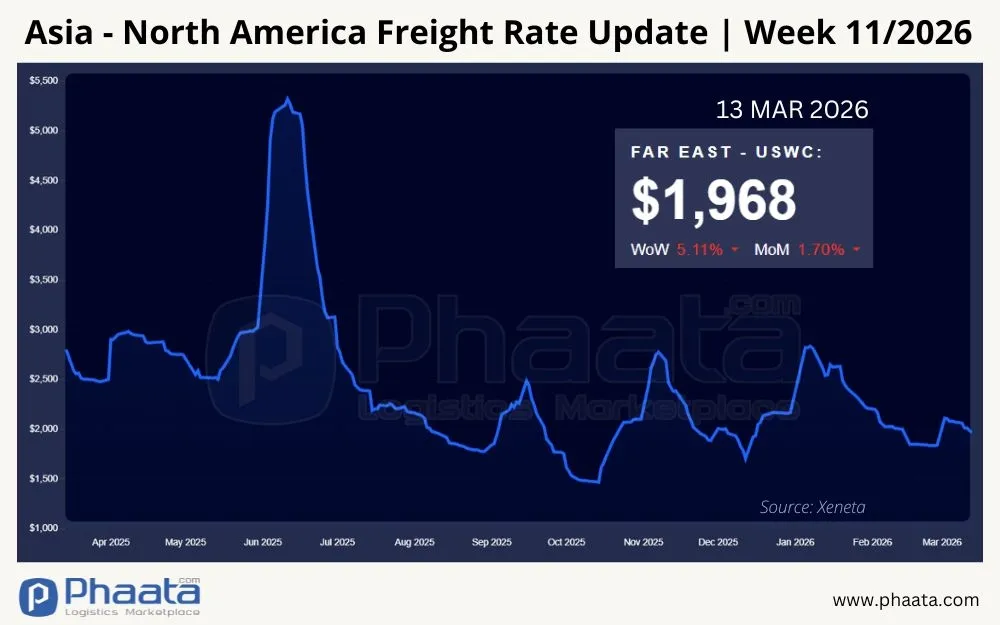
Asia-North America Freight Rates | Week 11/2026 (Photo: Phaata.com)
US Tariff Updates:
1. Initiation of Section 301 Investigations: A Stepping Stone for Long-Term Tariffs
On March 11, 2026, the Office of the US Trade Representative (USTR) officially launched new Section 301 investigations targeting 16 trading partners: China, the European Union (EU), Singapore, Switzerland, Norway, Indonesia, Malaysia, Cambodia, Thailand, South Korea, Vietnam, Taiwan, Bangladesh, Mexico, Japan, and India. These are primarily nations that signed or enforced trade agreements with the US during the previous period of IEEPA tariffs.
Investigation Objective: USTR is focusing its review on economies exhibiting signs of "structural manufacturing overcapacity" and maintaining "large, persistent trade surpluses" with the United States.
Legal Timeline: USTR will open the portal for written comments on March 17 and hold public hearings on May 5. Typically, a Section 301 investigation lasts from 6 to 18 months, but given current political pressures, this process could be significantly shortened.
The current 10% global tariff (applied under Section 122) has a legal limit of 150 days and will expire on July 24, 2026. Because President Trump cannot unilaterally extend Section 122 without congressional approval, the urgent initiation of this slew of Section 301 investigations (alongside 9 open Section 232 investigations) serves as a fallback legal tool for the US administration to legitimately impose long-term punitive tariffs once Section 122 expires.
2. Update on IEEPA Refund Progress: Direct Order Suspended to Build Automated System
On March 6, the Court of International Trade (CIT) decided to stay the execution of the order (issued March 4) that compelled US Customs and Border Protection (CBP) to immediately refund IEEPA duties.
This stay aims to provide CBP with time to establish a new module within the Automated Commercial Environment (ACE) system to process automated refunds on a massive scale.
CBP's automated refund module is expected to go live no earlier than 45 days from March 6 (i.e., April 20, 2026).
The stay only applies to the "execution timeline," while the court's original mandate requiring the "full refund of all IEEPA duties" retains its legal validity.
Stay tuned to articles on the Phaata International Logistics Marketplace for rapid and in-depth market updates.
3. Asia-Europe Ocean Freight Rates
The Asia - North Europe transport market in Week 11/2026 is witnessing a drastic reversal. The post-Tet slack season has ended, with factories in China restoring 100% of their production capacity. A sudden surge in export order volumes is directly clashing with a global fleet stretched to its maximum limit due to the Cape of Good Hope routing, pushing the operational network into a state of overload and driving freight rates upward.
On supply and demand:
Demand:
The post-Lunar New Year slack season has concluded. Manufacturing facilities in China have restored full operational capacity, triggering a rapid increase in export order volumes.
This recovery in export volumes occurs against a backdrop where European consumer purchasing power has not actually boomed, meaning market pressure stems primarily from operations rather than end-consumption.
Supply:
The global fleet is severely squeezed. The termination of war risk insurance contracts in the Persian Gulf region by insurance syndicates has forced 100% of commercial vessels to maintain the Cape of Good Hope routing for the foreseeable future.
The extended transit times of this African route have entirely eradicated the previous structural overcapacity in the market, significantly shrinking the actual supply of space.
On Operations:
Cape of Good Hope Journey Becomes the Default: Escalating conflicts in the Middle East have solidified the reality of the routing around Africa. Network reliability is plummeting rapidly due to severe vessel bunching.
Mega-ships are continuously discharging cargo off-schedule, causing severe congestion for port infrastructure systems. Port congestion at transshipment hubs and destination ports is slowing down container turnaround times, causing severe connection delays. Specific yard utilization figures are as follows:
-
Asian Transshipment: In Singapore, wait times for berthing have extended to 1.5 days. Yard utilization continues to linger at the warning threshold of 90%.
-
European Destination Ports:
-
Rotterdam: Maasvlakte II (APMT MVII) has hit a ceiling of 95%; RWG is at 85%; ECT is at 80%.
-
Hamburg: Eurogate Container Terminal (CTH) has reached 90%; HHLA (CTA) is at 85%.
-
Southampton: Yard utilization is at an alarming 90%.
-
Freight Rate Developments:
Ocean Freight rates from Asia to Europe in Week 11/2026 continued to increase by 3.51% week-on-week, reaching $2,360/FEU. This rate is up 4.15% month-on-month, according to Xeneta data.
This upward price momentum is driven by artificial supply tightening and soaring operational costs, not by a real recovery in purchasing power in Europe.
Bunker Cost Shock: The de facto blockade of the Strait of Hormuz has triggered a global crude oil price surge. Carriers are bearing massive costs for the additional marine fuel required for the Cape of Good Hope routing.
Carrier Pricing Tactics: Carriers have entirely shifted their pricing strategies. Standard base rate negotiations are suspended, replaced by the emergency implementation of Bunker Surcharges. Capitalizing on actual space shortages and upward price momentum, carriers are imposing new rate hikes for the second half of March to establish the highest possible baseline rate ahead of Q2 long-term contract negotiations.
Stay tuned to Phaata International Logistics Marketplace for in-depth and fast market updates.
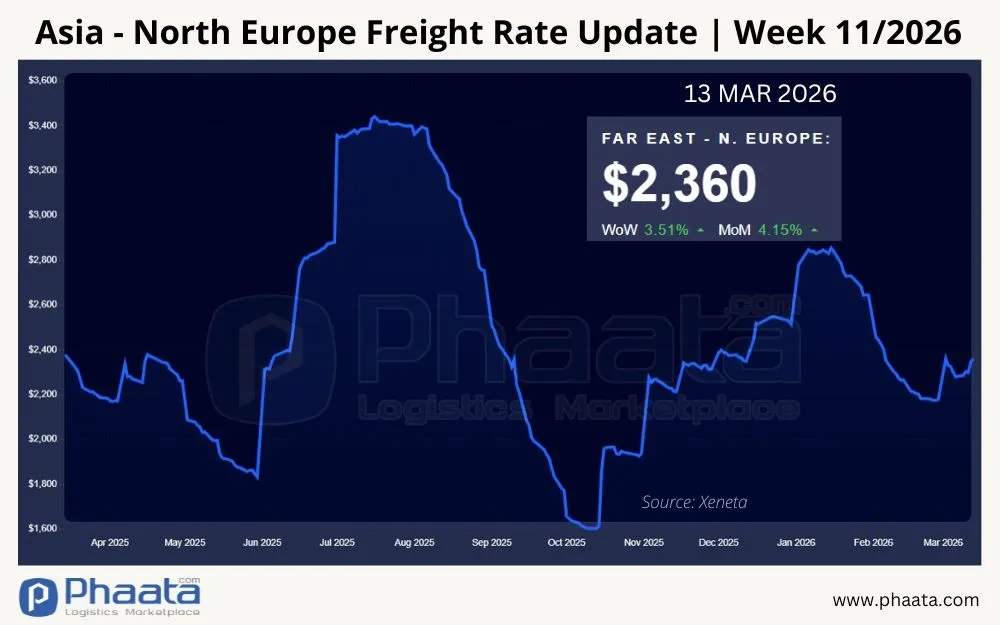
Asia-Europe Freight Rates | Week 11/2026 (Photo: Phaata.com)
4. North America - Asia Ocean Freight Rates
Ocean Freight rates from North America (West Coast) to Asia in Week 11/2026 continued to decrease by 1.35% week-on-week, down to $584/FEU. This rate is down 6.41% month-on-month, according to Xeneta data.
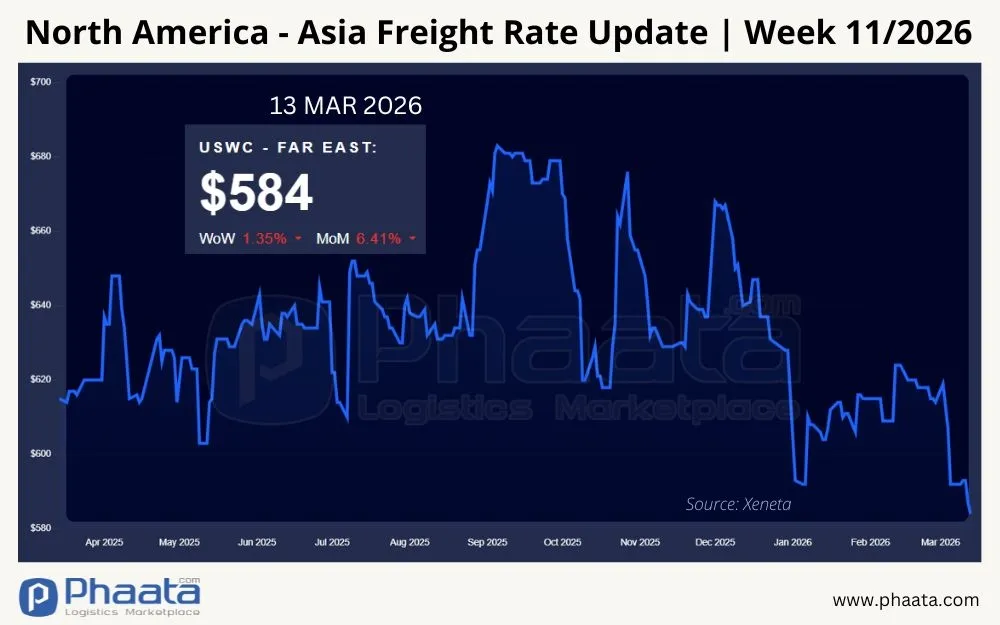
North America (West Coast) - Asia freight rates | Week 11/2026 (Photo: Phaata.com)
5. Northern Europe - Asia Ocean Freight Rates
Ocean Freight rates from North Europe to Asia in Week 11/2026 reversed trend, increasing sharply by 8.09% week-on-week, up to $147/FEU. This rate is up 3.52% month-on-month, per Xeneta data.
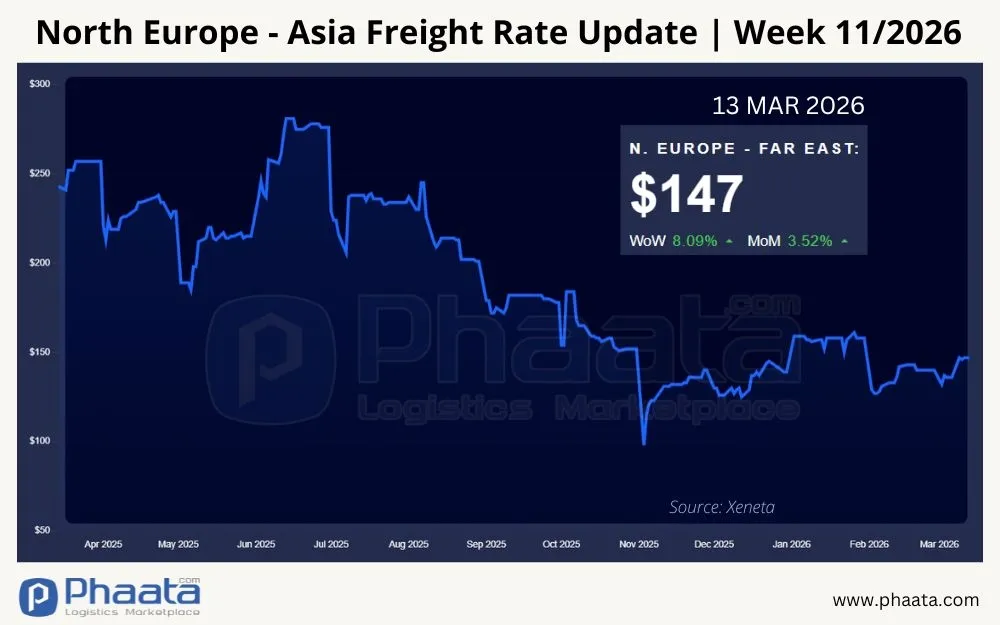
Container Freight rates from Northern Europe to Asia | Week 11/2026 (Photo: Phaata.com)
6. Conclusion and Recommendations from Phaata
The international logistics market in Week 11/2026 records severe divergence and cost volatility, driven by three main factors:
- Fuel Cost Shocks and Pricing Tactics: The Cape of Good Hope routing has become mandatory, driving up marine fuel costs. Carriers are simultaneously implementing Emergency Fuel Surcharges (EFS) on the North American trade lane and pushing FAK rates on the European trade lane to establish the highest baseline pricing ahead of Q2 long-term contract finalization.
- Supply-Demand Divergence: The Asia - Europe route faces actual transport capacity fractures and severe port congestion (90-95% density). Conversely, the Asia - North America route has an oversupply of space capacity (reaching over 90%), yet freight rates are still being anchored by carriers using various surcharges.
- Long-term Tariff Barriers: USTR's initiation of Section 301 investigations against 16 countries (including Vietnam) is a legal preparatory step paving the way for long-term punitive tariffs, replacing the 10% global tariff (Section 122) which expires at the end of July 2026.
Recommendations from Phaata
Amidst rising operational costs and legal risks, shipper enterprises should deploy the following recommendations:
1. Rate Negotiation and Operations:
Trans-Pacific Eastbound (TPEB): Space supply is currently in heavy surplus. Shippers must use this leverage to reject the March 15 General Rate Increase (GRI). Demand that carriers and forwarders provide a transparent breakdown of the formula applied for the Emergency Fuel Surcharge (EFS) in March and April, and absolutely refuse surcharges bundled into the base ocean freight rate.
Far East Westbound (FEWB): Quickly lock in Spot rate contracts for the second half of March before carriers push FAK rates further. It is imperative to add 14 to 21 days to the Lead time on commercial documents due to vessel bunching in Singapore, Rotterdam, and Hamburg.
2. US Market Risk Management:
Protect IEEPA Refund Rights: Although CBP delayed the launch of the automated ACE system until April 20, US importers must continue to file Protests for entries that paid IEEPA duties. This is the only legal maneuver to keep the entry status "live" and block the risk of losing refund rights once the 180-day limit is exceeded.
Activate Section 301 Defense Files: Export goods from Vietnam have officially entered USTR's investigation list. Procurement and legal departments must review the Bill of Materials (BOM), documents of component origin, and the value-add/processing ratio in Vietnam to be ready to provide proof of origin documentation upon request from US importers.
Stay tuned to articles on Phaata.com or Phaata fanpage for rapid and in-depth market updates.
Find Freight Rates Here
Find Logistics Companies Here
See more:
- Asia-US Freight Rates Heat Up: US Considers Jones Act Waiver as FMC Scrutinizes Carrier Surcharges
- Gulf Crisis: Maersk and MSC Suspend Routes, Freight Costs Face Threat of Skyrocketing
- Maersk Implements Sweeping Peak Season Surcharges Across Multiple Key Trade Lanes
- Maersk Suspends Cargo Bookings Across Multiple Gulf Nations Amid Hormuz Blockade Crisis
- India: 95% of Trade Dependent on Foreign Fleets and the Ambition to Turn the Tide
- West Asia Tensions: Indian Exporters and Shipping Lines in Heated Standoff Over 'War Surcharges'
- Tanger Med Port Rises to Strategic Hub Status Amid Global Maritime Crisis
- Rate Volatility: CMA CGM Announces Sweeping Adjustments to FAK Rates and Peak Season Surcharges Across Major Trade Lanes
- Carriers Impose $4,000/FEU Surcharge in the Middle East: Indian Exporters Appeal to Government for Help
- The Cape of Good Hope Route: Becoming the 'New Normal' for Global Shipping?
- Middle East Crisis: MSC Declares Emergency "End of Voyage" for Gulf-Bound Cargo, Imposes $800 Surcharge
- COSCO schedules: Vietnam - North America in Mar 2026
- SITC updates Vietnam-Intra Asia sailing schedules in Mar 2026
Source: Phaata - Vietnam's First International Logistics Marketplace
► Find Better Freight Rates & Logistics Service Providers!


Featured News
- Hapag-Lloyd applies Peak Season Surcharge from East Asia to USA and Canada
- The world\'s largest container ships MSC Irina and MSC Loreto floated
- MSC (Mediterranean Shipping Company) - The world\'s leading container shipping lines
- Information you need to know about Maersk Line
- Top 10 export and import goods between Vietnam - Philippines in the first 5 months of 2020

 Market News
See more
.webp)
.webp)
.webp)

 HOT PROMO
See more
256
 FCL
FCL
 28 Days
 Freight cost

CÔNG TY TRÁCH NHIỆM HỮU HẠN DT LOGISTICS (VN)
797
FCL
28 Days
Freight cost

Công Ty TNHH Quanterm Logistics Vietnam
1044
FCL
33 Days
Freight cost

CÔNG TY TNHH TIẾP VẬN TOÀN CẦU KM
1151
 Other
Other

INTERLOG CORP - CÔNG TY CỔ PHẦN GIAO NHẬN TIẾP VẬN QUỐC TẾ
1014
FCL
35 Days
Freight cost

CÔNG TY TNHH INTERNATIONAL LOGISTICS GLORY (VIỆT NAM)
Why do thousands of businesses trust Phaata?
USERS/MONTH
LOGISTICS COMPANIES
REQUEST FOR QUOTEŚ
QUOTATIONS
VIETNAM LOGISTICS COMMUNITY
5 Steps to Get the Best Quote
Find a price quickly/Send a RFQ
Compare multiple options
Contact for Further Consultation
Negotiating prices/services
Management & rating
 Freight rates
Sea freight
- FCL
See more
75
7
Days Direct
- ₫26,100,000 / 40'GP
- ₫26,100,000 / 40'HQ

CÔNG TY CỔ PHẦN TIẾP VẬN INTERCARGO
86
22
Days Transit
- ₫57,292,395 / 20'GP
- ₫111,806,175 / 40'GP
- ₫111,806,175 / 40'HQ
- ₫113,129,325 / 45'HQ

MELODY LOGISTICS COMPANY LIMITED
151
7
Days Transit
- ₫4,631,025 / 20'GP
- ₫10,585,200 / 40'HQ

GIA LINH LOGISTICS SERVICES CO., LTD. (G LINK Logistics)
674
28
Days Direct
- ₫76,345,755 / 20'GP
Công Ty TNHH Quanterm Logistics Vietnam
1,025
11
Days Direct
- ₫1,984,725 / 20'GP
- ₫3,043,245 / 40'HQ

Compass Logistics
 Premium
Sea freight
- LCL
See more
1,262
4
Days Direct
- ₫0 /cbm

CÔNG TY CỔ PHẦN GIAO NHẬN VẬN TẢI HỒNG SƠN
2,020
5
Days Direct
- ₫0 /cbm
CÔNG TY TRÁCH NHIỆM HỮU HẠN DT LOGISTICS (VN)
2,342
6
Days Direct
- ₫523,180 /cbm

CÔNG TY TNHH VẬN TẢI VÀ TIẾP VẬN TOÀN CẦU
2,473
 1,784
4
Days Direct
1,784
4
Days Direct
- ₫396,945 /cbm

CHI NHÁNH THÀNH PHỒ HỒ CHÍ MINH - CÔNG TY TNHH HECNY SHIPPING VIỆT NAM
 Air freight
- General cargo
Air freight
- General cargo
See more
494
1
Days Direct
- 46,310 ₫/kg

N.B.L INTERNATIONAL TRANSPORT CO., LTD
904
1
Days Direct
- 161,424 ₫/kg
CÔNG TY CỔ PHẦN GIAO NHẬN VẬN TẢI HỒNG SƠN
3,908
10
Days Transit
- 264,630 ₫/kg

Phoenix Logistics Vietnam - chi nhánh TP. Hồ Chí Minh (Phoenix International Forwarding Vietnam )
5,670
1
Days Direct
- 185,241 ₫/kg

CÔNG TY TNHH THƯƠNG MẠI VÀ DỊCH VỤ FASTRANS
8,431

 Rail freight
- FCL
Rail freight
- FCL
See more
1,884
5
Days Direct
- ₫44,987,100 / 40'HQ
- ₫44,987,100 / 45'HQ

CÔNG TY TNHH PHƯỚC TÁ
3,387
3
Days Direct
- ₫15,083,910 / 40'HQ

CÔNG TY CỔ PHẦN VẬN TẢI VÀ THƯƠNG MẠI ĐƯỜNG SẮT
13,873
7
Days Direct
- ₫48,956,550 / 20'GP

Công ty TNHH T&M Forwarding
12,684
5
Days Direct
- ₫7,145,010 / 20'GP

ASIAN EXPRESS LINE VIETNAM ( AEL VIET NAM )
9,512
10
Days Direct
- ₫9,262,050 / 20'GP

CÔNG TY CỔ PHẦN LOGISTICS QUỐC TẾ V&T
 Road freight
- FCL
Road freight
- FCL
See more
7
4
Day
- ₫5,000,000 / 40'GP

CÔNG TY CỔ PHẦN IGAP
1,938
1
Day
- ₫28,000,000 / 20'GP
- ₫28,000,000 / 40'GP

CÔNG TY TNHH THƯƠNG MẠI DỊCH VỤ VÀ KHO VẬN VIETTEL POST - TTC
3,833
4
Day
- ₫211,704 / 20'GP

CÔNG TY CỔ PHẦN KINH DOANH THƯƠNG MẠI VÀ DỊCH VỤ HỎA TỐC
46,735
1
Day
- ₫6,868,686 / 20'OT
- ₫6,868,686 / 40'OT
- ₫6,868,686 / 40'OT HQ

CÔNG TY TNHH LIÊN VẬN QUỐC TẾ SHINING OCEAN VIỆT NAM
104,116
2
Day
- ₫6,500,000 / 40'RF
- ₫6,500,000 / 40'RQ
- ₫6,500,000 / 45'RQ

CÔNG TY CP PROSHIP
Premium


