


Monday, 18/05/2026, 14:00 (GMT +7)
 2370
2370
International Shipping and Logistics Market Update Week 20/2026 | Phaata

International shipping and logistics market update - Week 20/2026
Table of Contents
-
World Container Index Week 20/2026
-
Asia - North America Ocean Freight Rates
-
Asia - Europe Ocean Freight Rates
-
Northern America - Asia Ocean Freight Rates
-
Northern Europe - Asia Ocean Freight Rates
-
Conclusions and Recommendations by Phaata
1. World Container Index Week 20/2026
Drewry’s World Container Index (WCI) for Week 20/2026 (May 11 to May 17, 2026) recorded a sharp increase, surging by 11.68% compared to the previous week to reach $2,553/FEU.
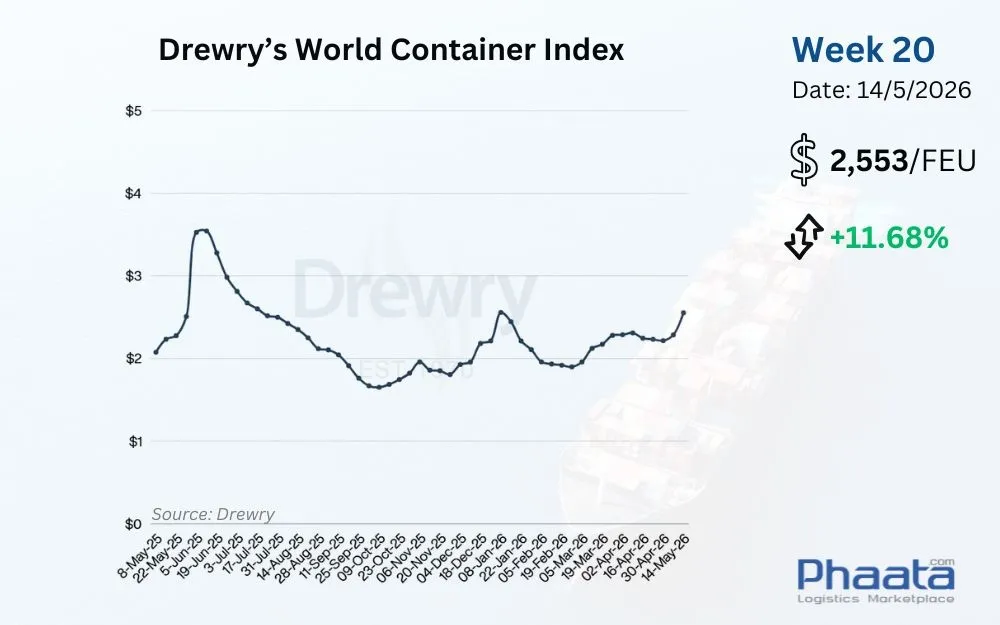
Drewry's World Container Index Week 20/2026 (Photo: Phaata)
2. Asia-North America Ocean Freight Rates
Supply and Demand:
Week 20 recorded the most severe space contraction of the current cycle, with actual deployed capacity hitting only 78% of standard levels. Facing space shortages, many carriers are prioritizing slot allocations for higher-margin FAK (Freight All Kinds) shipments while significantly tightening booking limits for NAC (Named Account) customers.
Conversely, transport demand remains robust. The continuous announcements of blank sailings for the upcoming weeks are expected to prolong the capacity crunch until at least early June. This simultaneously elevates operational risks across the trade lane, including rolled cargo, delayed container loading, and vessel schedule volatility. For urgent shipments or those with strict transit times, shippers should proactively secure early bookings and consider utilizing FAK rates or premium services to guarantee vessel space.
Rate Developments:
Ocean freight rates from Asia to the US West Coast in Week 20/2026 increased by 3.17% week-on-week, reaching $2,963/FEU. This rate is up 6.89% month-on-month, according to Xeneta data.
FAK Rate Hikes: Although booking space remains available for FAK cargo, the actual rate baseline officially increased on May 15 due to tightened capacity. Shippers must prepare cash flow for the next round of rate hikes anticipated in the first half of June. This pricing tension is forecast to cool only by late June when the pressure of structural overcapacity re-enters the market.
Stable Emergency Bunker Surcharge (EBS): The EBS continues to be applied, but current collection levels are holding steady. Carriers will conduct their next cost review in late May, adjusting surcharges closely in line with market oil price fluctuations.
Initiation of Peak Season Surcharge (PSS): Several carriers activated PSS implementations on May 15 and May 21. Given the current booking velocity and highly elevated vessel utilization rates, the PSS will undoubtedly be applied uniformly across the trade lane starting June 1.
Stay tuned to Phaata International Logistics Marketplace for in-depth and fast market updates.
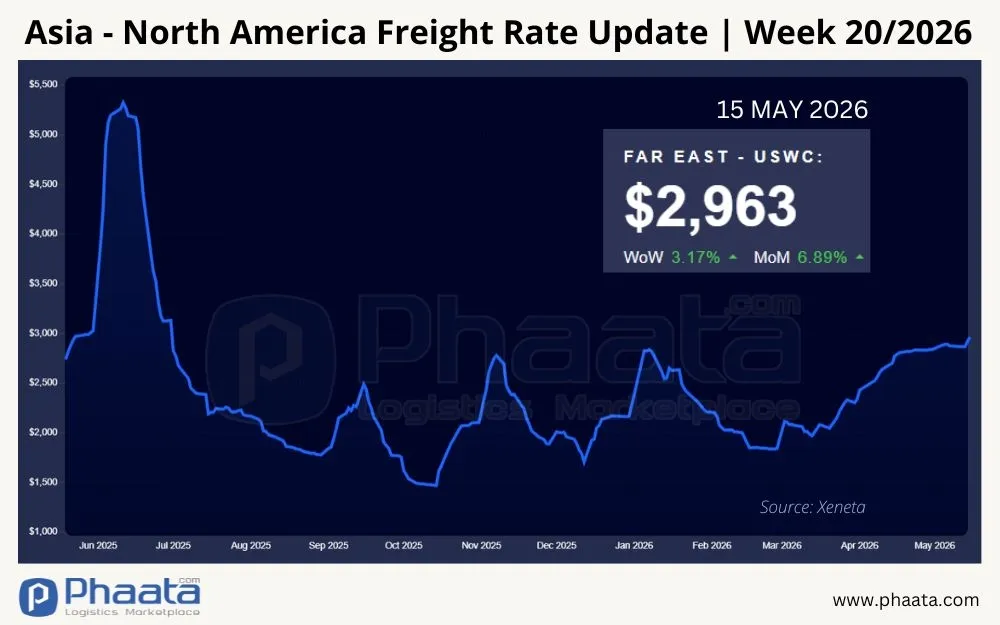
Asia-North America Freight Rates | Week 20/2026 (Photo: Phaata.com)
US Tariff Updates:
1. Ruling Frozen and Section 122 (10%) Tariff Collection Continues
Legal Proceedings: On May 12, the US Court of Appeals for the Federal Circuit issued a stay, officially freezing the May 7 ruling by the Court of International Trade (CIT) that struck down the Section 122 (10%) tariff.
Current Practical Operations: Under the impact of this stay, Customs and Border Protection (CBP) continues to apply and collect the 10% tariff on all imported goods. This rule applies even to the three plaintiff companies that recently won the CIT ruling.
Legal Risk Assessment: The government's appeal process is expected to drag on for months and may even reach the Supreme Court. However, the Section 122 mandate automatically expires on July 24, 2026. This impending expiration may diminish the urgency of a Supreme Court review. Importers are advised not to halt Section 122 tariff payments. Concurrently, they must immediately tally the total Section 122 duties paid since February 2026 and closely monitor the liquidation status of each entry. If the CIT's ruling is upheld in the future, the refund process will likely be funneled through the automated CAPE system.
2. CAPE System (IEEPA Refunds) Operational Progress and Cash Flow Bottlenecks
According to CBP's explanatory report submitted to the CIT on May 11, 2026, the CAPE refund processing system is hitting major volume milestones but is beginning to expose technical errors on the importers' end:
- Processing Volume: 126,237 entry files have been submitted to CAPE. Of these, 86,874 (68%) passed technical validation. At the line-item level, 15.1 million entries passed detailed reconciliation.
- Disbursement Scale: Approximately 8.3 million entries have completed the liquidated/reliquidated process and officially had the IEEPA duties removed. This volume corresponds to a refund budget of approximately $35.46 billion (including principal and interest). Data is currently being aggregated by Importer of Record (IOR) number and liquidation date for transfer to the Treasury for payout.
- Refund Bottleneck Risk: There are 1,880 approved refund orders currently "suspended" in the system because importers have not provided Automated Clearing House (ACH) electronic bank account information.
- Operational Directive: Customs brokers are required to immediately check and update ACH information on the ACE Portal. Any delay in account declaration will directly disrupt the refund cash flow.
3. Extension of Tariff Ultimatum for the European Union (EU)
Negotiation Deadline Extended: On May 7, the US President issued a message extending the deadline to July 4, 2026, for the EU to implement trade commitments and reduce tariffs to zero. This was accompanied by a threat to apply "much higher" tariffs if the EU fails to comply.
Temporary Suspension of Auto Tariffs: The plan to increase import tariffs on EU cars and trucks from 15% to 25% (initially announced on May 1) is currently stalled. No legal document has clarified whether this tariff will apply solely to Completely Built-Up (CBU) vehicles or include auto parts and components.
Procurement Operations: Enterprises importing goods, particularly auto parts from Europe, are temporarily spared the 25% tariff. However, they must leverage the time window between now and July 4 to accelerate imports and prepare a landed cost contingency margin for a scenario where negotiations collapse.
Stay tuned to articles on the Phaata International Logistics Marketplace for rapid and in-depth market updates.
3. Asia-Europe Ocean Freight Rates
Supply and Demand:
Import demand in the European market remains low, while the vessel oversupply situation on the Far East - Europe trade lane shows no clear signs of improvement.
However, carriers have collectively deployed multiple blank sailings in the second half of May, thereby reducing total market supply by approximately 12%. This move is significantly shrinking actual transport capacity, especially on Ocean Alliance services, where space is filling up very rapidly.
Operations:
Operational Status at Major European Ports Congestion pressure continues to mount at several key European transshipment hubs:
-
Rotterdam: Container yard capacity currently fluctuates between 80-88%, while barge wait times have stretched to 48-72 hours.
-
Hamburg: Yard utilization has reached approximately 89%, with an average vessel berthing wait time of about 2 days.
-
Antwerp-Bruges: Yard capacity remains at 70-80%, with berthing delays of 1 to 2 days.
Primary Causes of Operational Pressure The current operational disruptions stem from multiple converging factors:
-
Slow Cargo Clearance: Consignees picking up containers late, coupled with overloaded inland warehouses due to early importing to dodge tariff risks, have prolonged port container dwell times beyond normal levels.
-
Low Water Levels on the Rhine River: Barge operational capacity is significantly restricted, exacerbating backlogs in Rotterdam and Antwerp with wait times of 48 to 72 hours. Transport pressure is gradually shifting to road and rail.
-
Vessel Schedule Disruption due to Alliance Restructuring: Service network changes since January 2026 have destabilized berthing windows. Many off-schedule vessel arrivals make container yard and berth coordination difficult.
-
Pilot Strikes in Hamburg: Strikes organized by the Ver.di union on the Elbe River route continue to prolong vessel queues at the HHLA Container Terminal Altenwerder (CTA), adding pressure to the North European operational chain.
Market Outlook Water levels on the Rhine are gradually improving in May and June, which may help alleviate pressure on barge transport in the short term. However, the July-October period is traditionally the most severe low-water season of the year, so the risk of inland transport disruption must be closely monitored. Furthermore, the simultaneous arrival of vessels taking the Cape route and the Suez route could further intensify operational pressure at terminals. The upcoming European summer holidays are also forecast to negatively impact operational productivity at ports and inland logistics systems.
Freight Rate Developments:
Ocean freight rates from Asia to Europe in Week 20/2026 increased by 7.25% week-on-week, reaching $2,634/FEU. This rate is down 1.94% month-on-month, according to Xeneta data.
The Shanghai Containerized Freight Index (SCFI) generally remains stable, though a slight upward trend has emerged in the short term.
Carriers are pushing FAK rate increases in the second half of May, primarily through capacity control measures rather than being driven by actual cargo demand. The market is shifting from a phase of "continuous decline" to a state of "cautious stability," with the freight rate baseline showing signs of a short-term bottoming out.
Stay tuned to Phaata International Logistics Marketplace for in-depth and fast market updates.
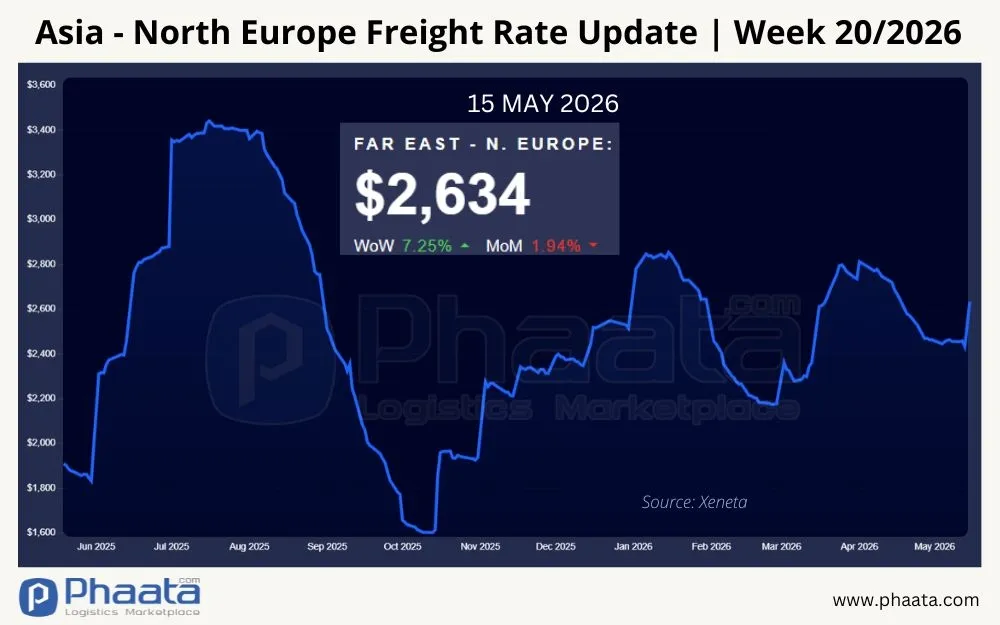
Asia-Europe Freight Rates | Week 20/2026 (Photo: Phaata.com)
4. North America - Asia Ocean Freight Rates
Ocean freight rates from North America (West Coast) to Asia in Week 20/2026 decreased slightly by 0.16% week-on-week, settling at $627/FEU. This rate is up 1.62% month-on-month, according to Xeneta data.
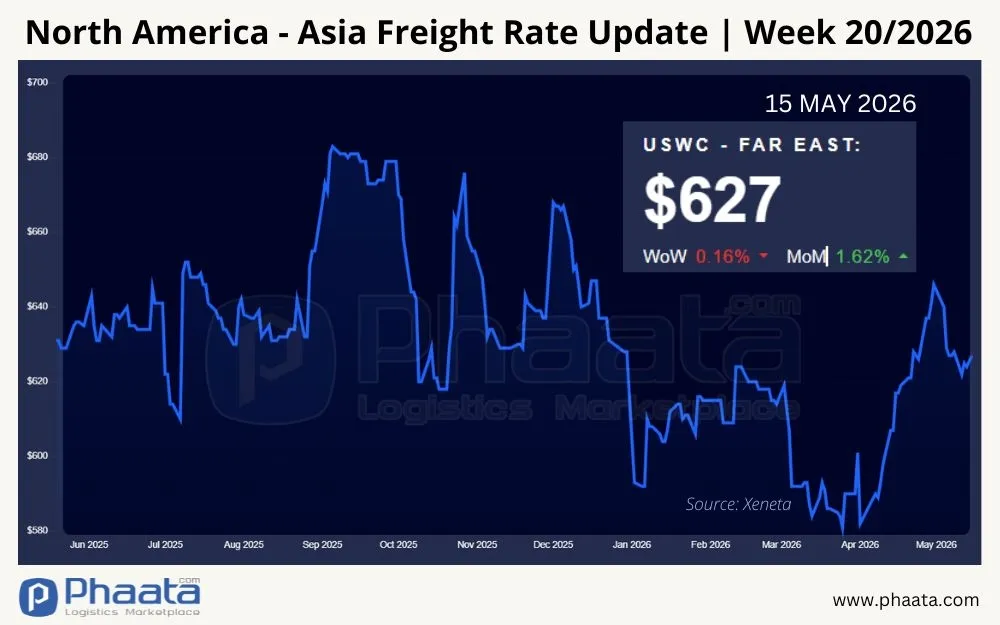
North America (West Coast) - Asia freight rates | Week 20/2026 (Photo: Phaata.com)
5. Northern Europe - Asia Ocean Freight Rates
Ocean freight rates from North Europe to Asia in Week 20/2026 increased by 6.17% week-on-week, reaching $241/FEU. This rate is down 1.23% month-on-month, per Xeneta data.
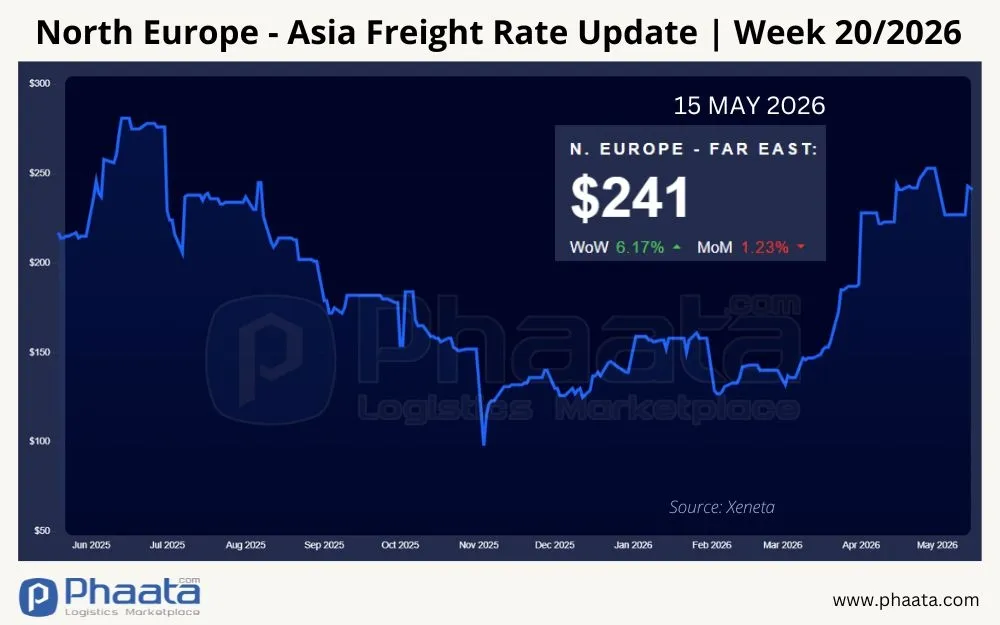
Container Freight rates from Northern Europe to Asia | Week 20/2026 (Photo: Phaata.com)
6. Conclusion and Recommendations from Phaata
Week 20/2026 recorded a distinct reversal in the international container shipping market as freight rates on several major trade lanes surged back simultaneously after a prolonged period of steep decline since the beginning of the year. The current upward pricing momentum does not stem from a robust recovery in global consumer demand but primarily originates from carriers proactively tightening capacity through blank sailings, service network adjustments, and slot allocation controls.
On the Asia - North America route, capacity shortage pressure is at its highest in recent months, with actual deployed capacity hovering at just 78%. Carriers prioritizing FAK cargo and simultaneously rolling out PSS surcharges indicate the market is entering a short-term rate hike phase ahead of the Q3 peak shipping season. The greatest risk currently is not just rapidly rising transport costs, but also the likelihood of rolled cargo, delayed loading, and continuous vessel schedule volatility.
Meanwhile, the Asia - Europe route has yet to record significant improvement in cargo demand. However, capacity cuts and prolonged congestion at major transshipment hubs like Rotterdam, Hamburg, and Antwerp are helping halt the rate decline and initiating a mild recovery. Operational factors such as low water levels on the Rhine, labor strikes, and schedule disruptions continue to be variables that could drive up inland logistics costs in Europe in the coming months.
Alongside transport factors, US trade policy risks continue to directly impact businesses' import plans and cash flows. The maintenance of the Section 122 tariff at 10%, combined with potential tax policy shifts regarding the EU, demonstrates that the international trade environment remains unstable. Import-export businesses must prepare contingency scenarios rather than expecting policies to be untangled anytime soon.
Recommendations from Phaata
Based on actual market fluctuations, businesses should note:
1. Proactively plan bookings and manage delivery schedules: With capacity shortages and blank sailings persisting on major routes, businesses must book earlier than usual, particularly for US-bound cargo from late May through the end of June. For shipments with strict deadlines, consider utilizing premium services or FAK to mitigate the risk of rolled cargo.
2. Strictly control landed logistics costs: Beyond the base Ocean Freight, businesses must continuously update surcharges such as PSS, EBS, demurrage, detention, and inland transport costs in Europe. Amid highly volatile vessel schedules, actual total logistics costs can escalate much faster than ocean freight rate increases.
3. Review trade terms and sales contracts: US importers must re-examine Incoterms, tariff responsibility clauses, and price adjustment mechanisms in contracts to limit risks arising from changes in import tax policies.
4. Closely monitor refund progress and entry status in the US: Businesses dealing with IEEPA or Section 122 tariffs must proactively reconcile liquidation data, standardize ACH information, and work early with customs brokers to avoid delays in the refund process.
5. Diversify transport options and sourcing: As both ocean freight and European port systems face operational pressure, businesses should prepare alternative plans such as switching destination ports, splitting shipments, or adjusting delivery schedules to reduce reliance on a single fixed transport route.
Overall, the international logistics market is currently entering a new cycle of volatility with simultaneous pressure from freight rates, transport capacity, and trade policies. The ability to react swiftly, control costs, and build flexible operational plans will be the determining factor for the competitiveness of import-export businesses in Q3/2026.
Stay tuned to articles on Phaata.com or Phaata fanpage for rapid and in-depth market updates.
Find Freight Rates Here
Find Logistics Companies Here
See more:
- Yang Ming Under Pressure from Freight Rates and Middle East Tensions in Q1 2026
- CMA CGM Air Cargo Officially Launches Freighter Route to Vietnam Amid a Red-Hot Market
- Q1/2026 Report: HMM Profits Plunge 56% Amid Dual Market Pressures
- Spot Rates Surge as Carriers Universally Implement Surcharges Ahead of Early Peak Season
- Hapag-Lloyd Reports Q1/2026 Loss Amid Dual Pressures from Freight Rates and Supply Chain Disruptions
- Trans-Pacific Freight Rates Remain Elevated Amid Muted Demand
- CMA CGM Implements Peak Season Surcharge from South China and Hong Kong
- Maersk: Iran War is Adding $500 Million in Costs per Month - And Customers Will Have to Shoulder a Portion
- COSCO schedules: Vietnam - North America in May 2026
- COSCO updates Vietnam-Intra Asia sailing schedules in May 2026
- COSCO updates Vietnam-North Europe sailing schedules in May 2026
- COSCO updates sailing schedules of Vietnam - South America & Africa in May 2026
- COSCO updates sailing schedules of Vietnam-Middle East & Oceania in May 2026
- SITC updates Vietnam-Intra Asia sailing schedules in May 2026
Source: Phaata - Vietnam's First International Logistics Marketplace
► Find Better Freight Rates & Logistics Service Providers!


Featured News
- Hapag-Lloyd applies Peak Season Surcharge from East Asia to USA and Canada
- The world\'s largest container ships MSC Irina and MSC Loreto floated
- MSC (Mediterranean Shipping Company) - The world\'s leading container shipping lines
- Information you need to know about Maersk Line
- Top 10 export and import goods between Vietnam - Philippines in the first 5 months of 2020

 Market News
See more
.webp)
.webp)
.webp)



 HOT PROMO
See more
30
 FCL
FCL
 28 Days
 Freight cost

CÔNG TY TRÁCH NHIỆM HỮU HẠN DT LOGISTICS (VN)
406
FCL
28 Days
Freight cost

Công Ty TNHH Quanterm Logistics Vietnam
659
FCL
33 Days
Freight cost

CÔNG TY TNHH TIẾP VẬN TOÀN CẦU KM
764
 Other
Other

INTERLOG CORP - CÔNG TY CỔ PHẦN GIAO NHẬN TIẾP VẬN QUỐC TẾ
812
FCL
35 Days
Freight cost

CÔNG TY TNHH INTERNATIONAL LOGISTICS GLORY (VIỆT NAM)
Why do thousands of businesses trust Phaata?
USERS/MONTH
LOGISTICS COMPANIES
REQUEST FOR QUOTEŚ
QUOTATIONS
VIETNAM LOGISTICS COMMUNITY
5 Steps to Get the Best Quote
Find a price quickly/Send a RFQ
Compare multiple options
Contact for Further Consultation
Negotiating prices/services
Management & rating
 Freight rates
Sea freight
- FCL
See more
56
7
Days Transit
- ₫4,631,025 / 20'GP
- ₫10,585,200 / 40'HQ

GIA LINH LOGISTICS SERVICES CO., LTD. (G LINK Logistics)
69
3
Days Direct
- ₫1,323,150 / 20'GP
- ₫3,969,450 / 40'GP
- ₫3,969,450 / 40'HQ

CÔNG TY CỔ PHẦN TIẾP VẬN INTERCARGO
578
28
Days Direct
- ₫76,345,755 / 20'GP
Công Ty TNHH Quanterm Logistics Vietnam
849
4
Days Direct
- ₫5,689,545 / 20'GP
- ₫10,982,145 / 40'GP
- ₫10,982,145 / 40'HQ
- ₫11,908,350 / 45'HQ

MELODY LOGISTICS COMPANY LIMITED
969
11
Days Direct
- ₫1,984,725 / 20'GP
- ₫3,043,245 / 40'HQ

Compass Logistics
 Premium
Sea freight
- LCL
See more
1,203
4
Days Direct
- ₫0 /cbm

CÔNG TY CỔ PHẦN GIAO NHẬN VẬN TẢI HỒNG SƠN
1,938
5
Days Direct
- ₫0 /cbm
CÔNG TY TRÁCH NHIỆM HỮU HẠN DT LOGISTICS (VN)
2,271
6
Days Direct
- ₫523,180 /cbm

CÔNG TY TNHH VẬN TẢI VÀ TIẾP VẬN TOÀN CẦU
2,401
 1,746
4
Days Direct
1,746
4
Days Direct
- ₫396,945 /cbm

CHI NHÁNH THÀNH PHỒ HỒ CHÍ MINH - CÔNG TY TNHH HECNY SHIPPING VIỆT NAM
 Air freight
- General cargo
Air freight
- General cargo
See more
441
1
Days Direct
- 46,310 ₫/kg

N.B.L INTERNATIONAL TRANSPORT CO., LTD
839
1
Days Direct
- 161,424 ₫/kg
CÔNG TY CỔ PHẦN GIAO NHẬN VẬN TẢI HỒNG SƠN
3,848
10
Days Transit
- 264,630 ₫/kg

Phoenix Logistics Vietnam - chi nhánh TP. Hồ Chí Minh (Phoenix International Forwarding Vietnam )
5,619
1
Days Direct
- 185,241 ₫/kg

CÔNG TY TNHH THƯƠNG MẠI VÀ DỊCH VỤ FASTRANS
8,403

 Rail freight
- FCL
Rail freight
- FCL
See more
1,843
5
Days Direct
- ₫44,987,100 / 40'HQ
- ₫44,987,100 / 45'HQ

CÔNG TY TNHH PHƯỚC TÁ
3,332
3
Days Direct
- ₫15,083,910 / 40'HQ

CÔNG TY CỔ PHẦN VẬN TẢI VÀ THƯƠNG MẠI ĐƯỜNG SẮT
13,831
7
Days Direct
- ₫48,956,550 / 20'GP

Công ty TNHH T&M Forwarding
12,644
5
Days Direct
- ₫7,145,010 / 20'GP

ASIAN EXPRESS LINE VIETNAM ( AEL VIET NAM )
9,493
10
Days Direct
- ₫9,262,050 / 20'GP

CÔNG TY CỔ PHẦN LOGISTICS QUỐC TẾ V&T
 Road freight
- FCL
Road freight
- FCL
See more
1,889
1
Day
- ₫28,000,000 / 20'GP
- ₫28,000,000 / 40'GP

CÔNG TY TNHH THƯƠNG MẠI DỊCH VỤ VÀ KHO VẬN VIETTEL POST - TTC
3,749
4
Day
- ₫211,704 / 20'GP

CÔNG TY CỔ PHẦN KINH DOANH THƯƠNG MẠI VÀ DỊCH VỤ HỎA TỐC
46,658
1
Day
- ₫6,868,686 / 20'OT
- ₫6,868,686 / 40'OT
- ₫6,868,686 / 40'OT HQ

CÔNG TY TNHH LIÊN VẬN QUỐC TẾ SHINING OCEAN VIỆT NAM
104,044
2
Day
- ₫6,500,000 / 40'RF
- ₫6,500,000 / 40'RQ
- ₫6,500,000 / 45'RQ

CÔNG TY CP PROSHIP
Premium
173,253
1
Day
- ₫18,997,200 / 20'GP
- ₫18,997,200 / 40'GP

CÔNG TY CỔ PHẦN GIAO NHẬN VẬN TẢI CON ONG


