


Monday, 20/07/2026, 16:46 (GMT +7)
 903
903
International Shipping and Logistics Market Update Week 29/2026 | Phaata

International shipping and logistics market update - Week 29/2026
Table of Contents
-
World Container Index Week 29/2026
-
Asia - North America Ocean Freight Rates
-
Asia - Europe Ocean Freight Rates
-
Northern America - Asia Ocean Freight Rates
-
Northern Europe - Asia Ocean Freight Rates
-
Conclusions and Recommendations by Phaata
1. World Container Index Week 29/2026
Drewry’s World Container Index (WCI) for Week 29/2026 (from July 13 to July 19, 2026) decreased by 1.98% compared to the previous week, dropping to $4,547/FEU.
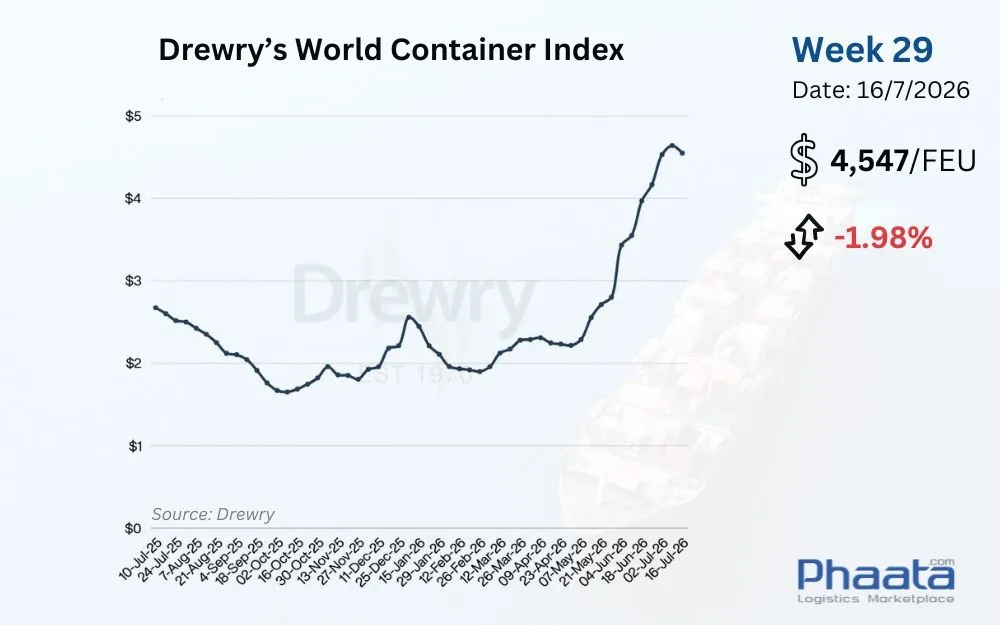
Drewry's World Container Index Week 29/2026 (Photo: Phaata)
2. Asia-North America Ocean Freight Rates
Supply and Demand:
-
Capacity continues to expand: The blank sailing ratio on the Trans-Pacific Eastbound (TPEB) route continues to drop, accounting for only about 0.4% of total scheduled capacity. This is lower than the 0.8% in Week 28 and 5.0% in Week 27, indicating that carriers are maintaining their strategy of injecting maximum capacity into active operations.
-
Fleet reallocation: A portion of operational capacity is being diverted by carriers to the Asia-Europe route to offset the decline in operational efficiency caused by prolonged disruptions in the Middle East. Consequently, the pace of capacity addition on the TPEB route has slowed somewhat.
-
Localized supply: Transport capacity bound for the U.S. West Coast (USWC) is being actively supplemented through the deployment of extra loaders and new service loops. Conversely, capacity supply to the U.S. East Coast (USEC) remains flat.
-
Demand shows signs of cooling post-front-loading: In June, many North American retailers accelerated their import schedules (front-loading) to mitigate the impact of tariff policies and rising fuel costs, pushing import volumes to high levels. However, current forecasts suggest import volumes may gradually decline toward the end of Q3 as consumer demand weakens under inflationary pressures.
Rate Developments:
Ocean freight rates from Asia to the North America West Coast in Week 29/2026 decreased by 7.31% week-on-week, settling at $6,555/FEU. This rate represents a 26.81% increase month-on-month, according to Xeneta data.
-
USWC Route: Planned rate hikes scheduled for July 15 have been adjusted by carriers toward a more cautious approach. The injection of additional capacity, coupled with signs of plateauing transport demand, has contributed to easing the upward price pressure.
-
USEC Route: The spot rate baseline remains elevated, recording only a slight downward adjustment compared to previous weeks.
Stay tuned to Phaata International Logistics Marketplace for in-depth and fast market updates.
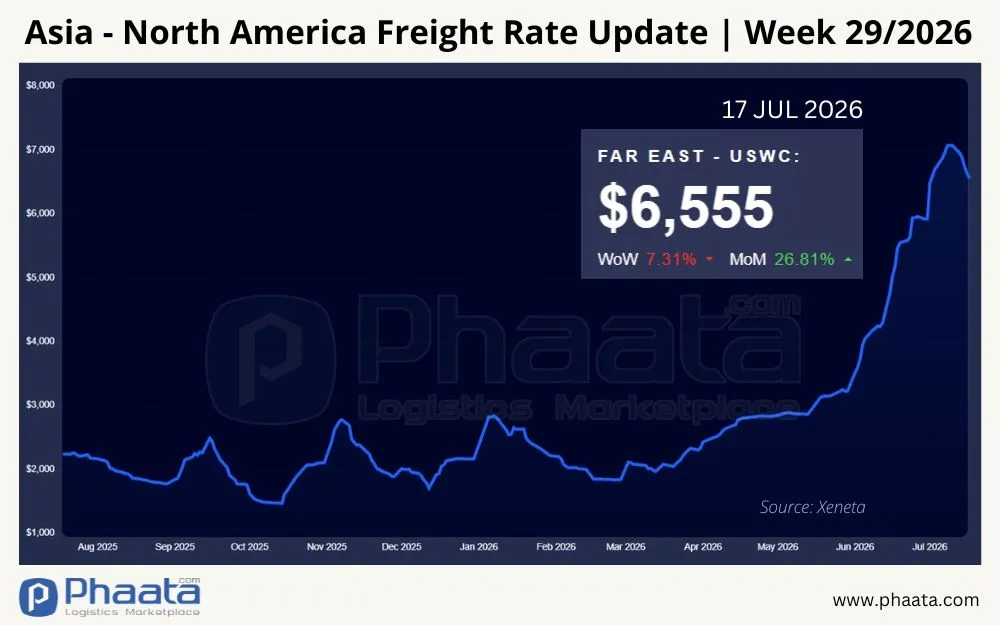
Asia-North America Freight Rates | Week 29/2026 (Photo: Phaata.com)
US Tariff Updates:
1. Bill on Additional Sanctions Targeting Russian Energy On July 14, the U.S. Senate introduced a draft bill proposing secondary tariffs of up to 100% on countries that continue to import oil and gas from Russia. If passed, this policy is expected to significantly impact supply chains linked to China and India.
-
The bill is currently under review. Its scope, effective date, and potential exemptions remain undetermined.
-
Businesses with supply chains involving China or India should closely monitor the legislative process and proactively assess the impact on their landed costs. Developing cost scenarios for a potential 100% secondary tariff will help businesses better prepare contingency plans.
2. U.S. Department of Justice (DOJ) Ramps Up Trade Enforcement The DOJ has established a new dedicated unit for trade enforcement and issued new guidelines regarding customs violations. Priority areas for scrutiny include:
-
Duty evasion
-
Undervaluation
-
Illegal transshipment
This move signals that the U.S. is increasingly bolstering its enforcement and monitoring capabilities over trade activities, rather than merely focusing on enacting new tariff policies. Businesses should review their compliance controls and evaluate workflows with their customs brokers to promptly detect and rectify errors related to tax declarations or tariff stacking.
3. BIS Continues to Expand ICTS Control Scope During a July 14 hearing, representatives from the Bureau of Industry and Security (BIS) stated that the scope of the Information and Communications Technology and Services (ICTS) regulations will be expanded into other sectors once the legal framework for connected vehicles is finalized. To date, BIS has not published the list of affected industries or the official implementation timeline. Detailed information will be updated once the regulations on connected vehicles are finalized.
4. USTR Reaffirms Intent to Maintain Tariff Policies The Office of the U.S. Trade Representative (USTR) indicated that the current tariff regime is highly likely to be maintained even after the current administration's term concludes. Businesses should treat existing tariffs as a long-term structural component of their supply chain costs, rather than viewing them as short-term measures.
Stay tuned to articles on the Phaata International Logistics Marketplace for rapid and in-depth market updates.
3. Asia-Europe Ocean Freight Rates
Supply and Demand:
-
Capacity remains tightly controlled: The blank sailing ratio on the Far East - North Europe route hovered at 8.8% in Week 29, a slight decrease from 9.4% the previous week. Nevertheless, this remains the highest cancellation rate among major international container shipping corridors.
-
Capacity under pressure from detours: Carriers maintaining the Cape of Good Hope routing to avoid security risks in the Red Sea are prolonging transit times, thereby degrading fleet operational efficiency. To offset this capacity loss, carriers have injected the highest number of vessels onto this route seen in the past year.
-
Stable demand amid persistent Red Sea risks: Transport demand on the Far East - North Europe route remains stable. However, the July 5 attack on a commercial vessel off the coast of Yemen has reignited risks for the Suez Canal maritime corridor, forcing some carriers to further delay plans to restore this routing.
Freight Rate Developments:
Ocean freight rates from Asia to Europe in Week 29/2026 dropped by 4.65% week-on-week, settling at $5,203/FEU. This rate represents an 18.06% increase month-on-month, according to Xeneta data.
-
Far East - North Europe rates gradually stabilizing: After weeks of sharp increases, spot rates on the Far East - North Europe route are showing signs of plateauing and are gradually establishing a new baseline.
-
Price trends depend on market demand: The trajectory of freight rates in the coming weeks will hinge primarily on the actual volume of cargo entering the market. If demand remains robust during the peak season, the current rate baseline is highly likely to be sustained.
Stay tuned to Phaata International Logistics Marketplace for in-depth and fast market updates.
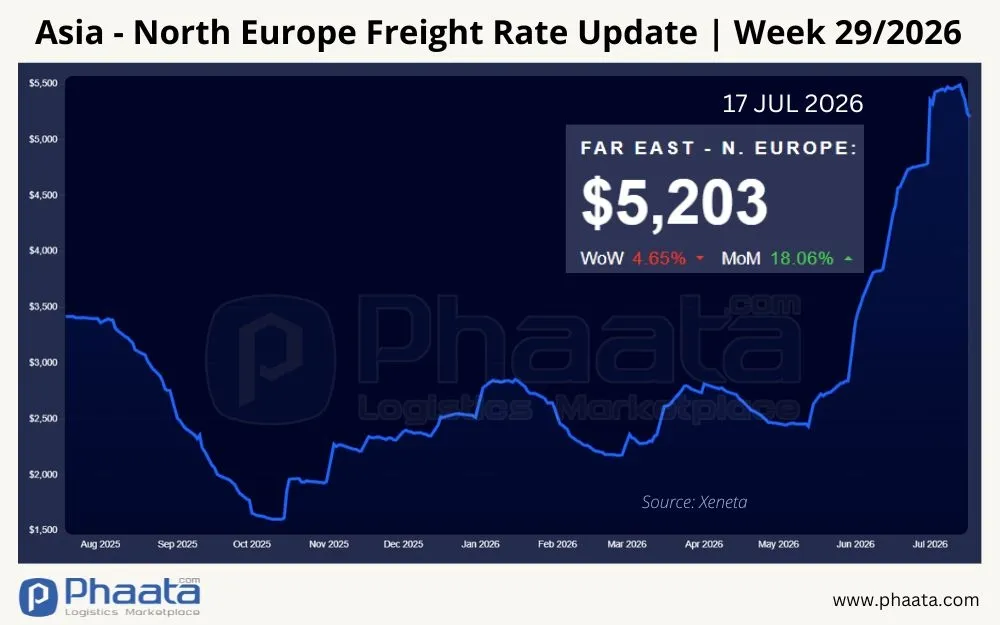
Asia-Europe Freight Rates | Week 29/2026 (Photo: Phaata.com)
4. North America - Asia Ocean Freight Rates
Ocean freight rates from North America (West Coast) to Asia in Week 29/2026 fell by 10.68% week-on-week, down to $619/FEU. This rate is a 2.06% decrease month-on-month, according to Xeneta data.
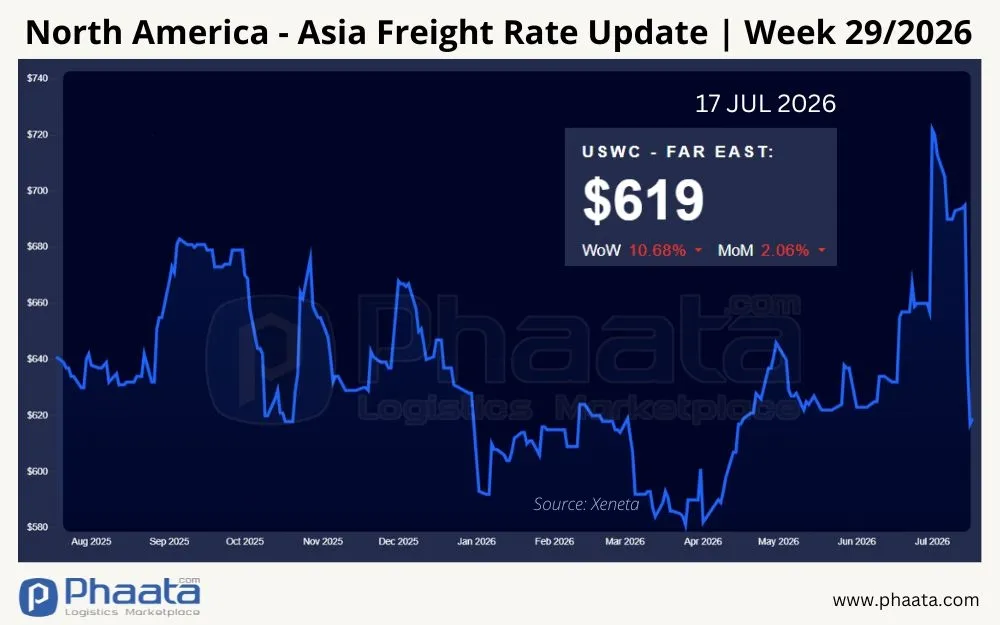
North America (West Coast) - Asia freight rates | Week 29/2026 (Photo: Phaata.com)
5. Northern Europe - Asia Ocean Freight Rates
Ocean freight rates from North Europe to Asia in Week 29/2026 decreased by 0.71% week-on-week, settling at $280/FEU. This rate is up 12.45% month-on-month, per Xeneta data.
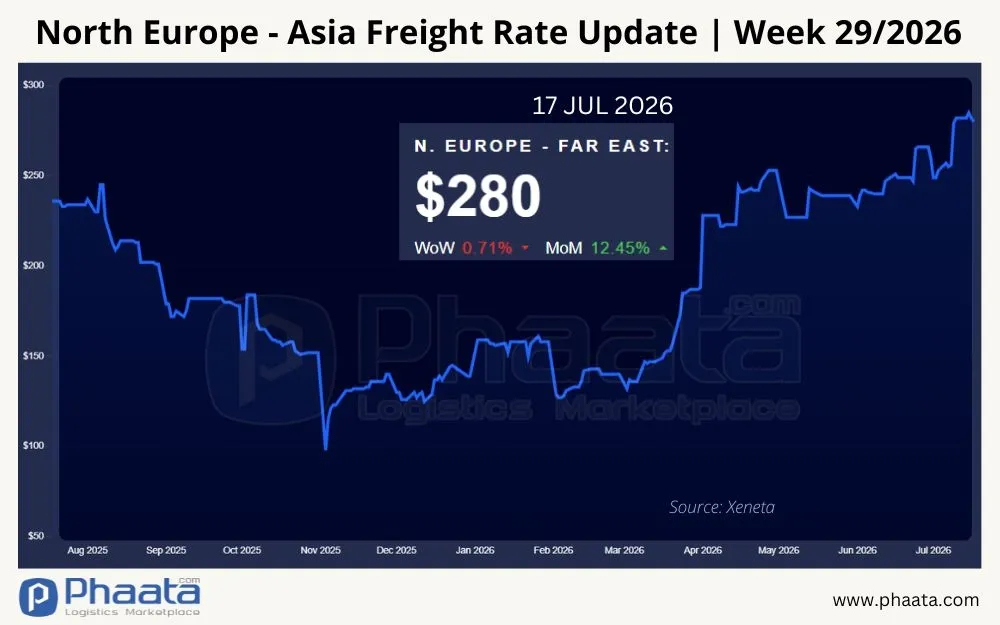
Container Freight rates from Northern Europe to Asia | Week 28/2026 (Photo: Phaata.com)
6. Conclusion and Recommendations from Phaata
The international container shipping market in Week 29/2026 recorded a mild correction following a prolonged period of sharp increases. Drewry's WCI dropped 1.98% to $4,547/FEU. Notably, spot rates from Asia to the U.S. West Coast fell by 7.31%, while the Asia-Europe route saw a 4.65% decline.
This development reflects three primary market trends:
-
Demand begins to cool: The wave of front-loading in Q2/2026, aimed at mitigating the impact of U.S. tariff policies, is gradually concluding. Simultaneously, import demand shows signs of stalling as purchasing power in consumer markets faces inflationary pressures.
-
Freight rates remain elevated: Despite the weekly downward adjustment, current rate baselines are still approximately 18-26% higher than a month ago. On the Trans-Pacific route, the blank sailing ratio plummeted to just 0.4%, reflecting carriers' efforts to boost supply. However, on the Asia-Europe route, operational costs incurred from the ongoing Cape of Good Hope detour continue to prop up the rate baseline.
-
Shifting market risks: Entering the second half of 2026, the primary risk for businesses is shifting away from transport capacity shortages. Instead, the focus is turning toward U.S. trade policy and compliance factors. These include Anti-Dumping/Countervailing Duty (AD/CVD) cases, enhanced commercial fraud scrutiny by the U.S. Department of Justice (DOJ), and proposed secondary tariffs on Russian energy-linked goods.
Recommendations from Phaata
1. Transport Management and Shipping Planning
-
Flexible freight contract structuring: As spot rates show signs of plateauing after a steep climb, businesses should consider a hybrid approach combining contract and spot rates, rather than committing to high-priced long-term contracts for the post-September 2026 period. This strategy enhances flexibility and optimizes costs when the market adjusts.
-
Proactive booking planning: For anticipated exports in August and September, businesses should engage early with carriers or logistics companies to confirm space allocations and empty container availability at least 3-4 weeks in advance.
-
Incorporate buffer time: For Europe-bound shipments, delivery schedules should be built around Cape of Good Hope transit times, adding an extra 7-10 days of buffer. This mitigates the risk of delays should vessel schedules remain volatile.
2. Customs Compliance and Tariff Risk Management
-
Review customs declaration processes: In light of the DOJ's heightened scrutiny on commercial fraud, businesses must thoroughly review all customs declaration procedures - including HS codes, declared values, and the application of tariff programs - to minimize the risk of investigations related to duty evasion or undervaluation.
-
Verify IOR status: U.S. importers must proactively verify the active status of their Importer of Record (IOR) numbers on the ACE system to prevent clearance disruptions.
-
Assess tariff scenario impacts: For supply chains sourcing raw materials or components from China and India, businesses should build landed cost scenarios to evaluate the potential impact if the proposed U.S. secondary tariffs are enacted.
-
Proactively update tax policies: Businesses should integrate Section 301 and AD/CVD tariffs into their medium and long-term cost planning, rather than hoping for swift policy reversals.
Stay tuned to articles on Phaata.com or Phaata fanpage for rapid and in-depth market updates.
Find Freight Rates Here
Find Logistics Companies Here
See more:
- COSCO Shipping Bulk Orders Four Newcastlemax Bulk Carriers at CSSC Qingdao Beihai
- MSC Introduces Peak Season Surcharge (PSS) for North Europe–North America Trade
- COSCO SHIPPING Launches CHX3 Service to Strengthen Peru–Costa Rica Connectivity
- Commercial Vessel Traffic Through the Strait of Hormuz Falls to Its Lowest Level Since May
- Maersk Introduces Low Water Surcharge (LWC) on Europe–Canada Trade
- Maersk Adjusts Fuel Surcharges for Inland Transport Services Across Multiple European Markets
- COSCO schedules: Vietnam - North America in Jul 2026
- SITC updates Vietnam-Intra Asia sailing schedules in Jul 2026
- SHOW INTRODUCTION THE 4TH VIET NAM INTERNATIONAL LOGISTICS EXHIBITION (VILOG 2026)
Source: Phaata - Where Shippers & Logistics Providers Connect
► Find Better Freight Rates & Logistics Service Providers!


Featured News
- Hapag-Lloyd applies Peak Season Surcharge from East Asia to USA and Canada
- The world\'s largest container ships MSC Irina and MSC Loreto floated
- MSC (Mediterranean Shipping Company) - The world\'s leading container shipping lines
- Information you need to know about Maersk Line
- Top 10 export and import goods between Vietnam - Philippines in the first 5 months of 2020

 Market News
See more

.webp)
.webp)
.webp)


 HOT PROMO
See more
245
 FCL
FCL
 28 Days
 Freight cost

CÔNG TY TRÁCH NHIỆM HỮU HẠN DT LOGISTICS (VN)
778
FCL
28 Days
Freight cost

Công Ty TNHH Quanterm Logistics Vietnam
1027
FCL
33 Days
Freight cost

CÔNG TY TNHH TIẾP VẬN TOÀN CẦU KM
1132
 Other
Other

INTERLOG CORP - CÔNG TY CỔ PHẦN GIAO NHẬN TIẾP VẬN QUỐC TẾ
1001
FCL
35 Days
Freight cost

CÔNG TY TNHH INTERNATIONAL LOGISTICS GLORY (VIỆT NAM)
Why do thousands of businesses trust Phaata?
USERS/MONTH
LOGISTICS COMPANIES
REQUEST FOR QUOTEŚ
QUOTATIONS
VIETNAM LOGISTICS COMMUNITY
5 Steps to Get the Best Quote
Find a price quickly/Send a RFQ
Compare multiple options
Contact for Further Consultation
Negotiating prices/services
Management & rating
 Freight rates
Sea freight
- FCL
See more
51
7
Days Direct
- ₫26,100,000 / 40'GP
- ₫26,100,000 / 40'HQ

CÔNG TY CỔ PHẦN TIẾP VẬN INTERCARGO
54
22
Days Transit
- ₫57,292,395 / 20'GP
- ₫111,806,175 / 40'GP
- ₫111,806,175 / 40'HQ
- ₫113,129,325 / 45'HQ

MELODY LOGISTICS COMPANY LIMITED
123
7
Days Transit
- ₫4,631,025 / 20'GP
- ₫10,585,200 / 40'HQ

GIA LINH LOGISTICS SERVICES CO., LTD. (G LINK Logistics)
648
28
Days Direct
- ₫76,345,755 / 20'GP
Công Ty TNHH Quanterm Logistics Vietnam
1,009
11
Days Direct
- ₫1,984,725 / 20'GP
- ₫3,043,245 / 40'HQ

Compass Logistics
 Premium
Sea freight
- LCL
See more
1,249
4
Days Direct
- ₫0 /cbm

CÔNG TY CỔ PHẦN GIAO NHẬN VẬN TẢI HỒNG SƠN
2,005
5
Days Direct
- ₫0 /cbm
CÔNG TY TRÁCH NHIỆM HỮU HẠN DT LOGISTICS (VN)
2,329
6
Days Direct
- ₫523,180 /cbm

CÔNG TY TNHH VẬN TẢI VÀ TIẾP VẬN TOÀN CẦU
2,461
 1,776
4
Days Direct
1,776
4
Days Direct
- ₫396,945 /cbm

CHI NHÁNH THÀNH PHỒ HỒ CHÍ MINH - CÔNG TY TNHH HECNY SHIPPING VIỆT NAM
 Air freight
- General cargo
Air freight
- General cargo
See more
484
1
Days Direct
- 46,310 ₫/kg

N.B.L INTERNATIONAL TRANSPORT CO., LTD
894
1
Days Direct
- 161,424 ₫/kg
CÔNG TY CỔ PHẦN GIAO NHẬN VẬN TẢI HỒNG SƠN
3,898
10
Days Transit
- 264,630 ₫/kg

Phoenix Logistics Vietnam - chi nhánh TP. Hồ Chí Minh (Phoenix International Forwarding Vietnam )
5,660
1
Days Direct
- 185,241 ₫/kg

CÔNG TY TNHH THƯƠNG MẠI VÀ DỊCH VỤ FASTRANS
8,426

 Rail freight
- FCL
Rail freight
- FCL
See more
1,875
5
Days Direct
- ₫44,987,100 / 40'HQ
- ₫44,987,100 / 45'HQ

CÔNG TY TNHH PHƯỚC TÁ
3,378
3
Days Direct
- ₫15,083,910 / 40'HQ

CÔNG TY CỔ PHẦN VẬN TẢI VÀ THƯƠNG MẠI ĐƯỜNG SẮT
13,865
7
Days Direct
- ₫48,956,550 / 20'GP

Công ty TNHH T&M Forwarding
12,676
5
Days Direct
- ₫7,145,010 / 20'GP

ASIAN EXPRESS LINE VIETNAM ( AEL VIET NAM )
9,509
10
Days Direct
- ₫9,262,050 / 20'GP

CÔNG TY CỔ PHẦN LOGISTICS QUỐC TẾ V&T
 Road freight
- FCL
Road freight
- FCL
See more
1,921
1
Day
- ₫28,000,000 / 20'GP
- ₫28,000,000 / 40'GP

CÔNG TY TNHH THƯƠNG MẠI DỊCH VỤ VÀ KHO VẬN VIETTEL POST - TTC
3,819
4
Day
- ₫211,704 / 20'GP

CÔNG TY CỔ PHẦN KINH DOANH THƯƠNG MẠI VÀ DỊCH VỤ HỎA TỐC
46,719
1
Day
- ₫6,868,686 / 20'OT
- ₫6,868,686 / 40'OT
- ₫6,868,686 / 40'OT HQ

CÔNG TY TNHH LIÊN VẬN QUỐC TẾ SHINING OCEAN VIỆT NAM
104,103
2
Day
- ₫6,500,000 / 40'RF
- ₫6,500,000 / 40'RQ
- ₫6,500,000 / 45'RQ

CÔNG TY CP PROSHIP
Premium
173,300
1
Day
- ₫18,997,200 / 20'GP
- ₫18,997,200 / 40'GP

CÔNG TY CỔ PHẦN GIAO NHẬN VẬN TẢI CON ONG


