


Sunday, 22/03/2026, 21:27 (GMT +7)
 1520
1520
International Shipping and Logistics Market Update Week 12/2026 | Phaata

International shipping and logistics market update - Week 12/2026
Table of Contents
-
World Container Index Week 12/2026
-
Asia - North America Ocean Freight Rates
-
Asia - Europe Ocean Freight Rates
-
Northern America - Asia Ocean Freight Rates
-
Northern Europe - Asia Ocean Freight Rates
-
Conclusions and Recommendations by Phaata
1. World Container Index Week 12/2026
Drewry’s World Container Index (WCI) for Week 12/2026 (from Mar 16 to Mar 22, 2026) continued to increase, albeit at a slower pace, rising by 2% compared to the previous week to $2,172/FEU. This marks the third consecutive week of gains following a preceding seven-week period of continuous decline.
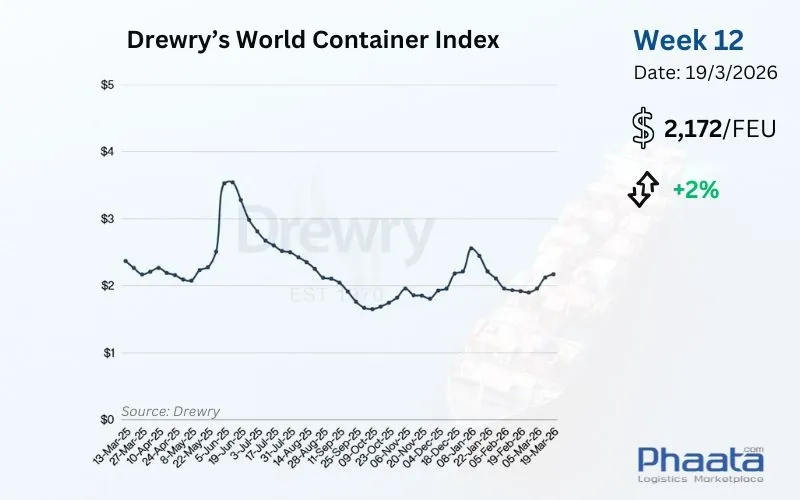
Drewry's World Container Index Week 12/2026 (Photo: Phaata)
2. Asia-North America Ocean Freight Rates
Supply and Demand:
Demand Side:
Booking volumes in Week 12 showed signs of a mild recovery; however, total export cargo output remains low. This discrepancy continues to deepen the supply-demand imbalance across the trade lane.
Supply Side:
The pace of capacity restoration by carriers is occurring very rapidly, expected to surpass the 90% mark in the second half of March. To control the excess space situation, carriers will inevitably roll out a massive wave of blank sailings starting in late March and extending throughout April.
Operations:
Indirect fallout from the Middle East: Although the Asia - North America route does not transit the conflict zone, the diversion of Asia-Europe fleets around the Cape of Good Hope is rupturing the global equipment turnaround cycle. The direct consequence for the Trans-Pacific Eastbound (TPEB) trade is localized empty container shortages and severe congestion at key transshipment hubs in Asia.
Rate Developments:
Ocean Freight rates from Asia to the North America West Coast in Week 12/2026 reversed trend, increasing by 3.91% week-on-week to $2,045/FEU. This rate is up 10.72% month-on-month, according to Xeneta data.
General Rate Increase (GRI): Carriers have uniformly maintained their GRI application notices for the second half of March. In actual operations, some shipping lines have officially rolled this surcharge into the Base rate for currently transacting shipments.
Emergency Fuel Surcharge (EFS): The sudden volatility and surge in bunker prices have forced carriers to immediately activate the EFS tool to offset operational costs:
-
Canadian Market: The EFS will be applied early, expected by the end of March.
-
US Market: The EFS officially takes effect in early April.
Carriers utilizing a Monthly Bunker adjustment mechanism have also locked in higher collection levels for the April cycle.
Peak Season Surcharge (PSS): Because actual cargo volumes in the market are insufficient to create space shortage pressure, carriers have been forced to further postpone the PSS collection schedule to April.
Stay tuned to Phaata International Logistics Marketplace for in-depth and fast market updates.

Asia-North America Freight Rates | Week 12/2026 (Photo: Phaata.com)
US Tariff Updates:
1. Progress on US Customs' Automated IEEPA Refund System (CAPE)
US Customs and Border Protection (CBP) is building the Centralized Account Processing and Management Environment (CAPE) to automate IEEPA duty refunds mandated by the Court of International Trade (CIT). The completion progress of the modules as of March 12 is as follows:
- Filing Portal (70% Complete): Importers and customs brokers will upload a CSV data file containing a list of entries that paid IEEPA duties. The system automatically checks formatting and verifies legal entity status. Data errors will be flagged by the ACE (Automated Commercial Environment) system requesting corrections.
- Mass Recalculation System (40% Complete): This module functions to strip IEEPA-taxable HS codes from the entry and automatically recalculate other valid outstanding duties and fees.
- Liquidation and Re-liquidation (80% Complete): The system establishes an entry liquidation schedule (executed Monday through Thursday weekly) and automatically calculates accrued interest. CBP retains the right to conduct manual reviews within a specific timeframe before finalization.
- Disbursement Processing (60% Complete): Refunds are grouped by importer and liquidation date. Businesses have the right to designate a third party to receive the refund.
- CBP expects to bring the CAPE system online within 45 days (from March 6).
2. Mandatory Operations for Shippers/Customs Declarants
While waiting for CBP to launch the CAPE system, import-export and accounting departments must immediately execute 3 operations:
- Establish Cash Flow: Log into the ACE system and declare Automated Clearing House (ACH) bank account details so CBP can directly transfer the refund.
- Audit Entry Data: Extract all submitted IEEPA duty data. Specifically classify and exclude Section 232 duties (as Section 232 taxable goods are not eligible for refund).
- File Protests: It is mandatory to file Protests for customs entries. This maneuver locks the entry status as "live," preserving 100% of the right to receive a refund in the scenario where CBP's system misses the deadline or the US Government successfully appeals the court's order.
3. New Tariff Risks: Section 301 Investigations Expanded to 60 Countries The US administration is accelerating the roadmap to impose new long-term tariff barriers:
- Expanding Investigation Scope: After targeting 16 countries (including Vietnam) with "overcapacity" allegations on March 11, USTR announced further Section 301 investigations against 60 trading partners on March 12 under the pretext of "use of forced labor." The total import value from these countries accounts for 99% of all US imports in 2025.
- Compressed Timeline: Stakeholders must submit written comments before April 15, 2026. Public hearings are set for April 28, 2026. Unlike the customary 6-18 month duration, these investigations are being fast-tracked to reach conclusions right as the 10% global tariff (Section 122) expires on July 24, 2026.
4. Lawsuit Aimed at Striking Down the 10% Global Tariff (Section 122)
24 US states have filed a lawsuit against President Trump, alleging that the application of Section 122 tariffs is for an improper purpose (no balance of payments emergency exists) and violates the rule of uniform application (too many commodity exceptions).
The CIT will hold a hearing on April 10, 2026, presided over by a 3-judge panel (unrelated to the IEEPA case). Plaintiffs are requesting the court issue a summary judgment to immediately strike down this 10% tariff. From now until the trial date, CBP will continue to collect the 10% tariff normally.
5. Post-IEEPA Landed Cost Structure
The removal of IEEPA tariffs and the application of the 10% tariff (Section 122) creates a massive divergence in input costs across different geographic regions:
- The Losers (Increased Costs): The European Union (EU), the UK, Japan, and South Korea. Because the 10% tariff (Section 122) is stacked on top of Most Favored Nation (MFN) rates, the current total tax burden for this group is higher than the ceiling they previously negotiated under IEEPA agreements.
- The Beneficiaries (Decreased Costs): China, Brazil, and India. These countries previously bore the highest punitive IEEPA tariffs ("Fentanyl" tariffs, reciprocal tariffs). Dropping the rate to the 10% mark drastically reduces the cost of goods from these markets.
Stay tuned to articles on the Phaata International Logistics Marketplace for rapid and in-depth market updates.
3. Asia-Europe Ocean Freight Rates
Supply and Demand:
Demand:
Total cargo output across the market remains low. Actual consumption in the European region is directly depressed by persistent inflationary pressure, causing importers to slash budgets for inventory replenishment.
Supply:
To cope with the drop in export volumes, carriers are executing extremely aggressive blank sailing programs. Actual data shows that total offered capacity on the North Europe trade lane was cut consecutively by 12.7% and 5.2% week-over-week in the first half of March.
The fact that 100% of fleets are forced to maintain the Cape of Good Hope routing due to the Middle East conflict has automatically absorbed a large portion of the structural overcapacity in the market.
Operations:
Schedule disruptions are causing localized congestion at both ends of the supply chain, reducing equipment turnaround speeds:
- Asian Transshipment Hubs: Key transshipment ports like Singapore and Tanjung Pelepas are facing berthing delays. Accumulating rolled cargo is pushing yard utilization at these ports to alarming levels of 80 - 85%.
- North European Destination Ports: Major terminals are reporting yard density hitting critical thresholds. Import container dwell times are being significantly prolonged due to the slowed pace at which importers are clearing cargo from the port.
Freight Rate Developments:
Ocean Freight rates from Asia to Europe in Week 12/2026 continued to surge by 13.52% week-on-week to $2,679/FEU. This rate is up 22.72% month-on-month, per Xeneta data.
Application of Emergency Fuel Surcharge (EFS): Citing disruptions to the fuel supply chain in the Strait of Hormuz, carriers are uniformly rolling out the Emergency Fuel Surcharge tool.
Carriers' Technical Objectives: The introduction and continuous adjustment of these surcharges are not merely to offset costs, but serve as operational tools for carriers to: (1) Control and select booking volumes; (2) Force the market to adapt to and accept a higher overall transport cost baseline; (3) Establish a rigid, non-negotiable price floor.
Short-term Rate Forecast: Although actual cargo output remains low, the Spot rate baseline is expected to hold steady with a slight upward bias. This trend is established entirely based on carriers' artificial intervention measures through imposing surcharges and tightening capacity supply.
Stay tuned to Phaata International Logistics Marketplace for in-depth and fast market updates.

Asia-Europe Freight Rates | Week 12/2026 (Photo: Phaata.com)
4. North America - Asia Ocean Freight Rates
Ocean Freight rates from North America (West Coast) to Asia in Week 12/2026 reversed to increase slightly by 0.34% week-on-week to $586/FEU. This rate is down 5.18% month-on-month, according to Xeneta data.

North America (West Coast) - Asia freight rates | Week 12/2026 (Photo: Phaata.com)
5. Northern Europe - Asia Ocean Freight Rates
Ocean Freight rates from North Europe to Asia in Week 12/2026 continued to increase by 6.80% week-on-week, up to $157/FEU. This rate is up 12.14% month-on-month, per Xeneta data.

Container Freight rates from Northern Europe to Asia | Week 12/2026 (Photo: Phaata.com)
6. Conclusion and Recommendations from Phaata
The transport market in Week 12/2026 has established a new cost baseline, entirely dominated by technical intervention measures from carriers and changes in customs policies, rather than the actual laws of cargo supply and demand.
Freight Rates Rise Counter to Volume: The WCI index, along with Asia-North America and Asia-Europe rates, surged simultaneously (up to 13.52% for the FEWB route) despite low export volumes. The sole driver stems from carriers deploying the Emergency Fuel Surcharge (EFS) tool and enforcing capacity reduction discipline via blank sailings.
Chain-Reaction Operational Bottlenecks: Maintaining the Cape of Good Hope routing is causing physical congestion at both ends of the supply chain. Yard density at Asian hubs (Singapore, Tanjung Pelepas) has hit the 80-85% threshold, causing localized shortages of empty containers for stuffing exports.
Financial Risks in the US Market: The transition from the IEEPA tariff system to the 10% Global Tariff (Section 122) increases the Landed Cost for allied nations while decreasing costs for China. Concurrently, CBP's delay in launching the automated refund system (CAPE) by an additional 45 days places importers at risk of missing the protest deadline for their entries.
Recommendations from Phaata
In the current market context, shippers/import-export businesses should consider the following recommendations to protect profit margins:
1. Transport and Rate Negotiation:
Lock in Space Ahead of the Blank Sailing Wave: Carriers will ramp up blank sailings in late March and April to squeeze prices. Shippers must send volume Forecasts and lock in bookings at least 14 days in advance to avoid the risk of rolled cargo at the port of loading.
Transparent Breakdown of EFS Surcharges: Demand that Forwarders provide official notification documents from the carriers regarding the calculation formula for the Emergency Fuel Surcharge (EFS). Do not accept quotes that lump the EFS into the Base rate, ensuring the right to reconcile costs later.
Adjust Estimated Lead Time: Directly add 7 to 10 days to the committed delivery schedule on contracts for Europe and North America routes to offset berthing wait times and transshipment delays at Asian hubs.
2. Customs Operations for the US Market:
Protect IEEPA Refund Rights: Do not wait for the CAPE system to be finalized. Immediately direct the customs brokerage department to file Protests for all entries that paid IEEPA duties nearing the 180-day mark from liquidation to block CBP's automatic finalization.
Establish Section 301 Defense Files: Goods originating from Vietnam are currently in the crosshairs of dual investigations (overcapacity and forced labor) with a compressed timeline (responses due before April 15, 2026). The documentation department must review, compile, and archive all material traceability records, detailed labor logs, and the Bill of Materials (BOM) to provide immediately to US import partners when requested by investigating agencies.
Stay tuned to articles on Phaata.com or Phaata fanpage for rapid and in-depth market updates.
Find Freight Rates Here
Find Logistics Companies Here
See more:
- Hapag-Lloyd and India Establish a Strategic Maritime Cooperation Framework
- MSC Group Inks Deal to Acquire 50% Stake in Sinokor Maritime
- The Future of the ZIM Deal: Regulatory Hurdles for Hapag-Lloyd and Maersk's Contingency Plan
- Hormuz Shock: Over 204,000 TEUs at Risk of Being 'Trapped', Specter of Empty Container Shortages Returns to Asia
- CMA CGM's Pivot: Repatriating Fleet Under the French Flag as a Billion-Dollar US Pledge Remains in Limbo
- International Shipping and Logistics Market Update Week 11/2026 | Phaata
- February Tanker Market Review
- Asia-US Freight Rates Heat Up: US Considers Jones Act Waiver as FMC Scrutinizes Carrier Surcharges
- Gulf Crisis: Maersk and MSC Suspend Routes, Freight Costs Face Threat of Skyrocketing
- Maersk Implements Sweeping Peak Season Surcharges Across Multiple Key Trade Lanes
- Maersk Suspends Cargo Bookings Across Multiple Gulf Nations Amid Hormuz Blockade Crisis
- India: 95% of Trade Dependent on Foreign Fleets and the Ambition to Turn the Tide
- West Asia Tensions: Indian Exporters and Shipping Lines in Heated Standoff Over 'War Surcharges'
- Tanger Med Port Rises to Strategic Hub Status Amid Global Maritime Crisis
- Rate Volatility: CMA CGM Announces Sweeping Adjustments to FAK Rates and Peak Season Surcharges Across Major Trade Lanes
- COSCO schedules: Vietnam - North America in Mar 2026
- SITC updates Vietnam-Intra Asia sailing schedules in Mar 2026
Source: Phaata - Vietnam's First International Logistics Marketplace
► Find Better Freight Rates & Logistics Service Providers!


Featured News
- Hapag-Lloyd applies Peak Season Surcharge from East Asia to USA and Canada
- The world\'s largest container ships MSC Irina and MSC Loreto floated
- MSC (Mediterranean Shipping Company) - The world\'s leading container shipping lines
- Information you need to know about Maersk Line
- Top 10 export and import goods between Vietnam - Philippines in the first 5 months of 2020

 Market News
See more
_-_Copy_-_Copy.webp)
.webp)

 HOT PROMO
See more
391
 FCL
FCL
 20 Days
 Freight cost

N.B.L INTERNATIONAL TRANSPORT CO., LTD
1299
FCL
21 Days
Freight cost
MG LOGISTICS JSC
3070
FCL
28 Days
Freight cost

CÔNG TY TRÁCH NHIỆM HỮU HẠN DT LOGISTICS (VN)
3690
FCL
28 Days
Freight cost

Công Ty TNHH Quanterm Logistics Vietnam
3063
FCL
33 Days
Freight cost

CÔNG TY TNHH TIẾP VẬN TOÀN CẦU KM
Why do thousands of businesses trust Phaata?
USERS/MONTH
LOGISTICS COMPANIES
REQUEST FOR QUOTEŚ
QUOTATIONS
VIETNAM LOGISTICS COMMUNITY
5 Steps to Get the Best Quote
Find a price quickly/Send a RFQ
Compare multiple options
Contact for Further Consultation
Negotiating prices/services
Management & rating
 Freight rates
Sea freight
- FCL
See more
212
7
Days Direct
- ₫529,260 / 20'GP
- ₫3,704,820 / 40'GP
- ₫3,704,820 / 40'HQ
- ₫4,631,025 / 45'HQ

MELODY LOGISTICS COMPANY LIMITED
267
40
Days Transit
- ₫303,557,073 / 40'RF

GIA LINH LOGISTICS SERVICES CO., LTD. (G LINK Logistics)
296
25
Days Transit
- ₫142,900,200 / 20'GP
- ₫195,826,200 / 40'GP
- ₫195,826,200 / 40'HQ

OPL LOGISTICS
342
 223
20
Days Transit
223
20
Days Transit
- ₫29,884,500 / 20'GP
- ₫31,189,500 / 40'GP
- ₫31,189,500 / 40'HQ

CÔNG TY CỔ PHẦN TIẾP VẬN INTERCARGO
Sea freight
- LCL
See more
619
3
Days Direct
- Refund ₫926,205 /cbm

CÔNG TY CỔ PHẦN GIAO NHẬN VẬN TẢI HỒNG SƠN
982
1,789
3
Days Direct
- ₫132,315 /cbm
CÔNG TY TRÁCH NHIỆM HỮU HẠN DT LOGISTICS (VN)
1,898
3
Days Direct
- ₫0 /cbm

CÔNG TY TNHH VẬN TẢI VÀ TIẾP VẬN TOÀN CẦU
3,861
 Air freight
- General cargo
Air freight
- General cargo
See more
2,082
1
Days Direct
- 46,310 ₫/kg
N.B.L INTERNATIONAL TRANSPORT CO., LTD
2,806
1
Days Direct
- 161,424 ₫/kg
CÔNG TY CỔ PHẦN GIAO NHẬN VẬN TẢI HỒNG SƠN
5,666
10
Days Transit
- 264,630 ₫/kg

Phoenix Logistics Vietnam - chi nhánh TP. Hồ Chí Minh (Phoenix International Forwarding Vietnam )
7,339
1
Days Direct
- 185,241 ₫/kg

CÔNG TY TNHH THƯƠNG MẠI VÀ DỊCH VỤ FASTRANS
8,796

 Rail freight
- FCL
Rail freight
- FCL
See more
3,436
5
Days Direct
- ₫44,987,100 / 40'HQ
- ₫44,987,100 / 45'HQ

CÔNG TY TNHH PHƯỚC TÁ
5,233
3
Days Direct
- ₫15,083,910 / 40'HQ

CÔNG TY CỔ PHẦN VẬN TẢI VÀ THƯƠNG MẠI ĐƯỜNG SẮT
15,571
7
Days Direct
- ₫48,956,550 / 20'GP

Công ty TNHH T&M Forwarding
14,337
5
Days Direct
- ₫7,145,010 / 20'GP

ASIAN EXPRESS LINE VIETNAM ( AEL VIET NAM )
9,864
10
Days Direct
- ₫9,262,050 / 20'GP

CÔNG TY CỔ PHẦN LOGISTICS QUỐC TẾ V&T
 Road freight
- FCL
Road freight
- FCL
See more
1,573
4
Day
- ₫5,000,000 / 40'GP

CÔNG TY CỔ PHẦN IGAP
4,181
1
Day
- ₫28,000,000 / 20'GP
- ₫28,000,000 / 40'GP

CÔNG TY TNHH THƯƠNG MẠI DỊCH VỤ VÀ KHO VẬN VIETTEL POST - TTC
105,502
2
Day
- ₫6,500,000 / 40'RF
- ₫6,500,000 / 40'RQ
- ₫6,500,000 / 45'RQ

CÔNG TY CP PROSHIP
 Premium
174,139
1
Day
Premium
174,139
1
Day
- ₫18,997,200 / 20'GP
- ₫18,997,200 / 40'GP

CÔNG TY CỔ PHẦN GIAO NHẬN VẬN TẢI CON ONG
263,659
3
Day
- ₫32,000,000 / 20'GP
- ₫64,000,000 / 40'GP
- ₫64,000,000 / 40'HQ
- ₫64,000,000 / 45'HQ

Công ty Cổ phần phát triển thương mại Thuận Đạt Việt Nam


